

CHRISTCHURCH, NZ & DELFT, NL — Executing an aggressive push to bring aircraft-like reusability to the space sector, New Zealand-Dutch aerospace company Dawn Aerospace announced it has successfully closed a $25 million Series B funding round. The capital injection elevates the company’s post-money valuation to $195 million.

The funding round was led by United States-based venture capital firm Balerion Space Ventures, alongside a global investment syndicate including the ANA Future Frontier Fund, Mana Ventures, Green Eight Capital, and existing investors such as Icehouse Ventures and GD1. The new capital will directly finance the scaling of Dawn’s commercial and operational infrastructure across the US and Europe to handle its expanding international defense and civil customer base.
Financial Discipline in a Capital-Heavy Sector
The funding lands as Dawn Aerospace exhibits highly unusual financial health for a deep-tech aerospace startup. While many space launch and infrastructure companies rely on continuous, heavy venture capital burn rates, Dawn has transitioned into cash-flow positive operations.
The company’s commercial revenues have scaled rapidly, expanding from under $3 million in FY22 to well over $15 million, marking an operational growth rate of more than 90 percent over the last 12 months.
“As a cash-flow positive company, raising capital is about accelerating the growth of programs we have extremely high conviction in, and that our customers are desperate for,” said Stefan Powell, CEO of Dawn Aerospace. “We’ve built a highly capital-efficient company by focusing on delivering real hardware and generating revenue, rather than burning capital on hype.”
A Multi-Orbit Hardware Footprint
Dawn’s technology architecture is split across two primary operational domains: in-space satellite propulsion and high-speed autonomous aircraft.
Since its Series A round in 2022, the company has become a primary global supplier of non-toxic chemical satellite propulsion, with more than 200 of its thrusters successfully operating in orbit across upwards of 50 distinct satellites. Its hardware currently supports over two dozen international missions—including commercial Earth observation constellations and lunar exploration programs—for customers spanning the US Air Force Research Lab (AFRL), the Royal Netherlands Air Force, and the Royal New Zealand Navy.
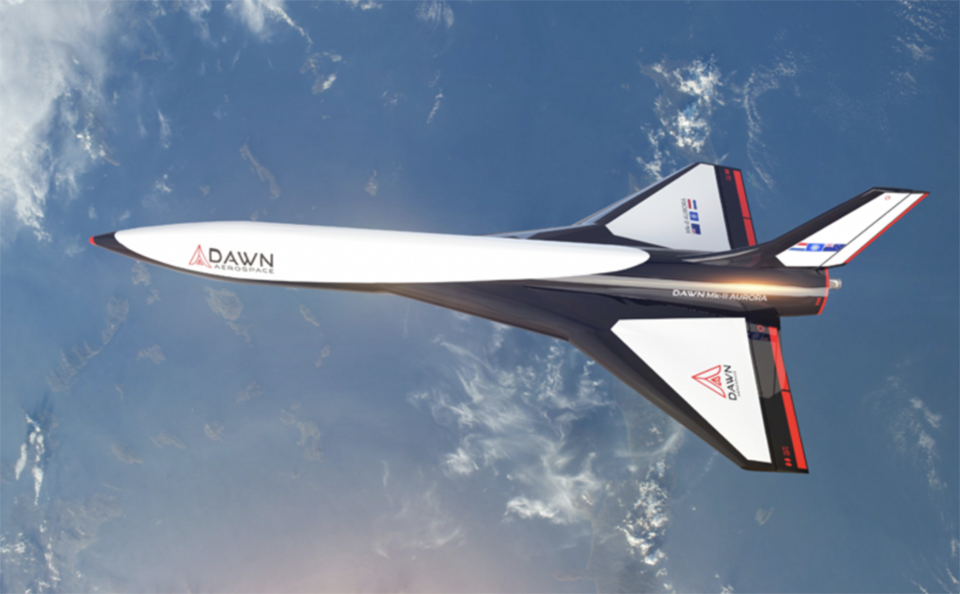
Concurrently, Dawn has achieved supersonic flight milestones with its Aurora suborbital spaceplane, making it the first privately developed aircraft to achieve supersonic speeds since the Concorde.
The Roadmap: Two Launches a Day and In-Orbit Refueling
The Series B capital will be used to accelerate two highly anticipated technological demonstrations designed to support the allied push for responsive, reusable space architectures:
- The Twice-Daily Kármán Flight (2027): Under a $17 million partnership signed with the State of Oklahoma, the unmanned Aurora spaceplane is scheduled to become the first vehicle to fly past the Kármán line (the globally recognized 100-kilometer boundary of space) twice within a single day. Operating at Mach 3.7 speeds, the campaign aims to prove that spaceplanes can match the rapid operational tempo and turnaround times of traditional military aircraft.
- The “Loop” In-Orbit Refueling Network (2028): Dawn plans to execute a live in-orbit demonstration of its satellite refueling technology, known as Loop. The satellite service is already backed by multiple defense organizations, with Dawn-engineered refueling ports currently integrated onto active Royal Netherlands Air Force satellites to facilitate future automated liquid fuel transfers in orbit.
“As the US and its closest allies build joint capability in space and hypersonics, the West needs partners who can deliver reusable, responsive access across the air and space domain,” noted Dan Wallman, Partner at Balerion Space Ventures. “Dawn is doing what few in this category have: building real commercial revenue and a spiral path from in-space propulsion and refueling, to a hypersonic spaceplane, to aircraft-like payload delivery to orbit, all with extraordinary capital efficiency.“
