

READING, UK — European satellite manufacturer NewOrbit has officially announced the closing of an oversubscribed $18.5 million Series A funding round aimed at commercializing Earth’s very low Earth orbit (VLEO).
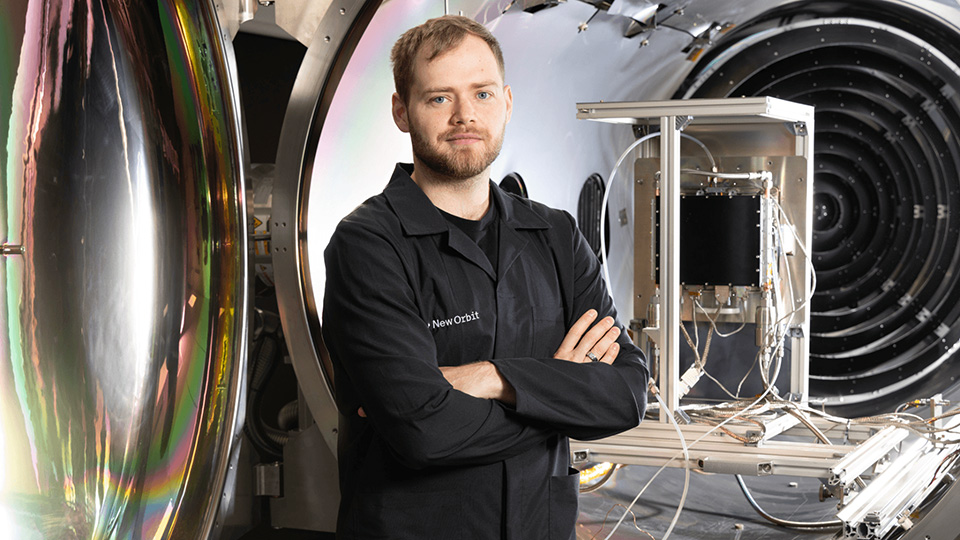
The capital injection will fund the development and deployment of the world’s first commercial satellite designed to operate consistently at altitudes between 200 km and 300 km—a region previously considered unviable for sustained commercial space flight.
The funding round was led by Voyager Ventures, alongside prominent angel investors including former NVIDIA Chief Scientist David Kirk, TIER Mobility co-founder Lawrence Leuschner, and family office Custos. Existing backers Atlantic.vc, Lifeline Ventures, LGF, and Illusian also participated.
Overcoming the Hostile VLEO Environment
While conventional satellites typically operate at or above 500 km, the VLEO band (200–300 km) presents unique physical challenges that have historically limited its commercial utility. NewOrbit’s spacecraft are specifically engineered to withstand the three primary disruptive forces of this orbit:
- Aerodynamic Drag: Atmospheric drag at these altitudes typically pulls uncooled spacecraft back to Earth within weeks.
- Atomic Oxygen: Extreme chemical exposure rapidly corrodes standard spacecraft surfaces.
- Aerodynamic Torques: Strong upper-atmospheric currents frequently destabilize orbital orientation.
To solve these issues, NewOrbit has developed its proprietary NEO-1 satellite platform, equipped with a specialized in-house propulsion system designed to actively counteract drag and maintain stability, extending the operational lifespan of its VLEO assets up to five years.
Disruption to Imaging and Communications
Operating closer to Earth fundamentally alters the economics of orbital data collection and communications. By reducing the physical distance to the surface, NewOrbit aims to deliver significant performance leaps:
- Cost-Efficient Imagery: Providing high-resolution satellite imagery at 20x lower cost than conventional higher-altitude configurations.
- Mass-Market Connectivity: Drastically lowering latency and improving link budgets to enable advanced applications like 5G direct-to-device (D2D) connectivity and live high-definition video streaming directly from space.
“For sixty years, VLEO has been treated as too hostile an environment for commercial satellites — but it is in fact the most valuable empty real estate in space,” said Anatolii Papulov, CEO and co-founder of NewOrbit. “Today, no one in the industry has a reliable, affordable and fast way to fly payloads in very-low Earth orbit. We built our NEO-1 satellite to do exactly that”.
Scaling Sovereign European Production
A major portion of the Series A capital will be allocated toward building the NEO Production Complex in the United Kingdom, which is scheduled to open its doors in 2027.
The facility will initially integrate the company’s first commercial demonstration satellite for a planned launch in 2028. Following the maiden flight, NewOrbit intends to scale manufacturing capacity from ten units per year to a continuous throughput of several satellites per week. Once fully operational, the complex will stand as Europe’s largest dedicated VLEO production hub, serving as a critical asset for regional digital and industrial sovereignty.
To support this aggressive scaling timeline, NewOrbit has pulled senior engineering talent from SpaceX, NASA, Tesla, and Airbus to its UK base. The company’s advisory board features high-profile institutional figures, including Jean-Jacques Dordain (Director General of the European Space Agency from 2003–2015) and Sir Chris Deverell (former Commander of the UK Joint Forces).
