

Firefly Aerospace has been awarded a seventy-five million dollar subcontract from NASA’s Jet Propulsion Laboratory to deliver four drones to the lunar south pole. This high-profile mission, named MoonFall, is targeted to launch no earlier than 2028.
Securing a Pivotal Lunar Mandate
It represents a foundational element of the first phase of NASA’s Moon Base initiative, a long-term infrastructure strategy aimed at enabling a sustained human presence and expanding both scientific and commercial operations on the Moon.
The Jet Propulsion Laboratory is responsible for constructing the drones and managing the overall mission, while NASA will independently source the launch vehicle. Firefly will leverage its Elytra spacecraft to execute the transit and deployment phases of the operation, further expanding its expanding portfolio of deep space and lunar exploration contracts.
The Transit and Deployment Profile
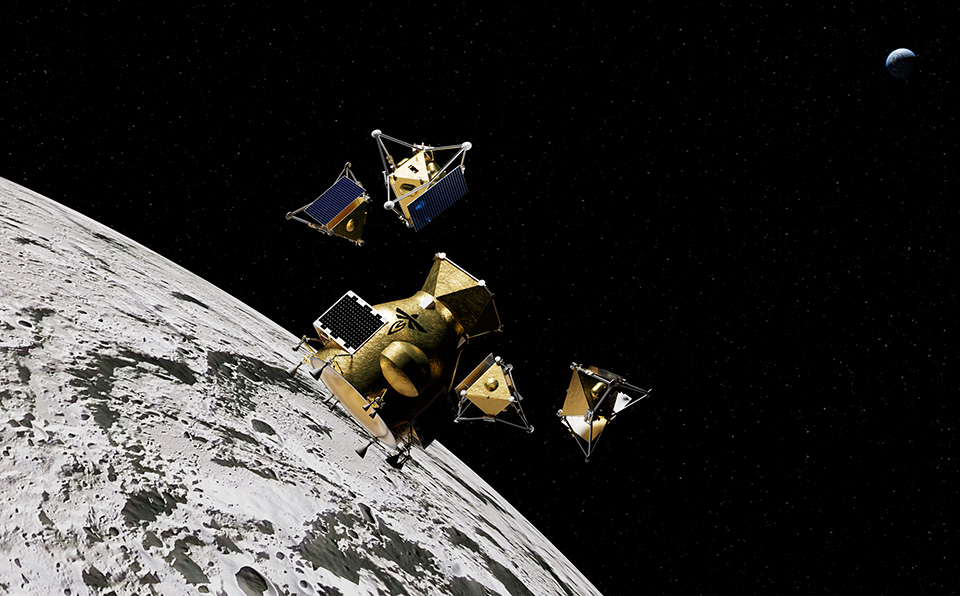
Upon launching, Firefly’s Elytra spacecraft will manage a forty-five day transit across cislunar space to reach the Moon. Once it enters lunar orbit, the spacecraft will perform a targeted deorbit and braking maneuver. This precisely timed sequence will allow Elytra to deploy the four drones approximately fifty kilometers above the lunar south pole terrain.
The Elytra vehicle utilized for this mission is configured in the Elytra Dark variation, which is specifically optimized for high delta-V maneuvers and increased payload capacity. This configuration provides the necessary performance to transport and precisely release the one thousand kilograms of drone hardware above the rugged lunar environment.
Exploring Hard-to-Reach Terrains
The MoonFall drones are designed to operate for up to fourteen Earth days, which is the equivalent of a single lunar day. They will survey the south pole landscape using high-definition optical cameras and sensitive scientific instruments. The exploration strategy targets permanently shadowed regions that are historically difficult to investigate from orbit or ground landers.
Drawing on the engineering legacy of NASA’s Ingenuity Mars Helicopter, these drones will utilize propulsive hops to travel across the lunar surface. This mobility allows them to map out safe landing zones for future astronauts and scout for vital resources, such as water ice, to support upcoming human missions under the Artemis program.
Once the primary flight operations conclude, a specialized survive-the-night payload on each drone will continue to gather data for several months, establishing an ongoing technical presence at the south pole.
Scaling Spacecraft Production Lines
The engineering foundation for the Elytra spacecraft relies heavily on systems derived from the company’s Blue Ghost program, including core avionics, carbon composite structures, and proprietary Spectre engines. This reuse of flight-proven architectures ensures higher mission reliability and shortens the overall hardware development cycle.
To accommodate this new subcontract alongside three existing commitments under NASA’s Commercial Lunar Payload Services initiative, the Texas-headquartered company is rapidly scaling up its operations.
The firm is currently expanding its cleanroom facilities to support an active assembly line of lunar landers and orbital vehicles, positioned to meet the accelerating demand for commercial and defense missions to cislunar space.
