

On May 20, 2026, California-based in-space manufacturing company Varda Space Industries successfully returned its W-6 capsule to Earth. The robotic re-entry vehicle landed gently under a parachute at the Koonibba Test Range on the Far West Coast of South Australia, near Ceduna.
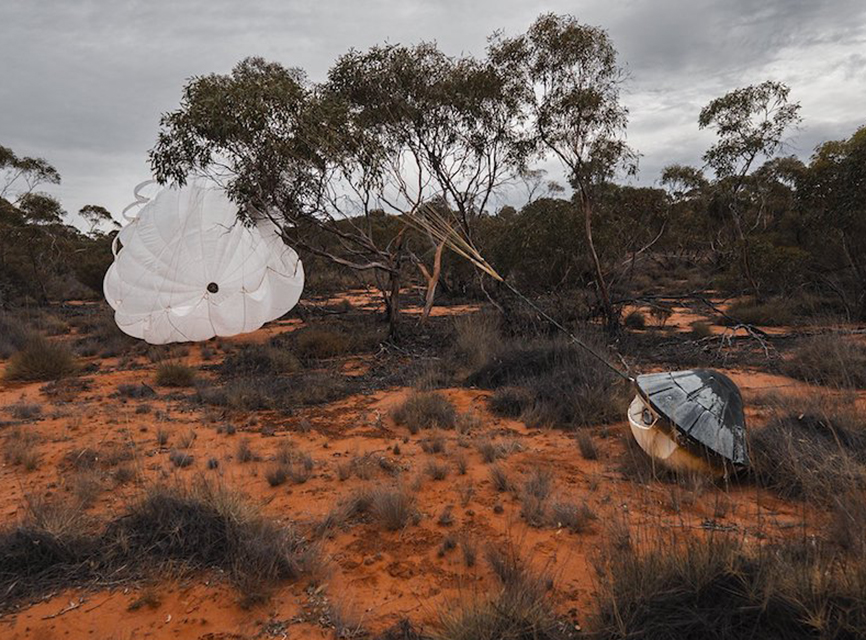
Local operations, range safety, airspace management, and tracking were managed by Australian launch provider Southern Launch, in an ongoing partnership with the Koonibba Community Aboriginal Corporation.
Returning Critical NASA and Defense Thermal Materials
Unlike Varda’s previous W-Series missions, which primarily focused on the crystallization of pharmaceutical compounds in microgravity, the W-6 mission profile was heavily optimized for atmospheric flight physics and material science.
The payload bay contained specialized testing equipment from NASA and other United States government defense partners. The mission functioned as a high-velocity orbital testbed for next-generation thermal protection systems (TPS). As the capsule slammed into the upper atmosphere at roughly 30,000 kilometers per hour, onboard sensors recorded real-time data on aerodynamic heating, structural stress, and material ablation rates.
This empirical data will be utilized by NASA and national security programs to validate computer models and accelerate the development of future reusable hypersonic vehicles, missiles, and deep-space return craft.
Normalizing High-Cadence Orbital Returns
The successful touchdown of the W-6 capsule represents a significant operational milestone, marking the fourth orbital capsule recovery executed at the Koonibba Test Range in just over 12 months. This repeated success signals that space return logistics are transitioning from rare, high-risk historical anomalies into routine, commercial infrastructure operations.
The geography of the South Australian outback makes it an elite destination for international re-entry logistics:
- Unprecedented Range Area: The facility offers over 41,000 square kilometers of uninhabited open land, creating an immense, forgiving touchdown footprint.
- Low Traffic Density: The remote location features exceptionally low maritime and commercial aviation traffic corridors, minimizing the regulatory friction required to clear and secure airspace during de-orbit burns.
- Sovereign Infrastructure: Southern Launch has built out specialized field tracking, telemetry hubs, and recovery assets that allow international clients to retrieve their space hardware within hours of landing.
Community Integration and the Future Space Economy
The operational footprint of the Koonibba Test Range relies heavily on a unique, nine-year integration framework co-developed with the Indigenous landowners. Managed alongside the Koonibba Community Aboriginal Corporation, the range provides the local community with long-term, high-tech employment opportunities and technical training pipelines.
Corey McLennan, CEO of the Koonibba Corporation, reflected on the local pride driven by the program, noting that Indigenous children are growing up watching actual spacecraft return from orbit right on their doorsteps. He emphasized that the visible reality of space operations is actively inspiring the next generation to pursue advanced STEM education paths.
With Varda and Southern Launch having recently signed an extended contract to facilitate a further 20 spacecraft returns at the site, South Australia is firmly established as a vital global terminal for the emerging low-Earth orbit manufacturing and logistics economy.
