

PARIS, FRANCE — At the Eurosatory 2026 defense exposition on June 29, 2026, Italian technology group Leonardo detailed the ongoing development and operational deployment profiles of its Vulcano precision-guided munition family.
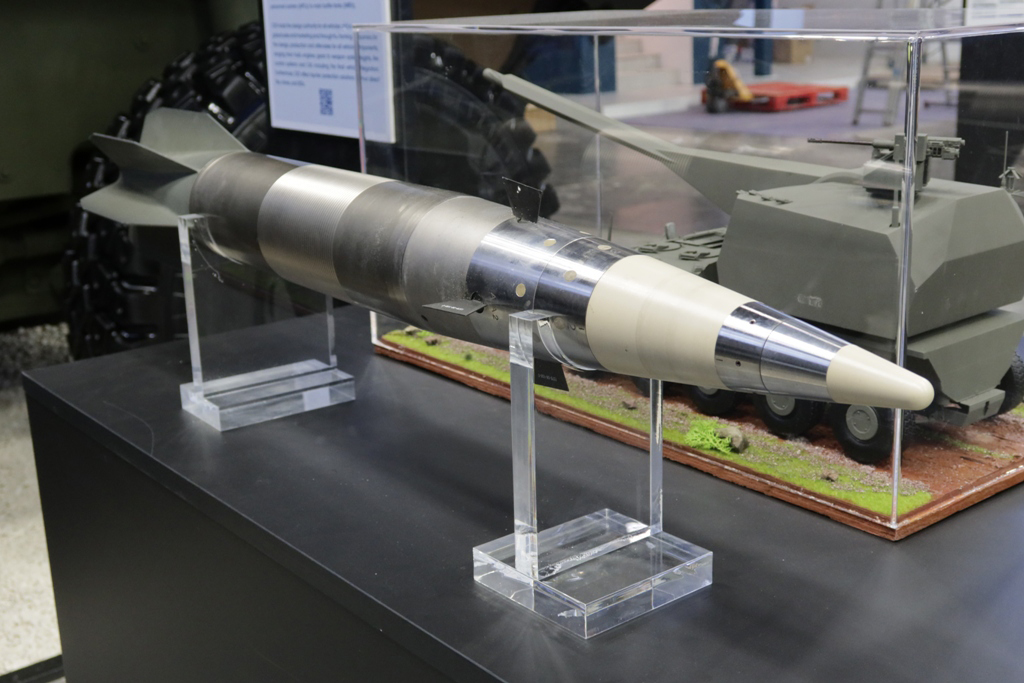
The technology suite, which includes sub-caliber long-range rounds designed for both naval and land artillery frameworks, was displayed in its 155 mm and 120 mm configurations. The presentation highlighted adjustments made to counter contemporary electronic warfare environments and updated procurement milestones within the transatlantic defense sector.
Transatlantic Procurement and Industrial Partnerships
The display follows a significant program milestone on June 5, 2026, when General Dynamics Ordnance and Tactical Systems (GDOTS), acting as prime contractor for an industrial consortium including Leonardo and Diehl Defence, secured a $37.86 million developmental contract from the U.S. Army. Awarded under the Extended Range Artillery Projectile (ERAP) program, the contract tasks the team with adapting a derivative of the Vulcano 155 Guided Long Range (GLR) projectile to fulfill the military’s next-generation artillery requirements.
The core Vulcano infrastructure is a joint engineering program alongside Germany’s Diehl Defence, which supplies the specialized optical and terminal guidance seeker subsystems for the precision-guided variants. To keep pace with current international consumption rates and broader European stockpiling initiatives, Leonardo confirmed it is currently doubling its industrial production footprint for the munition family.
Electronic Warfare Adaptations and Guidance Configurations
The 155 mm Vulcano architecture is organized into two primary categories: Ballistic Extended Range (BER) and Guided Long Range (GLR). The sub-caliber BER is an unguided, low-drag round capable of achieving a range of 50 km when deployed from a standard 52-caliber barrel. The GLR variants employ four front-mounted canard control surfaces that generate aerodynamic lift, extending the operational envelope up to 70 km while enabling trajectory shaping to optimize the impact angle against fortified structures.
To mitigate heavy Global Navigation Satellite System (GNSS) and GPS jamming trends observed in active combat theaters, Leonardo engineers have integrated an alternate operational mode for the baseline Inertial Measuring Unit (IMU) and GPS/GNSS-guided rounds. When operating under heavy electronic countermeasure interference, the projectile follows a purely ballistic arc for the majority of its flight path, delaying seeker initialization until the final terminal phase. While this approach bypasses the lift advantages of early canard maneuvering—capping the operational range at the 50 km ballistic threshold—it preserves precise terminal targeting accuracy without relying on continuous satellite positioning locks.
Additional configurations include:
- GLR-SAL (Semi-Active Laser): Utilizes a terminal seeker to home in on laser energy reflected from ground-based or airborne designators, enabling metric accuracy against mobile targets via a brief 10-second illumination window.
- GLR-IIR (Imaging Infrared): Features a terminal thermal seeker designed for coastal defense roles against naval vessels. Leonardo is currently developing a higher-resolution IIR sensor capable of discriminating complex land targets from background clutter.
Expansion to Armor-Integrated Indirect Fire
Leonardo also showcased its ongoing development of the Vulcano 120 mm variant, a system first made public in July 2025 to provide a Beyond-Line-of-Sight (BLOS) indirect fire capability for main battle tanks (MBTs). Designed to operate within the 10 to 30 km range window, the sub-caliber 120 mm round compensates for the limited 20-degree gun elevation characteristic of modern armor profiles by utilizing immediate post-launch trajectory adjustments.
Approximately 2 to 3 km after clearing the muzzle, the projectile executes an automated pitch-up maneuver to clear intermediate terrain obstacles. Terminal targeting for the baseline 120 mm round relies on a Semi-Active Laser (SAL) seeker paired with a vertical takeoff and landing (VTOL) uncrewed aerial vehicle (UAV) carrying a miniaturized laser designator. Initial live-fire testing windows are projected to commence within the next three years, drawing on risk-reduction data inherited from the mature 155 mm SAL qualification program.
