

PLASTER CITY, CALIFORNIA — In a report issued by the agency on June 18, 2026, NASA confirmed that a prototype four-wheel planetary rover successfully completed a series of high-speed autonomous field trials in the Colorado Desert near Plaster City, California.
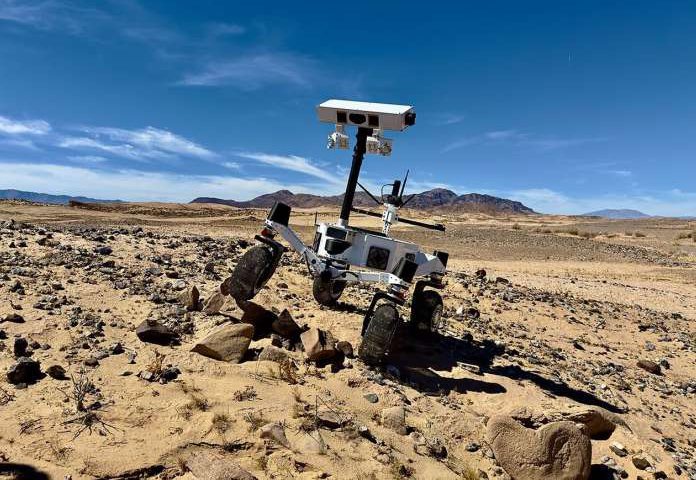
The field campaign, which occurred in March 2026, utilized the Exploration Rover for Navigating Extreme Sloped Terrain (ERNEST) vehicle to validate software and mobility architectures designed for future long-range lunar and Martian exploration missions. Engineers trailed the compact robotic testbed as it autonomously traversed approximately 16 miles over a combined 37 hours of active drive time across a seven-day intermittent testing window.
Technical Performance and Vehicle Specifications
Developed at NASA’s Jet Propulsion Laboratory (JPL) in Southern California, the ERNEST prototype measures 4 feet (1.2 meters) in length and utilizes custom-engineered wire mesh wheels to maintain traction over loose materials. Departing from the traditional passive rocker-bogie suspension systems featured on legacy planetary rovers, ERNEST integrates an active suspension system with two powered joints per wheel that drive an articulable gimbal. This system allows the vehicle to independently alter weight distribution, switch between various driving gaits—such as wheel-walking, “squirming,” and obstacle-climbing—and clear vertical barriers nearly equivalent to its wheel height. The vehicle also features a mechanical clutch to toggle into a passive suspension mode, conserving battery power when navigating flat, unobstructed terrain.
Autonomy Training and Operational Parameters
During the desert deployment, the engineering team tested the vehicle across changing ambient illumination profiles, including dawn, dusk, and full nighttime operations. These environments simulate the low-angle lighting conditions and extensive terrain shadows characteristic of the Moon’s polar regions. To facilitate real-time decision-making without relying on step-by-step commands from Earth, the rover’s localized computer architecture relies on navigation algorithms trained via reinforcement learning. Prior to physical field testing, the software underwent thousands of simulated operational hours across procedurally generated terrain within JPL’s Digital Automated Remote Tracking Simulation (DARTS) laboratory. The autonomous navigation package enabled ERNEST to achieve sustained traveling speeds of up to 0.6 mph (1 km/h), representing an order-of-magnitude velocity increase over the navigation speeds achieved by current Mars rovers.
Funding and Mission Outlook
The development of the ERNEST platform began in 2022, initially backed by JPL internal research and development allocations. The program has since transitioned to external funding sources, receiving current financial support from NASA’s Mars Exploration Program and the Exploration Science Strategy Integration Office under the Science Mission Directorate in Washington. Caltech manages JPL on behalf of NASA. Moving forward, program technologists aim to leverage data from the March desert campaign to scale the architecture up to a vehicle twice the size of the current prototype. This scaled design is intended to satisfy the high-mileage requirements of long-duration, commercial-partner-supported exploration campaigns targeting permanently shadowed crater floors, lava tubes, and water-ice deposits situated at the lunar south pole.
