

Chris Forrester — The FCC auction of cellular licences (AWS-3, Auction 113) wrapped last week after 72 rounds having settled on accepted bids of more than $3.57 billion. Up to $3.3 billion of the proceeds will be used to reimburse cellular operators which will have to swap out Chinese equipment as part of the FCC’s “rip and replace” mandate in order to safely establish new technology.
A total of 17 businesses were qualified to bid in the auction including EchoStar and SpaceX as well as the major US cellular operators. Most of the licenses are actually licenses that EchoStar subsidiary Dish bought in Auction 97, which occurred more than 10 years ago but which were subsequently ruled inadmissible and reversed. That auction raised more than $2.9 billion in 2014.
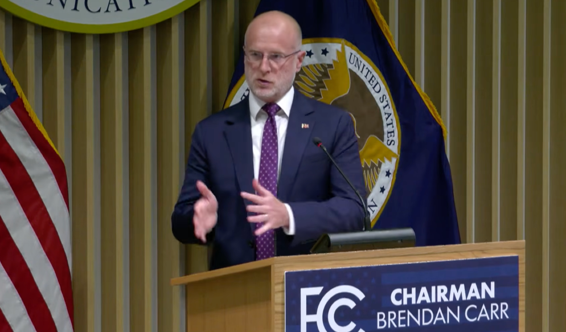
FCC Chairman Brendan Carr said the latest auction had beaten expectations with significant per-unit prices. “Today’s successful auction generated billions of dollars in competitive bids to put spectrum to effective commercial use, and it bolsters competition in the wireless marketplace,” Carr said in his statement. “We will carry this momentum forward as we prepare for the upper C-band auction in the year ahead.”
New Street Research analyst David Barden in his latest summary said the average price came out at $2.53/MHz-POP. Prices ranged from 15 cents/MHz POP for American Samoa to $5.67/MHz POP for Honolulu, Hawaii. Major cities did well, with Chicago topping $4 (per MHz/POP) and New York reaching $3.30.
But FCC Chairman Carr must now grapple with the promised auction of more than 100 MHz – and perhaps 160 MHz – of spectrum in the upper C-band. Carr says the FCC is well prepared for the auction which will kick off no later than July next year.
One analyst suggested that some would-be bidders were keeping their powder dry during Auction 113 because of the upcoming C-band spectrum auction.
SES has also highlighted its own costs (including those of Intelsat) for clearing its C-band frequencies. On June 18 SES’s Nancy Eskenazi (SVP/Global Legal & Regulatory Affairs) wrote to the FCC about C-band (3.98 to 4.2 GHz) and emphasized its breakdown of costs needed to be funded to enable SES to continue supplying its clients with “substantially the same services after the transition as today”. SES explained that transitioning 160 MHz of Upper C-band spectrum will require launching “new, specifically designed Ku-band satellites with C-band uplink capabilities to support services currently provided solely using the C-band.”
And the costs are considerable. To clear 160 MHz will cost some $3.6 billion, which SES breaks down as follows:
- 5 new hybrid Ku-satellites for primary service
- 2 back-ups to protect the primary craft
- Financial costs while building the craft, and awaiting compensation
- Terrestrial Recovery Network
- New Integrated Receiver/decoders (IRDs) for clients
- Customer Migration and Earth Station Transitions
- TT&C, and Antenna equipment
- Contingencies
SES says it is actively negotiating contracts for the satellites and launches and expects that the cost for new satellites (including costs incurred for satellite procurement, launch, insurance, and ground equipment for each satellite) will total approximately $2.62 billion.”
The Terrestrial Recovery Network requirement allow “Earth stations receiving content in parts of the country with high precipitation may experience “rain fade” because the Ku-band is more susceptible to weather-based degradation than the C-band. Mitigation measures will be needed at these earth stations to ensure that substantially the same service can be maintained to customers during and post-transition. These measures will include the terrestrial packet recovery network SES proposed on the record.”
The new IRDs are needed “because legacy IRDs do not support the protocols needed to make the packet recovery network work. Finance charges are anticipated for these purchases, as the outlay of funds will occur over time, and reimbursement is generally dependent on the rollout of the end solution,” says SES. SES puts the costs of the Terrestrial Recovery Network and IRDs will cost about $777 million.
Then there are the costs associated with Customer Migration to the new feeds, and Earth Station Transitions. SES explains: “C-band antennas at thousands of broadcast or cable head-ends (typically 3.7m in size) will need to be retrofitted with Ku-band feeds. As much as possible, SES will seek to reuse existing equipment at such receive sites. However, some new Ku-band antennas may need to be installed (a) where retrofit is not technically feasible or (b) to
point at additional orbital locations to continue receiving the same programming. Given that antennas will have different makes, models, and equipment that will vary in age and design, each antenna will need to be assessed during a site survey, and the appropriate transition solutions for each site will vary on a case-by-case basis. In addition, filtering solutions for antennas that continue to receive services in the portion of the C-band that is not cleared will also require equipment and labor.”
SES says these costs will be about $93 million.
The satellite operator also says that its new satellites will need new Telemetry, Tracking & Control (TT&C) equipment and uplink antennas. SES says: “Customers generally have only enough uplink antennas to transmit in either the C- or
Ku-band, not both. As such, SES will need to build and/or lease antennas that can replicate the uplink programming for each customer for several months by receiving the service in the band in which they currently transmit and uplinking it to the new service transponder and satellite.”
SES says these obligations will cost about $45 million. It also says that managing all these elements will see unavoidable costs (such as legal costs, contractor reimbursement, program management costs and engineering service costs) and total about $62 million.
SES has also built in Contingency Costs of $150 million, and these overall cost obligations are before a Cent is paid to SES by way of compensation for freeing up the frequencies. Moreover, this is by no means an overnight task. SES says 100 MHz could be cleared in about 30 months, but it would take another 60 months to clear an additional 60 MHz.
SES says it has already earmarked an “investment envelope” of $1.6 billion to kick-start the procurement and launch of new satellites, much of which will be spent with US vendors.
Back in 2020 the FCC auctioned 280 MHz of C-band capacity, and SES and Intelsat received almost $9 billion between them by way of compensation for freeing up their spectrum. Analysts at investment bank BNP-Paribas recently estimated the benefit to SES from the FCC’s compensation at more than $1 billion (for the initial 100 MHz of capacity). SES is obliged to pay 42.5% of the spectrum sale proceeds to Intelsat’s former shareholders for the sale of the 100 MHz. SES gets 100% of any subsequent auction compensation which covers the remaining 60 MHz..
The 2020 negotiations saw the FCC pay an incentive to SES and Intelsat of about $31.5 million per MHz. That sum might well be topped if recent transactions are any guide.
