

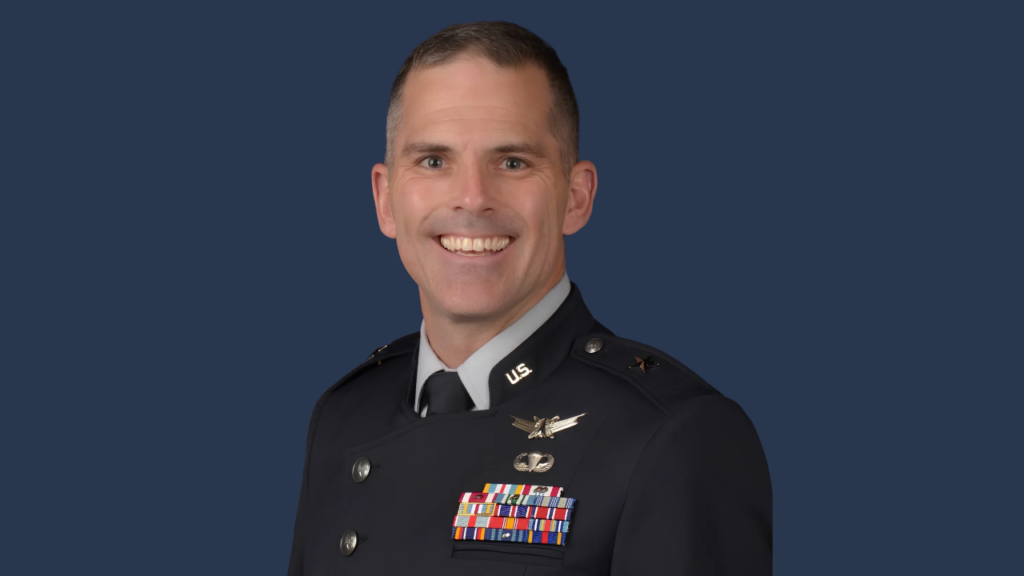
Editor’s Note (updated September 15, 2026): This article originally placed Zarybnisky’s session on Thursday, October 29 at 9:00 a.m., which is where the conference agenda listed it when the article was published. The session has since been moved to Wednesday, October 28 at 5:05 p.m. and retitled “Interview with the Space Force Portfolio Acquisition Executive.” The article also originally identified Zarybnisky as a colonel; he has since been promoted to brigadier general, and his rank and photograph have been updated throughout.
On July 29, Space Systems Command awarded SpaceX two task orders covering 18 Falcon 9 missions and worth $1.6 billion, all flying from Vandenberg Space Force Base and all expected to be complete by the end of 2027. The orders fall under Lane 1 of National Security Space Launch Phase 3 and carry communications and targeting satellites for the Space-Based Sensing and Targeting portfolio. “We have set an unprecedented two-month acquisition timeline under the Phase 3 Lane 1 contract from requirement identification to award,” said Brig. Gen. Eric Zarybnisky, the acting Portfolio Acquisition Executive for Space Access. The officer who runs the Space Force’s launch portfolio takes the MilSat Symposium stage at Silicon Valley Space Week in October.
Zarybnisky has held Space Access in an acting capacity since January 2026, working from Patrick Space Force Base in Florida. The portfolio covers launch delivery, ranges and sustainment. It is one of nine the Space Force created when it restructured its procurement enterprise this summer, and Air Force Secretary Troy Meink has said probably 90 to 92 percent of contracting authority now sits with executives like Zarybnisky. He held the predecessor job, Program Executive Officer for Assured Access to Space, from June 2025. Much of his career has been at the National Reconnaissance Office, including four launch assignments there: Chief of Launch Vehicle Analysis from 2005, Chief Engineer for Launch Systems from 2007, Chief of the Space System Acquisitions and Launch Division from 2020, and Senior Materiel Leader in the Office of Space Launch from 2023 to 2025. He commanded the 4th Space Launch Squadron at Vandenberg from 2015 to 2017. His degrees are a bachelor of science in operations research and economics from the Air Force Academy, and a master of science and a doctorate in operations research from the Massachusetts Institute of Technology. The Senate confirmed his appointment to brigadier general on July 16, one of seven Space Force colonels confirmed that day, and he has since been promoted. The conference program lists him at the new rank.
In July the Space Force raised the Lane 1 contract ceiling from $5.6 billion to $17 billion, after its estimate of the missions to be ordered over five years grew from between 30 and 60 to roughly 170. The provider list grew too. Lane 1 added Impulse Space and Relativity Federal in July, each on a $5 million task order for an initial capabilities assessment and tailored mission assurance work, bringing the field to seven alongside Blue Origin, SpaceX, United Launch Alliance, Rocket Lab and Stoke Space. Rockets are only one of the three constraints Zarybnisky has named. “I really need three things to happen at the exact same time: I need a satellite that’s ready, a rocket that’s ready, and a range that’s ready,” he said in a Space Systems Command interview last December.
The agenda lists Zarybnisky’s session as “Interview with the Space Force Portfolio Acquisition Executive,” running Wednesday, October 28, from 5:05 p.m. to 5:35 p.m. in the Hahn Auditorium at the Computer History Museum in Mountain View. It names no interviewer and gives the session no description. The interview closes the day’s programme and follows “Buy What We Can vs. the Build-First Budget” at 4:20 p.m., where Col. Timothy Trimailo, Director of the Commercial Space Office at Space Systems Command, sits with Justin Langlois of the National Reconnaissance Office, Rich Pang of Amazon Leo Government and Bob Pescatore of Voyager, under the moderation of Quilty Space chief executive Chris Quilty. The evening reception follows at 5:35 p.m.
Silicon Valley Space Week runs Tuesday, October 27 through Thursday, October 29 at the Computer History Museum, with Satellite Innovation across the first two days and the MilSat Symposium across the last two. Zarybnisky’s interview closes the symposium’s opening day. The 18 Falcon 9 missions his portfolio ordered in July are expected to fly by the end of 2027.
Voyager Technologies, whose products general manager joins Col. Trimailo on the session preceding this one, is a sponsor of Silicon Valley Space Week, which SatNews produces.
