

MANASSAS, Va. — Securing a critical breakthrough for the domestic trusted microelectronics supply chain, BAE Systems announced the successful testing milestone of its new Endura™ System-on-Chip space processor. The evaluation confirms that the compact processor can survive not only natural cosmic radiation but also the most severe strategic electronic warfare environments.
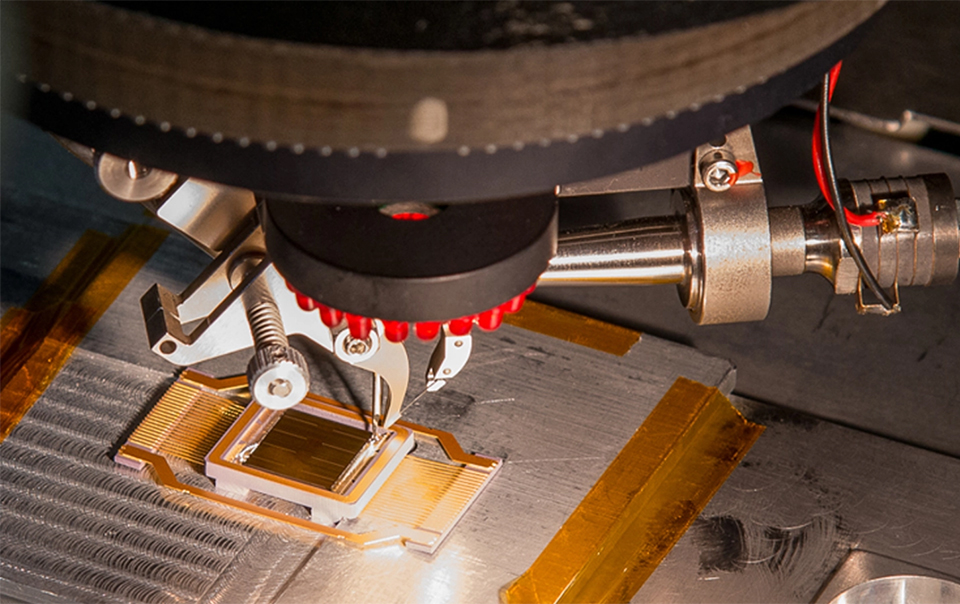
The development addresses a persistent constraint within the defense satellite market: the reality that semiconductor advancement and military space qualification move at completely different speeds. By utilizing a commercial foundry framework to produce strategic-grade silicon, BAE Systems delivers a smaller, lower-power, and significantly more cost-effective computing platform than traditional bespoke rad-hard processors.
Redefining the 45nm Silicon-on-Insulator Pipeline
The architecture of the Endura SoC represents a deeply collaborative manufacturing model designed to insulate the U.S. space sector from foreign supply chain interventions. Developed by BAE Systems’ Space Systems group in Manassas, Virginia—a certified Category 1A Microelectronics Trusted Source—the chip utilizes proprietary Radiation-Hardened 45-nanometer (RH45®) design libraries.
The physical fabrication is handled securely within the United States through GlobalFoundries’ high-security commercial facility in Malta, New York. By building the Endura architecture on GlobalFoundries’ commercial 45nm silicon-on-insulator (SOI) platform, the partnership successfully leverages advanced commercial scaling while embedding deep, physical-layer resilience against catastrophic latch-up events and single-event upsets caused by heavy ions.
The system architectural blueprint highlights Endura’s multi-functional design. Beyond general-purpose processing, the architecture natively integrates advanced network routing layers, Level 1 and Level 2 internal cache blocks, hardware-isolated secure boot modules, and embedded programmable FPGA blocks. This combination provides spacecraft builders with flexible, mission-specific hardware acceleration, allowing satellites to dynamically adapt their payload functions and data processing routines directly in orbit.
Mitigating Ground Dependencies via Orbital Edge Computing
The successful radiation validation of the Endura chip addresses a major operational bottleneck for defense and commercial constellation operators. Historically, the severe computational limitations of older, highly legacy rad-hard processors meant satellites could handle minimal raw data processing in orbit. Satellites had to act as simple relays, continuously downlinking massive, unprocessed sensor files to land-based stations, exposing deep data links to adversary jamming and electronic intercept.
A hardened, highly scalable processor shifts this paradigm toward autonomous edge computing. Satellites can run localized artificial intelligence workloads, execute complex orbital tracking algorithms, encrypt sensitive datastreams at the hardware level, and handle high-bandwidth networking tasks entirely on the spacecraft.
Ezra Hall, senior director of aerospace and defense at GlobalFoundries, emphasized the domestic security importance of the manufacturing pipeline, noting that the facility serves as a cornerstone of trusted domestic semiconductor fabrication, providing the secure foundational technologies needed for mission-critical defense applications.
To expand commercial accessibility, BAE Systems is applying a platform-agnostic distribution strategy. The Endura components are being scaled across multiple tiers—serving high-reliability, multi-decade Class A strategic defense programs as well as high-volume, lower-assurance Class C and D proliferated low-Earth orbit commercial constellations. Software Development Units are currently open for active order delivery to allow prime systems integrators to immediately begin coding and verifying payloads ahead of active launch profiles.
