

When the CST-100 Starliner will return to crewed flight is becoming a point of consternation. NASA and Boeing engineers have been mired in intensive root-cause investigations, focusing on how the thruster seals degraded under thermal stress.
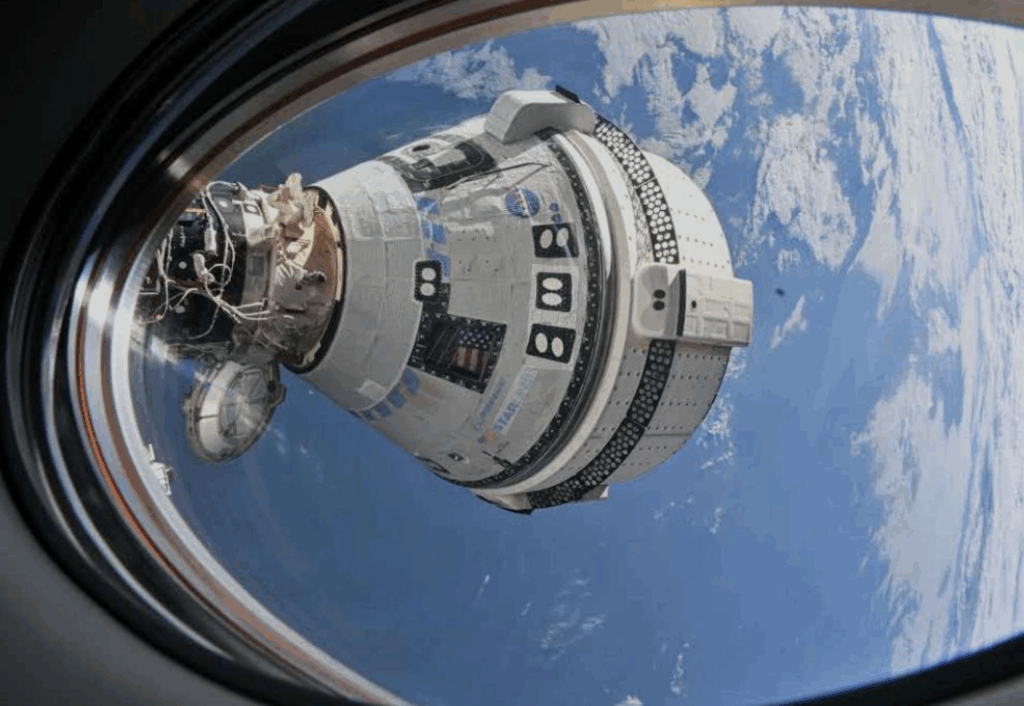
The roots of the delay trace back to the June 2024 Crew Flight Test (CFT) to the International Space Station (ISS). During that mission, Starliner suffered multiple thruster degradation issues and helium leaks in its service module. Out of an abundance of caution, NASA ultimately made the call to bring the spacecraft back to Earth empty, leaving its crew, astronauts Butch Wilmore and Suni Williams, on the ISS to eventually return home on a SpaceX Crew Dragon in early 2025.
Since that return, NASA and Boeing engineers have been focusing on how the thruster seals degraded under thermal stress and how to permanently mitigate the helium system leaks. Because these anomalies require significant hardware redesigns, software overhauls, and rigorous new testing cycles, neither NASA nor Boeing has been able to commit to a firm calendar date for Starliner’s next launch.
The Implications for the Space Sector
This ongoing standstill has profound operational and financial ripple effects across the aerospace industry.
1. The Choke Point on NASA’s Redundancy Strategy
NASA’s commercial crew philosophy has always been anchored to the principle of “dissimilar redundancy”—having two completely independent commercial spacecraft capable of launching American astronauts. The goal was to ensure that if a technical flaw grounded one fleet, the nation wouldn’t lose access to space. With Starliner sidelined, the entire U.S. space transportation pipeline rests on SpaceX’s shoulders. This leaves the ISS vulnerable to a total launch freeze if Crew Dragon suffers a systemic hardware anomaly.
2. Severe Financial Bleed for Boeing
Starliner operates under a fixed-price contract, which NASA established to protect taxpayers from government cost overruns. Under this model, Boeing is entirely responsible for any financial overages incurred during development and remediation. The spacecraft’s repeated technical setbacks, post-flight investigations, and delayed operational missions have forced Boeing to absorb over $1.5 billion in cumulative, out-of-pocket losses on the program, intensifying corporate scrutiny on the business unit.
3. Operational Gridlock on the ISS Manifest
The International Space Station operates on a tightly coordinated orbital manifest. Launches, dockings, spacewalks, and crew rotations must be scheduled months in advance to avoid port congestion and crew fatigue. Starliner’s indefinite delay complicates this scheduling, forcing NASA to continuously adjust its launch manifest, modify commercial cargo arrivals, and extend crew expeditions to keep the station fully staffed.
4. Shifting Dynamics for Post-ISS Commercial Stations
The aerospace market is actively planning for life after the ISS, which is scheduled for retirement and deorbit by 2030. Private consortia are already designing commercial space stations, such as Orbital Reef and Starlab, and their business models depend on multiple commercial transport providers competing to ferry corporate clients and researchers. The prolonged timeline for Starliner’s certification delays the maturation of a competitive, multi-vendor commercial spaceflight market, momentarily cementing a monopoly in the low-Earth orbit transport economy.
