

On Friday, July 10, 2026, the China Aerospace Science and Technology Corporation (CASC) successfully executed its first-ever controlled recovery of an orbital-class rocket booster.
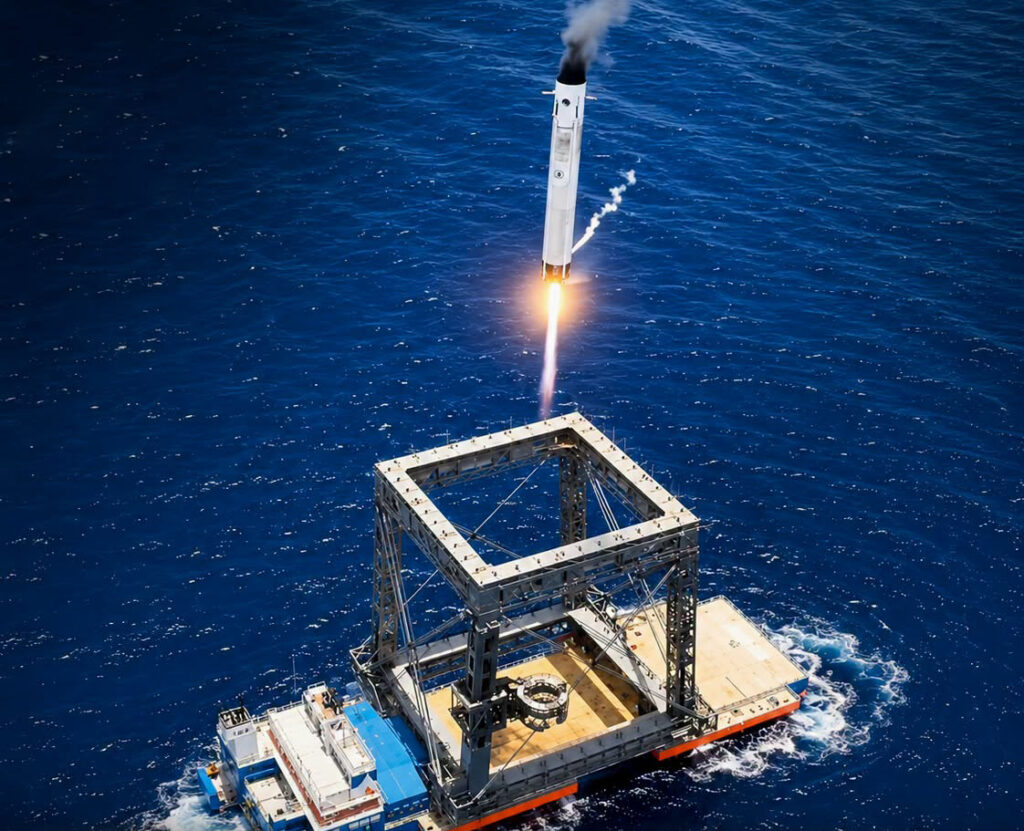
The maiden flight of the Long March 10B carrier rocket lifted off at 12:15 a.m. EDT (0415 GMT) from the Hainan Commercial Space Launch Site, successfully deploying its satellite payload into the targeted orbit before its first stage performed a vertical return over the South China Sea.
With this mission, China becomes the second nation globally to successfully recover an orbital launch vehicle booster. Notably, the operation marked the world’s first successful utilization of a sea-based net-capture system rather than traditional landing legs.
Technical Specifications of the Long March 10B
Developed by the China Academy of Launch Vehicle Technology (CALT), the Long March 10B is a liquid-fueled, two-stage configuration designed for high cost-effectiveness and mass transit capabilities:
- Dimensions: Measures 63 meters (207 feet) in height with a core diameter of 5 meters.
- Mass & Thrust: Features a liftoff mass of approximately 760,000 kilograms, powered by seven YF-100K kerosene-liquid oxygen (LOX) engines generating 890 tonnes of combined thrust.
- Payload Capacity: Capable of ferrying up to 16,000 kilograms (35,275 pounds) to Low Earth Orbit (LEO) when operating in its reusable configuration.
- Propellant Matrix: The first stage burns a kerosene-LOX mixture, while the upper stage utilizes liquid methane and LOX.
Engineering Rationale Behind the Net-Capture Architecture
Approximately six minutes after stage separation, the booster deployed four specialized landing hooks to catch tensioned cables over a flexible, hydraulic-damped net system anchored to the recovery vessel Linghangzhe.
According to Chen Muye, a technical expert at CALT, choosing a net-based capture system over deployable struts yields vital payload advantages. “Net-based recovery helps simplify the rocket’s onboard structure, reduces vehicle mass, and increases payload capacity,” Chen stated. He added that the system features high tolerance for landing-point deviations, significantly expanding the successful capture window compared to rigid landing pads.
Next Operational Framework and Re-flight Schedule
The Long March 10B serves as the cargo variant of the broader Long March 10 architecture, which forms the baseline for China’s crewed lunar exploration timeline target of 2030.
CASC engineers are currently transitioning the recovered first stage to post-flight processing facilities. The state enterprise plans to fully inspect, refurbish, and re-fly this identical booster stage before the end of the year, accelerating China’s operational cadences within the reusable launch market.
