

By Nick David, Editorial Lead, SatNews
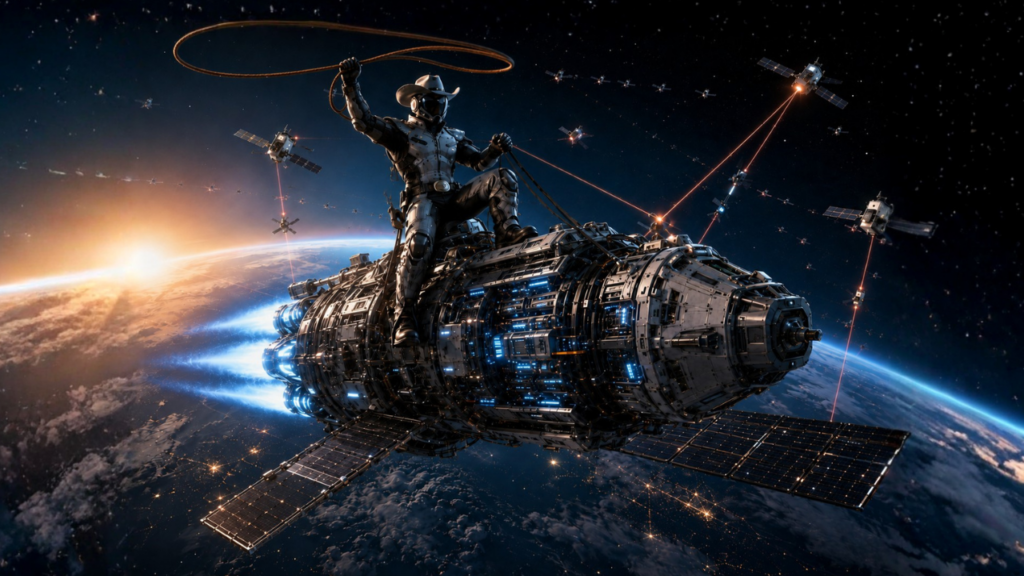
Cowboy Space Corporation, the company most of us knew last month as Aetherflux, closed a $275 million Series B and, three days later, asked the Federal Communications Commission for permission to put up to 20,000 satellites carrying data-center hardware into low Earth orbit. Index Ventures led the round at a post-money valuation of $2 billion, the same firm that led Aetherflux’s $50 million Series A thirteen months ago. Disclosed equity to date now stands at roughly $325 million. The FCC application, filed May 14 under the constellation name “Stampede,” is the largest orbital data center deployment plan anyone has put on paper.
If you’ve been reading our coverage this year, you already know why this lands the way it does. We’ve been mapping the orbital data center thesis bottleneck by bottleneck: cooling, data gravity, debris exposure, economics, the edge-compute supply chain. Cowboy just bet $275 million that every one of those bottlenecks can be solved by collapsing launch and compute into the same vehicle.
What Cowboy Actually Built
The technical claim is the part worth slowing down on. Cowboy isn’t proposing to ride to orbit on someone else’s rocket and unfurl a data center once it gets there. The company’s upper stage is the data center payload. Founder and CEO Baiju Bhatt, co-founder of Robinhood and now leading the most consequential pivot in NewSpace this year, argues that designing the rocket’s second stage and the compute platform as one integrated vehicle strips out the redundant mass that makes every other orbital compute pitch pencil out badly.
The specs Cowboy is publishing aren’t modest. Each Stampede satellite is expected to weigh 20,000 to 25,000 kilograms, generate one megawatt of usable power from dawn-dusk sun-synchronous orbits between 700 and 1,000 kilometers, and host just under 800 GPUs. The compute payload itself will be built around Nvidia’s Space-1 Vera Rubin module, the product Nvidia unveiled at GTC in March and positioned as its first purpose-built LEO AI infrastructure block. Cowboy was named on Nvidia’s launch slate of Space-1 partners. First proprietary launch carrying a one-megawatt data center: before the end of 2028.
The FCC filing requests multiple waivers, most notably because Stampede would rely primarily on optical inter-satellite and downlink communications rather than the congested radio bands every other megaconstellation is fighting over. The satellite design, Cowboy told the commission with admirable candor, is unfinished and will require a license modification before service begins.
Why It Lands Where It Lands
The orbital data center idea isn’t new on these pages. Chris Forrester’s Orbital Data Centers: Data or Debris? framed the investor case and the skeptics’ case in March. Two days later we published The Rise of the Orbital Data Center on the launch of the first commercially operational orbital cloud, and the same day we ran The Physics Wall on the cooling problem nobody is pricing properly. Fractal Lab Part II pulled apart the data-gravity constraint and argued the market would fracture into two mutually exclusive compute types: the high-speed Real-Time Reduction Hub and the massive Batch Trainer. Earlier this month, Access Hub and Maargin published a white paper arguing that frugal LEO constellations with integrated orbital micro-compute are the actual near-term wedge. And the Consumer NPU boom piece we ran Tuesday traces why the silicon side of this is finally tractable.
Read those pieces together and Cowboy’s bet snaps into focus. Cowboy is not betting that orbital compute is a good idea. That question is already settled. Cowboy is betting it can solve all four ODC bottlenecks simultaneously (launch supply, thermal, data gravity, and unit economics) by owning the rocket. If they can, vertical integration becomes the moat. If they can’t, $275 million buys a very expensive proof that someone has to specialize.
Dr. Oguz Karasu’s SmallSat Europe Market Brief on ODC economics next month just became the conference session everyone in this thesis will want to be in the room for.
What Cowboy Has to Prove
I’ll say what I think: the launch-cadence argument is the strong one. The current commercial launch manifest cannot accommodate a 20,000-satellite, 20-tonne-per-bird constellation on anyone else’s vehicle, and the grid-interconnect queues that AI hyperscalers are stuck in on the ground really are years deep. Cowboy isn’t selling physics. They’re selling a vehicle that, if it flies, removes the constraint everyone else is bottlenecked on.
The harder questions are the ones Forrester raised in March and the ones our cooling piece sketched. Dissipating one megawatt of thermal load in vacuum is not a trivial engineering exercise, and a 20,000-satellite shell at 700–1,000 km has a debris liability that the optical-only architecture mitigates but does not eliminate. Cowboy’s own FCC filing concedes the satellite design isn’t done. That’s not damning. It’s honest. But the next eighteen months will be about closing those gaps in public.
For now, the headline is that the capital has arrived, the regulatory clock is ticking, and the ODC thesis just stopped being a question of whether and started being a question of who. SatNews will keep mapping it.
About the Author
A storyteller at heart, Nick David covers space policy, satellite markets, defense, and the technologies reshaping how humanity operates beyond Earth. With a background in creative direction, brand strategy, and editorial storytelling, he brings a modern lens to complex subjects and a relentless curiosity about what comes next.
