

BALTIMORE, MD — When the FIFA World Cup kicks off across 16 host cities, the spotlight will be squarely on the 48 teams competing across 104 matches. Yet behind the stadium lights, an equally intense battle will be taking place across the global fiber networks: the challenge of capturing, encoding, and distributing millions of gigabytes of live video data simultaneously without a single second of lag.
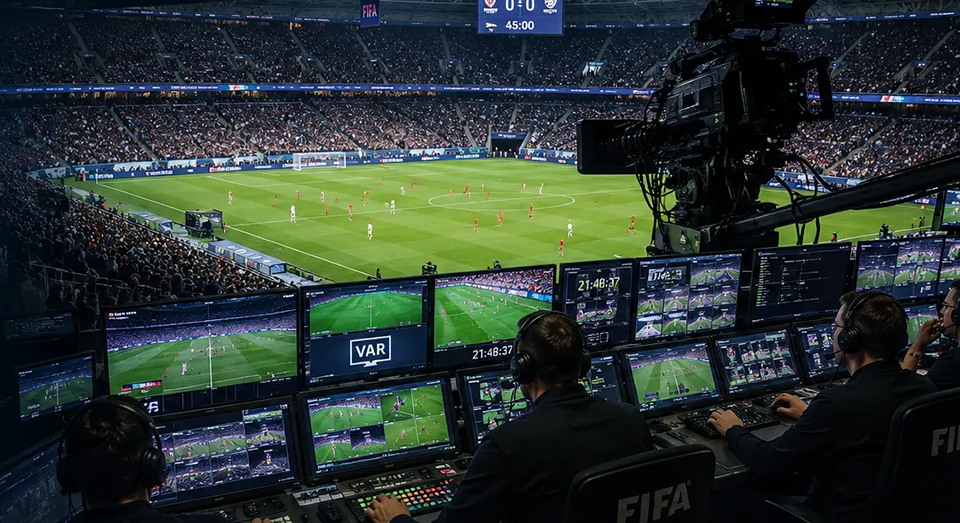
Broadcasting a modern mega-event has evolved far beyond sending a single video feed to television networks. Today, a stadium operates as a localized digital smart city. A single live play on the field must simultaneously route to a myriad of distinct destinations, each with entirely separate technical requirements:
- The Global Broadcast: Maximum visual quality sent to global networks.
- In-Stadium Displays: Massive jumbotrons and concourse TVs requiring zero-latency playback so fans inside the stadium don’t see the action on screen after they hear the crowd cheer.
- Operational Control Rooms: Multi-view monitoring stations where security and operational teams stitch together quad-display outputs to keep hundreds of cameras in view at once.
To manage this complex architecture, broadcast engineers are increasingly relying on adaptable Video-over-IP distribution systems. Hardware developers like Delta Digital Video (DDV) are designing new modular architectures—such as their 5480E encoders and 5480D decoders—specifically to address these crowded network ecosystems.
A primary key to keeping these massive video pipelines functional comes down to specialized mathematical compression, or codecs. Rather than applying a blanket solution, modern event networks must rely on a hybrid approach to save bandwidth:
- H.264: Used for backward compatibility with legacy monitors and standard operations.
- H.265 (HEVC): Deployed to squeeze down data sizes for ultra-high-definition (UHD) 4K video over crowded local networks.
- JPEG-XS: The gold standard for critical broadcast paths, designed to deliver visually lossless picture quality with virtually non-existent latency.
As sporting events scale up in size, the technology happening off-camera is becoming just as complex as the games themselves. High-density video distribution racks are turning into the unsung heroes of the tournament, ensuring that whether a fan is sitting in the front row, watching a monitor in a stadium security room, or streaming from across an ocean, they receive the exact same frame at the exact same moment.
