

On May 14, 2026, Red Cat Holdings, Inc. (Nasdaq: RCAT) announced that flat-panel satellite terminal manufacturer Kymeta has joined the Red Cat Futures Initiative. Under the new defense partnership, Red Cat’s maritime division, Blue Ops, will integrate Kymeta’s software-defined metamaterial antennas into its Variant 7 uncrewed surface vessel (USV).
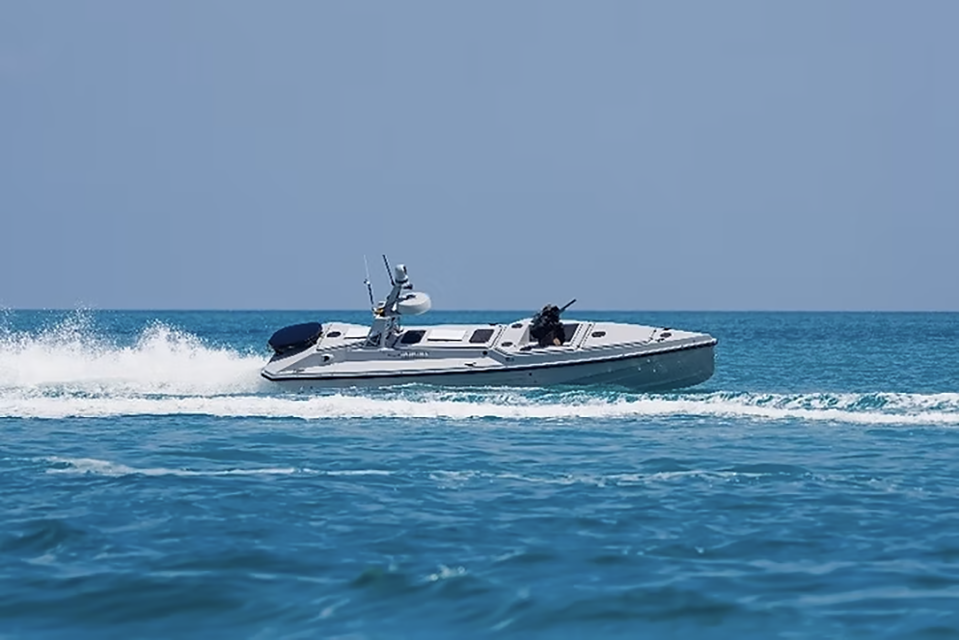
The system is engineered to provide persistent, beyond-line-of-sight communications on the move for autonomous naval operations in contested electronic warfare environments.
Multi-Orbit Redundancy at the Tactical Edge
The collaboration addresses the critical payload vulnerabilities of operating autonomous maritime systems over long distances without fixed ground infrastructure. By embedding Kymeta’s low-profile terminal into the Variant 7 hull architecture, the USV gains access to a layered satellite network that seamlessly bridges multiple orbital paths.
The integrated communications terminal relies on an intelligent routing engine capable of dynamically switching between different satellite configurations:
- Low Earth Orbit (LEO): Providing high-throughput, low-latency data streams required for real-time video transmission and automated payload sensor updates.
- Medium Earth Orbit (MEO): Offering mid-tier routing flexibility and highly resilient backing data paths.
- Geostationary Orbit (GEO): Supplying wide-beam wideband coverage to ensure baseline connectivity when closer orbital configurations are obstructed or degraded.
Mitigating Electronic Warfare and GNSS-Denied Risks
A major obstacle for uncrewed distributed operations is the threat of adversarial jamming, spoofing, and signal degradation. Kymeta’s flat-panel architecture utilizes electronic beam steering, allowing the terminal to lock onto overhead satellites and change pointing angles in milliseconds without mechanical gimbals. This rapid reacquisition capability provides the Variant 7 USV with GNSS-denied persistence, allowing the vehicle to maintain command and control even when standard GPS navigation signals are entirely blocked by electronic warfare counters.
Furthermore, the integration supports advanced maritime swarming and real-time target acquisition capabilities. By establishing multi-layered, low-power communication channels, multiple Variant 7 vessels can coordinate autonomous maneuvers and share localized sensor data simultaneously. This distributed networking format lowers the overall radio-frequency signature of the fleet while maximizing the survivability of the mission.
Industrial Rationale within the Futures Initiative
The partnership represents an expansion of the Red Cat Futures Initiative, an industry-wide consortium designed to accelerate the deployment of advanced autonomous capabilities to frontline military operators. By pre-qualifying trusted subsystem components like Kymeta’s antennas, Red Cat aims to minimize integration friction and significantly compress traditional defense procurement timelines. This allows tactical edge hardware—such as computer vision, swarming software, and electronic warfare mitigation tools—to be fielded as a unified, mission-ready solution.
Barry Hinckley, President of Blue Ops, emphasized that reliable long-range connectivity is a primary enabler for complex naval missions. He noted that integrating Kymeta’s flat-panel technology into the Variant 7 platform delivers the extended operational range and security required for modern distributed warfare. Manny Mora, CEO and President of Kymeta, echoed this focus, stating that the collaboration is centered on ensuring operators can depend on persistent command and control, even under the most challenging maritime conditions.
Scheduled Field Testing and SOF Week Manifest
The combined USV satellite communications solution follows successful full-scale naval integration exercises conducted in Key West, Florida, earlier in May 2026. Red Cat is scheduled to debut the Kymeta-equipped Variant 7 USV during a series of live-action demonstrations at SOF Week in Tampa, Florida, running from May 18 through May 21, 2026.
The live exercises will focus on proving the terminal’s low-power efficiency, stable multi-orbit switching under high sea-state hull dynamics, and its capability to maintain uninterrupted data throughput during simulated communication-degraded scenarios. Following the completion of the SOF Week field trials, Blue Ops intends to finalize the commercial production manifest for the upgraded Variant 7 platform, targeting initial deliveries to U.S. and allied defense customers by the fourth quarter of 2026.
