

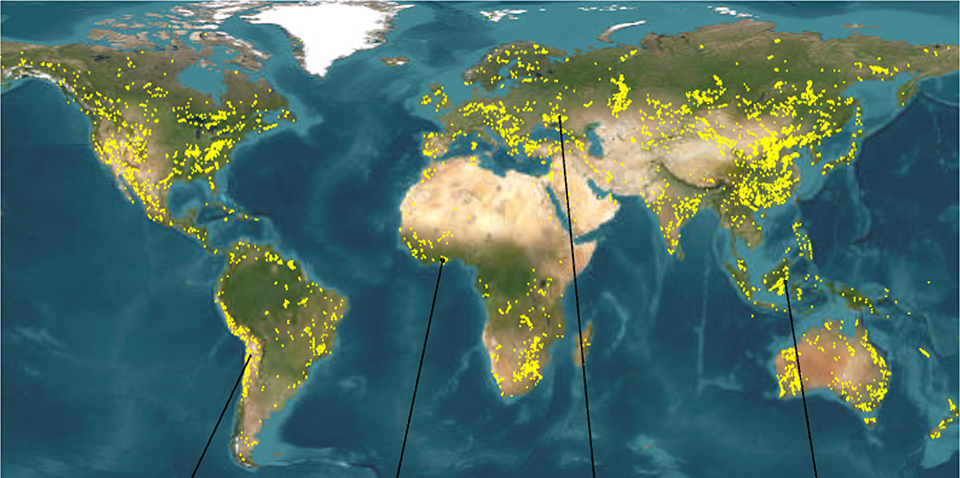
As terrestrial infrastructure reaches its physical and economic limits, the global satellite sector is seeing a concentrated surge in demand across three primary geographic theaters. By mid-2026, the industry has pivoted away from broad global coverage toward high-density regional deployments tailored to specific sovereign and industrial needs. From the “Sovereign Shield” policies in Asia-Pacific to the industrialization of the Arctic corridor, the geography of space connectivity is being redrawn.
The Asia-Pacific Pivot: China and India Lead
The Asia-Pacific region is currently the fastest-growing market for direct-to-satellite services, projected to hold a 26.5 percent market share by the end of 2026. This acceleration is driven by the emergence of China and India as spacefaring “juggernauts” with long-term strategic visions for technological independence. China is currently deploying multiple mega-constellations, including Spaceai’s Qianfan (90 active satellites, 15,000 planned) and the state-backed Guowang/Xingwang network (34 active satellites, 12,992 planned).
These deployments are not merely for connectivity but serve as sovereign infrastructure. Governments in the region are increasingly viewing satellite networks as essential for national security and digital inclusion. India’s Department of Telecommunications has recently incentivized satellite providers to bridge the digital divide in rural sectors, while Australia’s NBN Co continues to expand high-throughput satellite footprints to support remote agriculture and smart city projects.
The Africa Backhaul Surge: Bridging the Usage Gap
In Sub-Saharan Africa, the strategic focus has shifted from simple coverage to high-capacity backhaul. While the coverage gap narrowed to 9 percent by 2024, the “usage gap”—the portion of the population with coverage who cannot afford or utilize the service—reached 64 percent in late 2025. To address this, major mobile network operators (MNOs) are partnering with satellite providers to lower the cost of terrestrial infrastructure.
During MWC 2026, Vodafone announced a partnership with Amazon Leo to provide satellite backhaul for 4G and 5G base stations across Africa where fiber is unavailable. Similarly, Orange is pursuing a multi-partner strategy with AST SpaceMobile and Eutelsat to trial direct-to-device (D2D) services. These partnerships aim to integrate satellite connectivity as a native extension of existing mobile platforms rather than an expensive add-on, helping to scale the addressable market for digital services.
The Arctic Corridor: A New Industrial Frontier
The polar region satellite communications market is experiencing rapid growth, expected to reach $2.77 billion in 2026 with a compound annual growth rate (CAGR) of 11.5 percent. This spike is driven by the transformation of the Arctic from an isolated frontier into an active industrial and shipping corridor. As sea ice reaches record minimums, annual traffic in the region has increased by 40 percent since 2013, creating an urgent need for maritime surveillance and high-latitude connectivity.
New LEO constellations focused on polar coverage are now providing the low-latency links required for Arctic shipping and scientific research. For instance, the collaboration between Danish and Swedish defense forces utilizes space-based surveillance to track “shadow fleet” movements and monitor environmental changes across Greenland and the North Atlantic. These systems are essential for maintaining situational awareness in a region where physical capability directly determines geopolitical influence.
Sovereign Space and Strategic Autonomy
The overarching driver for this geographic concentration is the push for sovereign space infrastructure. Geopolitical tensions have forced nations to rethink their supply chain strategies and network dependencies. Viasat CEO Mark Dankberg noted during SatShow 2026 that countries now realize they “need more than what they’ve been buying,” seeking dedicated capacity that they can control and secure during regional crises.
This demand for autonomy is pushing the industry toward software-defined satellites that can be reconfigured in real-time to focus capacity on shifting hotspots. By separating control and data planes, operators can dynamically allocate resources to disaster-prone areas in Southeast Asia or high-traffic shipping lanes in the North Sea without requiring new hardware launches.
The Transition to Sustainable Monetization
As the industry moves toward 2027, the focus will shift from technical feasibility to sustainable monetization. While North America currently dominates the market with a 39.8 percent share due to high government defense spending, the growth in emerging markets is expected to outpace developed regions. The integration of satellite support into consumer chipsets by vendors like Qualcomm and MediaTek will structurally expand the addressable base for D2D services.
However, challenges remain regarding regulatory hurdles and spectrum allocation in densely populated regions of Asia and Africa. The next phase of global expansion will likely be defined by the ability of satellite operators to navigate complex local licensing requirements while maintaining interoperability with terrestrial 5G standards. Success in these hotspots will depend on providing not just data, but a resilient, sovereign-aligned platform for the digital economy.
