

On Tuesday, April 14, 2026, NASA Administrator Jared Isaacman delivered a transformative keynote at the 41st Space Symposium, detailing a fundamental pivot in America’s approach to deep space exploration. Under the newly unveiled “Ignition” initiative, NASA will deprioritize the orbital Gateway station to accelerate the construction of a permanent human foothold at the lunar south pole by 2030 and launch the world’s first nuclear-powered interplanetary spacecraft, SR-1 Freedom, by 2028.
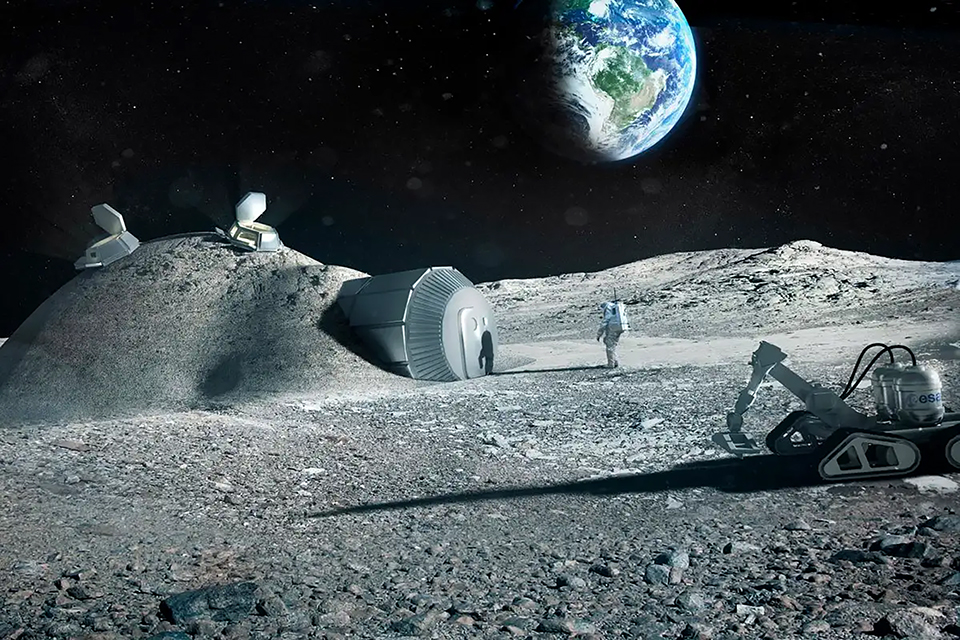
Strategic Transition to Sustained Surface Presence
The announcement marks a departure from the “expeditionary” model of the early Artemis missions toward a permanent settlement strategy. To fund this acceleration, NASA will pause the current development of the Gateway lunar space station, shifting those resources toward heavier surface infrastructure. The transition will be supported by a phased delivery of payloads, utilizing cargo-capable Human Landing Systems (HLS) to ferry habitation modules and logistics to the lunar surface.
SR-1 Freedom and the Nuclear Power Roadmap
Central to the “Ignition” strategy is the deployment of space-based nuclear fission power. NASA, in partnership with the Department of Energy and Department of Defense, aims to field a 20-kilowatt space-based reactor by 2028 aboard the SR-1 Freedom. This spacecraft will utilize nuclear electric propulsion (NEP) to transport payloads to Mars with efficiency that far exceeds traditional chemical rockets.
By 2030, a scaled version of this technology, dubbed Lunar Reactor-1, is scheduled for deployment on the Moon. This reactor will provide the continuous 20-kilowatt power supply necessary to sustain life and operations during the 354-hour lunar night, a period where solar power is non-viable.
Infrastructure and International Contributions
The permanent lunar base will integrate hardware from several international partners. Key elements identified in the strategy include the Multi-Purpose Habitats (MPH) provided by the Italian Space Agency (ASI) and the Lunar Utility Vehicle from the Canadian Space Agency (CSA). Domestic infrastructure will be bolstered by the revival of the VIPER (Volatiles Investigating Polar Exploration Rover) project, which will now serve as a permanent prospector for lunar water and resources near the outpost.
Rationale: Leadership in the Cislunar Economy
The pivot to a permanent base is driven by the National Space Policy’s mandate to establish American leadership in the emerging cislunar economy. Administrator Isaacman emphasized that NASA is “no longer in the business of trying to please everyone,” choosing instead to concentrate resources on high-yield objectives that activate the industrial base. By building a permanent “railroad” of nuclear-powered transport, the agency aims to drive down the cost of deep-space logistics and ensure long-term strategic autonomy.
Future Timeline and Interplanetary Vision
Following the establishment of the initial 2030 outpost, NASA plans a “sustained cadence” of missions to increase habitation capacity. Between 2033 and 2036, the agency expects to deliver roughly 150,000 kilograms of payload to the Moon, including pressurized rovers that will allow astronauts to work without suits for extended durations. This lunar foundation is explicitly designed as a blueprint for the eventual human exploration of Mars, using the SR-1 Freedom’s operational data to refine life-support and propulsion systems for the seven-month journey to the Red Planet.
