

Targeting the growing requirement for resilient space domain awareness and autonomous orbital infrastructure, the U.S. Naval Research Laboratory (NRL) will unveil its latest suite of revolutionary technologies at the 41st Space Symposium.
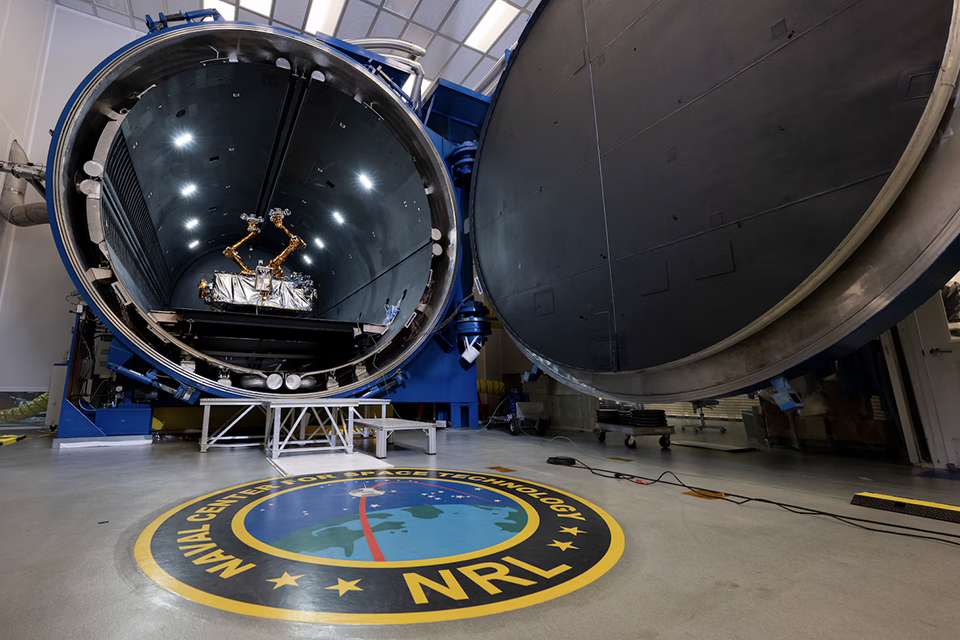
NRL will demonstrate how its current research into solar monitoring, debris detection, and robotic servicing is shaping the future of national security in the space domain.
Infrastructure for Space Logistics and Resilience
The NRL’s presence at the symposium follows the successful April 7 launch of three advanced experimental payloads aboard the STP-S29A mission. These payloads—LARADO, GOSAS, and GARI-1C—represent the vanguard of the Navy’s effort to maintain a technological advantage in increasingly congested and contested orbital regimes.
A key highlight of the symposium will be a panel discussion on April 16 titled “Building the Backbone: The Infrastructure Behind Space Logistics.” Bernard Kelm, Acting Director of NRL’s Naval Center for Space Technology (NCST), will discuss the transition of unmanned robotic satellite servicing from research and development to a fielded national capability. This initiative aims to enable the fine inspection, repair, and repositioning of existing spacecraft, effectively extending the lifecycle of high-value national assets.
Featured Payload and Sensor Technologies
NRL will present detailed specifications and operational data for several active and upcoming missions:
- LARADO (Lasersheet Anomaly Resolution and Debris Observation): A space-based sensor designed to detect and characterize orbital debris too small to be tracked by ground-based systems.
- CCOR (Compact Coronagraph): A series of three solar imaging sensors. The CCOR-1 instrument, currently operational on NOAA’s GOES-19, recently provided critical data on a G4-class geomagnetic storm in January 2026 and captured images of the disintegrating Comet C/2026 A1 on April 7.
- Proximity Operations Laboratory: NRL will showcase its 45 ft by 100 ft Space Robotics Laboratory, which utilizes motion simulation platforms to test spacecraft maneuvers for docking and robotic grappling.
- Neptune® C2 Software: A government-owned command and control baseline used on over 100 satellites across all orbital regimes.
Executive Perspective
“NRL represents the rich history and ongoing innovation of the U.S. Navy in space,” said Dr. Bruce Danly, NRL Director of Research. “From pioneering the technology behind GPS to launching the nation’s first intelligence satellite, NRL has been at the forefront for over a century. Our presence at the Space Symposium allows us to engage with our partners in the Department of War and industry to ensure our current research addresses the most pressing threats to space superiority.”
Timeline to Operational Integration
Following the symposium, NRL will focus on the spring 2026 operational debut of CCOR-2 aboard NOAA’s Space Weather Follow On-Lagrange 1 (SWFO-L1) observatory. Additionally, the COSI (Compton Spectrometer and Imager) telescope is moving into final integration phases ahead of its scheduled 2027 launch, where it will survey the soft gamma-ray sky to observe energy-specific processes in deep space.
