

Chris Forrester — Once upon a time – and this is a true story – when interviewing Roman Bausch (SES CEO 1995-2014) in 2012 he said SES would not invest in building a LEO fleet. Instead, and behind the scenes at the time, SES was talking with O3b (“the Other 3 Billion”), where it already had an investment position and which had been founded by serial entrepreneur Greg Wyler in 2007 with help from SES, Google, HSBC, Liberty Global and others.
O3b’s first 4 satellites acquired from Thales Alenia launched somewhat later than originally planned in 2013 and other launches followed to total 20 satellites in orbit by 2019. O3b became a wholly-owned subsidiary of SES in 2016 by buying out the other co-founders and enabled SES to justifiably claim that it was the only geostationary satellite company with a fleet of lower-orbiting MEO satellites. The new fleet enabled speedier latency and a capability of much-improved backhaul for telcos and WiFi suppliers.
More investment followed, and SES upgraded its O3b concept with orders with Boeing for the O3b mPOWER versions and very much ‘next-gen’ satellites. These new satellites would each have thousands of spot beams with software-defined routing to direct capacity to the Earth below but also to ships at sea. Indeed, much was made of its service to the giant floating cities of Cruise Liners and their populations of some 6000 passengers and up to 3000 crew members and their everyday connection needs.
SES ordered an initial 7 mPOWER craft from Boeing. But there were problems with the first satellites in orbit and insurance claims were made (and are still not totally resolved). Modifications were made and the Boeing mPOWER orders were increased, from the initial 7 to 11 and then 13. Ten craft are now orbiting and the final 3 due for launch later this year.
But now SES’s enthusiasm for MEO orbits have been dramatically increased. At the Washington, DC Satellite Show SES confirmed it had ordered 28 very much ’next generation’ meoSphere satellites from Los Angeles-based K2 Space. K2 will supply the craft’s main body buses while SES will supply payloads.
K2 Space was founded in 2022 by Karan Kunjur and his brother Neel Kunjur, former SpaceX engineers. The company launched its first satellite, Heritage, in January 2025, demonstrating critical subsystems in low-Earth orbit.
The new fleet will be operational by 2030 says SES and will operate alongside the existing mPOWER satellites. An initial ‘pathfinder’ satellite (“Gravitas”) will launch in the next few days as part of SpaceX’s next Transporter 16 mission. The first fully functioning meoSphere satellites should launch in 2029.

Indeed, the order is a major indication of confidence for the future and recognition that there’s plenty of business ahead for MEO-based satellites. The K2 portion of each satellite costs about $15 million.
This move is a major departure for SES and further confirms the operator’s intention to become more self-sufficient in satellite production. It has made no secret of using skillsets much closer to its Luxembourg base to build its new satellites. SES has an ongoing relationship with SWISSto12 for various elements including antenna design as well as buying their HummingSat line of smaller – and cheaper – satellites.
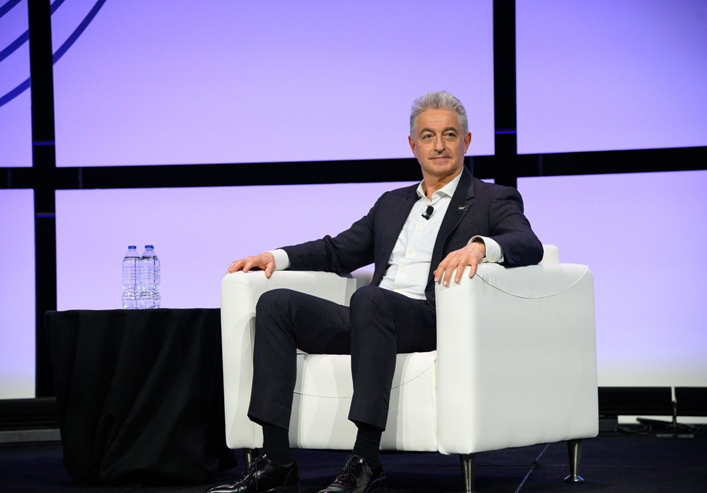
SES is helped that SWISSto12’s chairman is Steve Collar, who was the CEO at SES until Adel Al-Saleh was appointed. Al-Saleh told delegates at the DC show that the company’s MEO fleet would eventually contain around 100 satellites.
“The program launches with a close collaboration designed for efficient satellite production. SES will pair its own software-defined payloads, being developed and manufactured in Luxembourg, with an initial 28 high-power satellite platforms developed by K2 Space, representing the first phase of the broader meoSphere rollout. The collaboration gives SES tighter control over key supply-chain elements, compresses the build timeline, and allows the company to manage schedules and costs with precision, laying the foundation for future scalability,” says SES.
These meoSphere satellites will significantly boost global broadband capacity, increasing user data speeds while reducing terminal sizes and costs. These step-change improvements come from advances in payload and terminal technologies, software-defined networking, 5G non-terrestrial network (5G NTN) standards and MEO’s inherent strengths: efficient geographic coverage, ability to steer capacity to the high-demand areas, optimizing ground-station deployment, and low latency. The meoSphere network, says SES, is designed to meet growing demand for secure, stable, reliable, and resilient connectivity across government, mobility, and fixed telecommunications markets.
SES has its own commercial LEO relationships with Starlink, and has a major investment in Lynk Global while Intelsat has a similar relationship with Eutelsat’s OneWeb, so its LEO demands are secured.
And there’s more to come. In April it is likely that Europe will make its final decisions on the shape and functionality of its planned IRIS2 super-secure mega-constellation (Infrastructure for Resilience, Interconnectivity and Security by Satellite). SES expects to be given responsibility for the MEO portion of IRIS2 which will comprise 18 satellites – and these will be additional to anything currently in the SES MEO scheme.
It was not a coincidence that SES CEO Adel Al-Saleh was honored as ‘Satellite Executive of the Year’ in Washington. The award is a recognition of Al-Saleh’s contribution. Roman Bausch would surely be happy with current progress at SES.
