

By Evan Grey Legal Contributor, SatNews
For a quarter of a century, the International Space Station (ISS) has served as a true monument to post-Cold War optimism: an orbital sanctuary where geopolitical adversaries shared life support, conducted joint research, and operated under a framework of perhaps idealized international collaboration. As the station’s structural fatigue mounts, its planned deorbit into the Pacific draws closer. Whether that splashdown occurs in 2031 or Congress extends operations into 2032, that era of collaboration is ending.
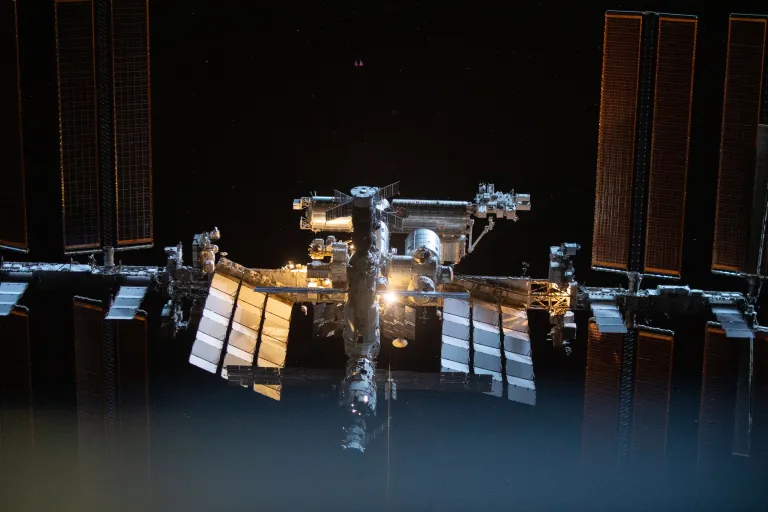
In its place, a new narrative has taken hold across the aerospace industry: the triumph of the free market. Recent headlines are dominated by capital injections and regulatory milestones from the Commercial LEO Destinations (CLDs). Vast Space just secured a $500 million war chest. Starlab Space successfully passed its NASA Commercial Critical Design Review. Axiom Space continues to build out its parasitic modules.
The prevailing consensus is that private enterprise has organically arrived to save human spaceflight. That consensus is fundamentally flawed.
The commercialization of low Earth orbit (LEO) is not a triumph of free-market capitalism; it is the creation of a high-stakes geopolitical procurement battleground. As we enter a new era of near-peer competition, the space economy remains a strict monopsony; driven not by consumer demand but by the strategic requirements of sovereign anchor tenants.
The transition away from the ISS is forcing sovereign states to make an impossible choice: accept the geopolitical, legal, and data-surveillance liabilities of foreign corporate tenancy, or spend billions to maintain orbital autonomy. Welcome to the Orbital Tenancy Trap.
The Myth of the Free Market
Understanding the ISS transition requires looking past the illusion of the free market to examine the calculus of power and structural risk. The clearest evidence of this consolidated ecosystem is found in NASA’s current leadership. With commercial space pioneer Jared Isaacman now serving as Administrator, the traditional boundaries between private enterprise and state procurement are dissolving. Isaacman built his historic spaceflight legacy through a deep architectural partnership with SpaceX. Placing an industry leader with such profound commercial ties at the helm of a federal agency is not an ethical scandal; it is an undeniable structural signal. It broadcasts to international partners that the U.S. space economy operates not as a decentralized free market, but as a highly consolidated sovereign procurement loop.
Isaacman’s recent launch of NASA Force (recruiting private tech talent directly into government roles) and his late-February Artemis course correction to test commercial lunar landers in low Earth orbit prove that LEO is not a free-market sandbox; it is the heavily funded staging ground for sovereign dominance. His scathing memo classifying the Boeing Starliner failures as a Type-A mishap signals that the government is no longer a passive checkbook for commercial space: it is a ruthless, demanding sovereign buyer.
Commercial LEO space stations are only economically viable with this exact kind of U.S. government investment. The math is stark. NASA currently spends roughly $3 billion a year, nearly a third of its human spaceflight budget, just to keep the aging ISS operational. By transitioning to commercial stations, the U.S. government sheds a massive baseline operating cost. By shifting to fixed-price commercial services, NASA and the Department of Defense (DoD) have forced private capital to absorb the risk of failure, accelerating development timelines while lowering costs for the anchor tenant.
Just as the U.S. government used land grants to subsidize the Transcontinental Railroads, it is now using taxpayer-funded procurement to subsidize private orbital infrastructure. The free market narrative is merely a convenient political shield used to obscure a state-directed industrial policy.
The Great Orbital Decoupling
This U.S. monopsony creates a profound strategic crisis for traditional allies. Europe is now confronting the difficult reality that if the ISS is deorbited and they rely entirely on U.S. startups for LEO access, they permanently forfeit their orbital autonomy.
This realization is driving a massive geopolitical realignment: the active bifurcation of the global space economy. We are watching regions like Europe and China systematically decouple from Western commercial dependencies.
The European Space Agency’s (ESA) recent push to investigate building its own sovereign space station is the human-spaceflight equivalent of the European Commission’s IRIS² communications constellation. We are watching Europe apply the IRIS² playbook to astronauts. They are attempting to build their way out of an American commercial monopoly because relying on foreign corporate infrastructure for baseline access reduces a global power to a captive tenant.
But a sovereign station means nothing without sovereign access. ESA’s vision of an independent outpost is entirely tethered to the operational cadence of the Ariane 6 heavy-lift rocket. If Ariane 6 cannot scale its launch capabilities, Europe will be forced to deploy its sovereign modules using a SpaceX Falcon 9. You cannot claim orbital autonomy if your front door requires an American billionaire’s key.
The Proportionality Trap
The most volatile consequence of this transition is strictly legal. As private space stations replace the ISS, their financial survival will hinge entirely on securing contracts from the Department of Defense. Because the Pentagon remains the only entity with the capital to keep these orbital habitats solvent, the integration of civilian and military payloads becomes unavoidable.
We are already seeing the DoD aggressively operationalize commercial assets. Just weeks ago, the Space Development Agency (SDA) awarded AST SpaceMobile a $30 million HALO contract to demonstrate tactical military satellite communications directly via commercial broadband satellites. The lines between military and commercial infrastructure are being intentionally erased.
This produces a targeting nightmare under the Law of Armed Conflict (LOAC). Imagine a scenario where a commercial station is hosting highly classified SDA tactical transport payloads on one side and civilian European researchers on the other.
By sharing commercial outposts, international partners are unknowingly strapping their civilian science programs to U.S. dual-use military assets. If an adversary determines that the station’s military payloads pose an imminent threat, the entire station could legally become a legitimate military target under a loose interpretation of LOAC. The privatization of the ISS effectively obliterates the civilian immunity of our allies.
Orbital Edge Computing and Data Sovereignty
For the satellite communications and Earth Observation (EO) sectors, the primary threat is not kinetic; it is data sovereignty. The era of the borderless internet is dead on Earth, and it is dying in orbit.
Future commercial space stations will not just be habitats; they will function as orbital data centers. EO satellites will increasingly beam raw intelligence directly to these stations via laser cross-links to be processed by on-board AI before being sent to Earth.
Simultaneously, these stations will host highly strategic manufacturing. With United Semiconductors recently securing capacity on Starlab — a joint venture backed by Mitsubishi Corporation — for in-space semiconductor production, the regulatory stakes have never been higher. If a European defense startup or a Japanese robotics firm conducts highly sensitive research on an American-owned commercial space station, whose laws apply to that data? Will the U.S. government enforce export controls like the International Traffic in Arms Regulations (ITAR) or Export Administration Regulations (EAR) on the semiconductor data generated on those servers?
Building a sovereign European station is a physical manifestation of data sovereignty — ensuring that allied intellectual property does not traverse American corporate IT infrastructure.
The Transitional Monopsony
The obvious rebuttal: every great infrastructure transition in American history started as a government monopsony. The Transcontinental Railroads required federal land grants before private freight revenue materialized. GPS was a military system before it became the backbone of civilian logistics. The internet was a DARPA project before it was an economy. The argument that commercial LEO stations are “merely” government-subsidized misreads the sequence; it mistakes a transitional phase for an end state.
This position has real evidence behind it. Axiom Space is already booking private astronaut missions, pharmaceutical research flights, and commercial manufacturing slots that have nothing to do with NASA or DoD. Vast Space’s $500 million raise came overwhelmingly from private investors, not government coffers. If the CLD market follows the GPS trajectory, today’s sovereign anchor tenant becomes tomorrow’s minority customer as commercial demand scales.
This doesn’t make the geopolitical risks imaginary. But it does mean the Orbital Tenancy Trap may be a transitional condition rather than a permanent one — and the allies who panic-build sovereign alternatives could find themselves operating expensive, underutilized stations while the commercial platforms they fled evolve into genuinely diversified marketplaces. The question is not whether the monopsony exists today; it is whether the monopsony persists long enough to calcify the geopolitical dependencies before commercial demand arrives to dilute them.
The Industry Pivot: Engineering Jurisdictional Isolation
The transition away from the ISS permanently shifts the function of the commercial space industry. The new mandate for aerospace leaders is straightforward. They must prioritize jurisdictional isolation over simple connectivity, a geopolitical reality that forces three immediate industry pivots:
- The Routing Liability: Satellite operators can no longer rely on simple shortest-path routing algorithms. They must implement strict, policy-based routing protocols that verify the sovereign ownership and security classification of a commercial node before beaming sensitive Earth Observation (EO) data to it via laser cross-links.
- The Hardware Opportunity: The most strategic hardware market of the 2030s will not be life-support systems. It will be building physically and digitally air-gapped sovereign computing nodes. These are zero-trust, ITAR-free processing payloads that can be hosted on American space stations while keeping allied intellectual property completely walled off from U.S. regulatory oversight.
- Bypassing the Ground Segment: Relying on foreign ground stations creates a sovereignty trap where host nations can monitor metadata. Operators will increasingly use Optical Inter-Satellite Links (OISL) to bounce data between sovereign orbital nodes, bypassing foreign-controlled ground networks entirely until the data is directly over friendly territory.
Industry conferences and commercial joint ventures are no longer venues for academic diplomacy; they are essential checkpoints in the Sovereign-Commercial Nexus. The International Space Station was a sanctuary; its commercial replacements will be the front lines of a new orbital war for sovereignty.
