

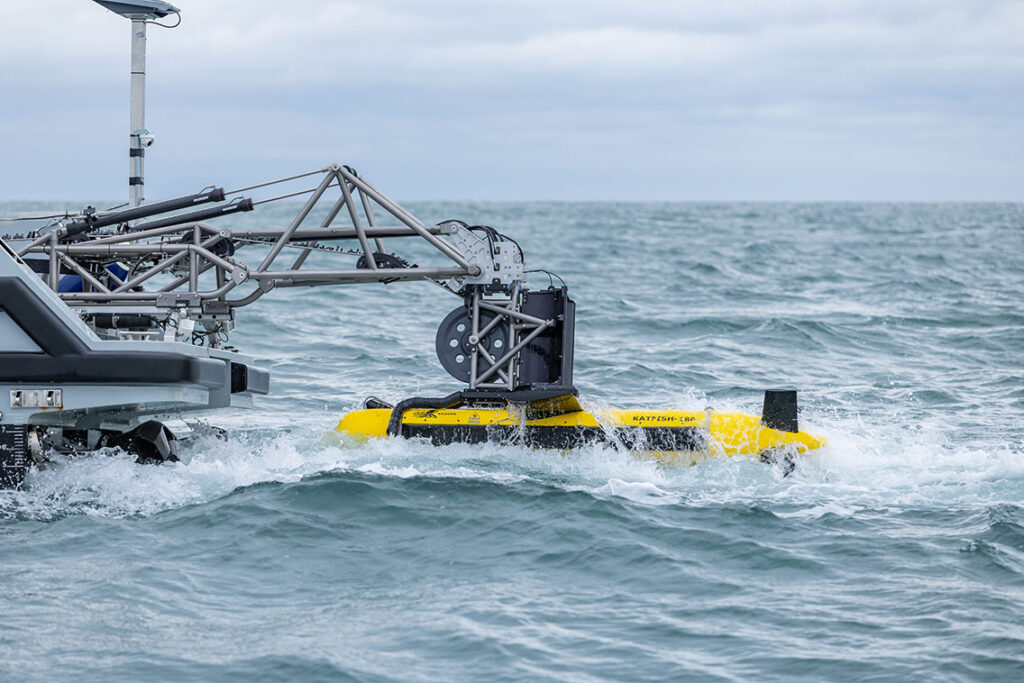
ST. JOHN’S, Newfoundland and Labrador — In a significant advancement for the future of maritime security and unmanned operations, Kraken Robotics Inc. and TKMS ATLAS UK have successfully demonstrated a fully integrated, autonomous survey system capable of streaming high-bandwidth data in real-time via satellite.
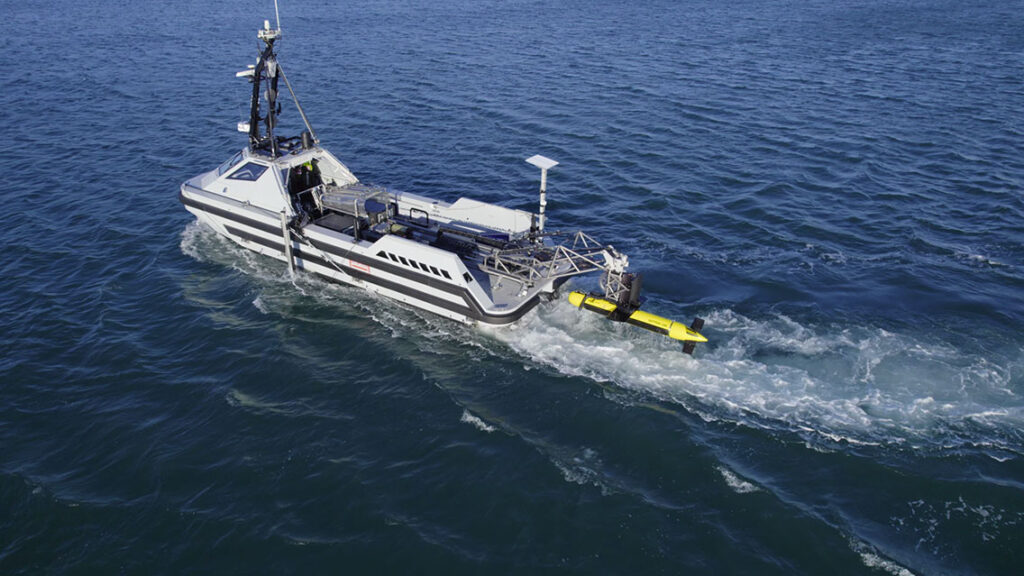
The demonstration, conducted off the coast of Portland, UK, for an audience of NATO navies, validated the integration of Kraken’s KATFISH towed Synthetic Aperture Sonar (SAS) and its Launch and Recovery System (USV-LARS) onto the ARCIMS Unmanned Surface Vessel (USV). While the robotics hardware represents a leap forward in engineering, the successful execution of the mission highlights the critical role of robust MILSATCOM in modern naval warfare.
The SATCOM Enabler For the defense satellite industry, the key takeaway from the Portland demonstration is the successful management of high-throughput data in a contested, moving environment. The ARCIMS USV, equipped with the KATFISH system, did not merely record data for later analysis; it utilized satellite communications to live-stream high-resolution SAS and bathymetric survey data directly to a shore-based command center.
This capability closes the tactical loop, allowing operators to classify contacts—such as sea mines or threats to critical underwater infrastructure—in real-time, despite being miles away from the sensor. The system successfully transmitted data with a resolution of 3 cm x 3 cm, a bandwidth-intensive requirement that stresses the limits of traditional maritime uplinks. The success of this data link proves that modern USVs can act as true extensions of the command center rather than isolated data-gathering nodes.
Operational Robustness
The tests were conducted in November 2025, with the vessels operating in sea state three. The ability to launch, tow, and recover a sonar body autonomously in rough waters, while maintaining a stable satellite link for Command and Control (C2), addresses two of the primary hurdles in naval autonomy: physical reliability and connection stability.
“With the surge in unmanned systems for defence, naval forces need the best technology available to protect national security,” said Greg Reid, President and CEO of Kraken Robotics. “With its ability to safely and autonomously launch and recover KATFISH from USVs, our USV-LARS allows small naval platforms to collect KATFISH’s high resolution synthetic aperture sonar (SAS) data, significantly increasing their capabilities and acting as force multipliers.“
System Specifications
The integrated solution combines several advanced technologies:
- The ARCIMS USV: An 11-meter vessel developed by ATLAS UK, providing the power and stability required for the mission.
- The KATFISH: An actively stabilized towfish capable of surveying at depths of up to 300 meters.
- The USV-LARS: An all-titanium launch and recovery system designed to minimize magnetic signature and weight, fitting seamlessly into the ARCIMS common deck interface.
Together, they form the industry’s first air-deployable, 300-meter depth-rated autonomous survey package.
Strategic Implications
The collaboration targets a growing urgency in the defense sector: the protection of Critical Underwater Infrastructure (CUI) and rapid Mine Countermeasures (MCM). By removing personnel from the minefield and utilizing USVs controlled via satellite, navies can drastically reduce risk to human life while increasing the tempo of operations.
The speed of integration was also a focal point of the announcement. Wesley Galliver, Head of Surface Ship Systems Division at TKMS ATLAS UK, noted, “Integrating ARCIMS with KATFISH and LARS in such a compressed timeframe sets a new benchmark for delivering operational capability to our customers. This achievement demonstrates what can be accomplished when innovation and collaboration come together.“
The entire mobilization, integration, and testing phase was completed in just two weeks, a timeline that suggests this “system of systems” is ready for rapid deployment in emerging conflict zones where speed and situational awareness are paramount.
As navies increasingly rely on distributed maritime operations, the demand for resilient, high-bandwidth satellite solutions to support platforms like the ARCIMS-KATFISH combination is expected to grow exponentially.
