

• Skip to primary navigation
  • Skip to main content
  • Skip to primary sidebar
  • Skip to secondary sidebar
  • Skip to footer
  • NEWS:
  • SatNews
  • SatMagazine
  • MilSatMagazine
  • SmallSat News
  • |     EVENTS:
  • SmallSat Symposium
  • Satellite Innovation
  • MilSat Symposium
  • SmallSat Europe

SatNews

Satellite Industry Intelligence Since 1983

Subscribe
  • LATEST
  • SatNews Events
  • Magazines
  • Calendar
  • Subscribe
  • Missions & Constellations
    • Exploration & Science Missions
    • In-Orbit Servicing & Orbital Operations
    • LEO Constellations
    • Mission Autonomy & Onboard Systems
    • Mission Deployments & Manifests
    • Navigation & PNT
    • SmallSat
    • Spacecraft & Payload Technology
    View All in Missions & Constellations →
    Amazon to Acquire Globalstar for $11.6 Billion to Fuel D2D ExpansionAmazon to Acquire Globalstar for $11.6 Billion to Fuel D2D Expansion
    SmallSat Europe Speaker Focus: Daniel Metzler, Isar AerospaceSmallSat Europe Speaker Focus: Daniel Metzler, Isar Aerospace
    Webb Observations Challenge Fundamental Mass LimitsWebb Observations Challenge Fundamental Mass Limits
    Dawn Aerospace Unveils “Loop” Refueling Network to Combat Orbital ObsolescenceDawn Aerospace Unveils “Loop” Refueling Network to Combat Orbital Obsolescence
  • Business
    • Contracts & Commercial Deals
    • Earnings & Financial Reporting
    • Events & Conferences
    • Funding & Venture Capital
    • Market Forecasts
    • Mergers & Acquisitions
    • Personnel Moves & Appointments
    View All in Business & Finance →
    Oklahoma Positions as Commercial Space Manufacturing Hub at Space SymposiumOklahoma Positions as Commercial Space Manufacturing Hub at Space Symposium
    Global Defense Leaders Convene as Space Symposium 41 Addresses Orbital SecurityGlobal Defense Leaders Convene as Space Symposium 41 Addresses Orbital Security
    SmallSat Europe Speaker Focus: Chris Quilty, Quilty SpaceSmallSat Europe Speaker Focus: Chris Quilty, Quilty Space
    “SpaceX and the biggest IPO in history”“SpaceX and the biggest IPO in history”
  • Defense
    • Counterspace & ASAT
    • Defense Budgets & Procurement
    • ISR & Reconnaissance
    • MILSATCOM
    • Missile Warning & Defense
    • National Security Programs
    • Space Domain Awareness
    View All in Military & Defense →
    General Atomics Completes Pre-Ship Review for Space Force Weather PayloadGeneral Atomics Completes Pre-Ship Review for Space Force Weather Payload
    NRL to Showcase Sovereign Space Capabilities at 41st Space SymposiumNRL to Showcase Sovereign Space Capabilities at 41st Space Symposium
    Northrop Grumman Minotaur IV Lofted USSF Tech Demonstration Payloads to OrbitNorthrop Grumman Minotaur IV Lofted USSF Tech Demonstration Payloads to Orbit
    The End of the VSAT Parts BinThe End of the VSAT Parts Bin
  • Gov
    • Export Controls & Compliance
    • International Space Agreements
    • National Space Policy
    • Space Law & Treaties
    • Space Sustainability & Debris Policy
    • Space Traffic Management / Debris Removal
    View All in Government & Regulation →
    FCC Modernizes Satellite Spectrum Rules to Unleash Next-Generation BroadbandFCC Modernizes Satellite Spectrum Rules to Unleash Next-Generation Broadband
    SmallSat Europe Speaker Focus: Daniel Bock, Morpheus SpaceSmallSat Europe Speaker Focus: Daniel Bock, Morpheus Space
    SmallSat Europe Speaker Focus: Dr. Ane Aanesland, ThrustMeSmallSat Europe Speaker Focus: Dr. Ane Aanesland, ThrustMe
    Isaacman’s Budget Math: How NASA Plans to Reach the Moon With a Quarter Less MoneyIsaacman’s Budget Math: How NASA Plans to Reach the Moon With a Quarter Less Money
  • Launch
    • Launch Providers
    • Launch Schedule & Calendars
    • Launch Sites & Infrastructure
    • Rocket Technology & Vehicles
    View All in Launch →
    Ensign-Bickford Hardware Supports Successful Artemis II Lunar MissionEnsign-Bickford Hardware Supports Successful Artemis II Lunar Mission
    China Accelerates Orbital Internet Deployment with Successful Smart Dragon-3 Sea LaunchChina Accelerates Orbital Internet Deployment with Successful Smart Dragon-3 Sea Launch
    What the SpaceX IPO Changes for Every Satellite OperatorWhat the SpaceX IPO Changes for Every Satellite Operator
    €30 million Financing for PLD Space’s Small Satellite Launcher€30 million Financing for PLD Space’s Small Satellite Launcher
  • Software
    • Autonomous Ground Operations
    • Data Processing & AI/ML
    • Digital Twins & Modeling
    • Ground Segment & Teleports
    • Mission Planning & Simulation
    • Space Systems Software Engineering
    • Spectrum & Licensing
    View All in Software Automation & Ground Systems →
    Cloudcomputing Targets 1.5M Identities in Spain and Finalizes Innovate IT AcquisitionCloudcomputing Targets 1.5M Identities in Spain and Finalizes Innovate IT Acquisition
    Archangel Lightworks Secures £10M Series A to Scale Optical Ground InfrastructureArchangel Lightworks Secures £10M Series A to Scale Optical Ground Infrastructure
    Keysight and Sateliot Win ESA and GSMA Foundry Challenge for 6G InnovationKeysight and Sateliot Win ESA and GSMA Foundry Challenge for 6G Innovation
    Automation and Agility: How SSC Space Go is Designed for the New Age of GroundAutomation and Agility: How SSC Space Go is Designed for the New Age of Ground
  • Services & Apps
    • Climate & Environmental Monitoring
    • Disaster Response & Security Mapping
    • Earth Observation & Imaging
    • Maritime & Aviation Satcom
    • Satellite Communications
    View All in Services & Applications →
    Kraken Robotics Integrates KATFISH Sonar on SEFINE RD-22 USV Following Multi-Naval DemonstrationsKraken Robotics Integrates KATFISH Sonar on SEFINE RD-22 USV Following Multi-Naval Demonstrations
    Astroscale Plans World-First Multi-Orbit Satellite Inspection MissionAstroscale Plans World-First Multi-Orbit Satellite Inspection Mission
    The Downlink Deficit: The Pentagon’s Optical Mesh Network and the Terrestrial BottleneckThe Downlink Deficit: The Pentagon’s Optical Mesh Network and the Terrestrial Bottleneck
    Cinemo Reimagines the Vehicle as a Software-Defined Entertainment HubCinemo Reimagines the Vehicle as a Software-Defined Entertainment Hub

SpaceX launches Europa Clipper, NASA’s largest spacecraft to “study an ocean world beyond Earth…mind blowing science”

October 14, 2024

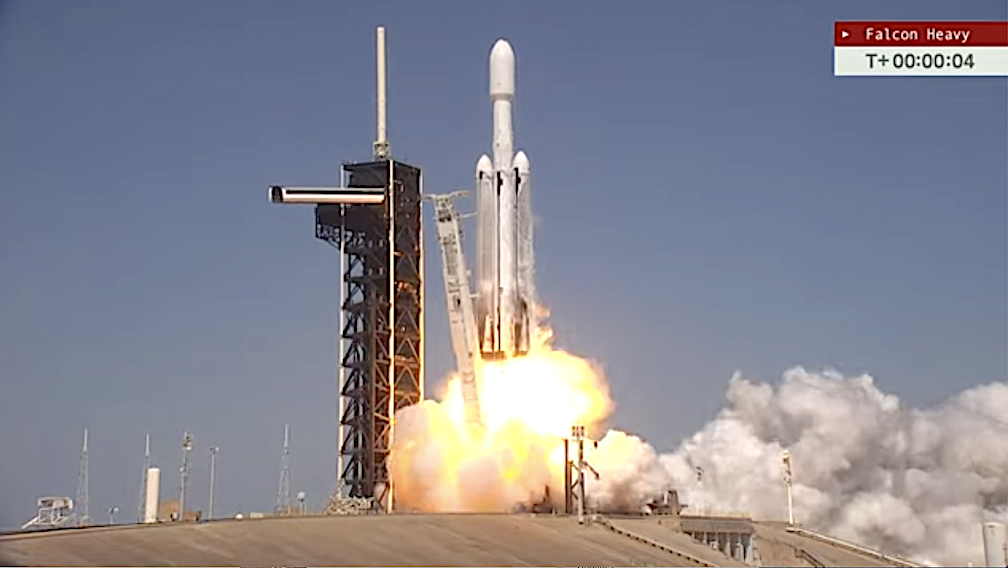
Launch of Europa Clipper captured by Satnews from SpaceX streaming video.

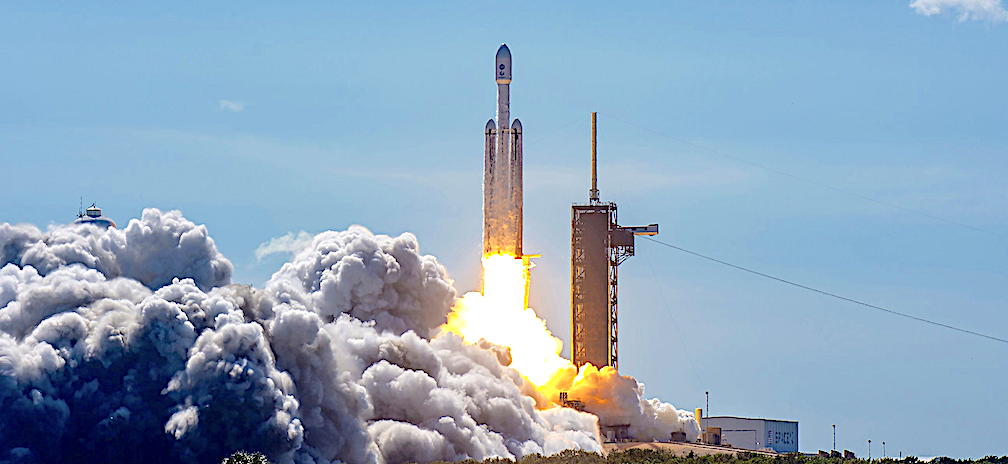
On Monday, October 14 at 12:06 p.m. ET Falcon Heavy launched NASA’s Europa Clipper mission from Launch Complex 39A (LC-39A) at NASA’s Kennedy Space Center in Florida.

This was the sixth and final flight for the first stage boosters supporting this mission, which previously launched NASA’s Psyche one year ago and other missions USSF-44, USSF-52, USSF-67, Hughes JUPITER 3.
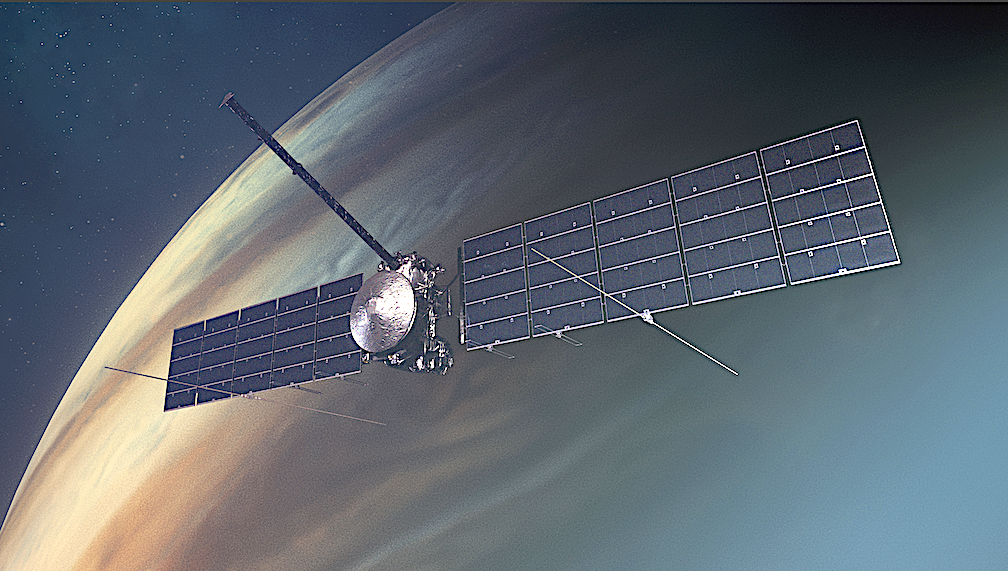
This artist’s concept depicts NASA’s Europa Clipper spacecraft in orbit around Jupiter. The mission is targeting an Oct. 10, 2024, launch.
NASA/JPL-Caltech

Europa Clipper is the largest spacecraft NASA has ever developed for a planetary mission with solar arrays spanning more than 100 feet (~30 meters) when deployed and weighing nearly 13,000 pounds (6,000 kilograms) at launch. Powered by 24 engines, Europa Clipper will make nearly 50 flybys of Jupiter’s icy moon Europa, surveying for conditions suitable to support life. Scientists predict a salty ocean lies beneath Europa’s icy surface which has more water than Earth’s oceans combined. It will take five years to reach Europa, with an anticipated arrival in 2030.

NASA’s Europa Clipper has embarked on its long voyage to Jupiter, where it will investigate Europa, a moon with an enormous subsurface ocean that may have conditions to support life. The spacecraft launched at 12:06 p.m. EDT Monday aboard a SpaceX Falcon Heavy rocket from Launch Pad 39A at NASA’s Kennedy Space Center in Florida.

NASA

The largest spacecraft NASA ever built for a mission headed to another planet, Europa Clipper also is the first NASA mission dedicated to studying an ocean world beyond Earth. The spacecraft will travel 1.8 billion miles (2.9 billion kilometers) on a trajectory that will leverage the power of gravity assists, first to Mars in four months and then back to Earth for another gravity assist flyby in 2026. After it begins orbiting Jupiter in April 2030, the spacecraft will fly past Europa 49 times.
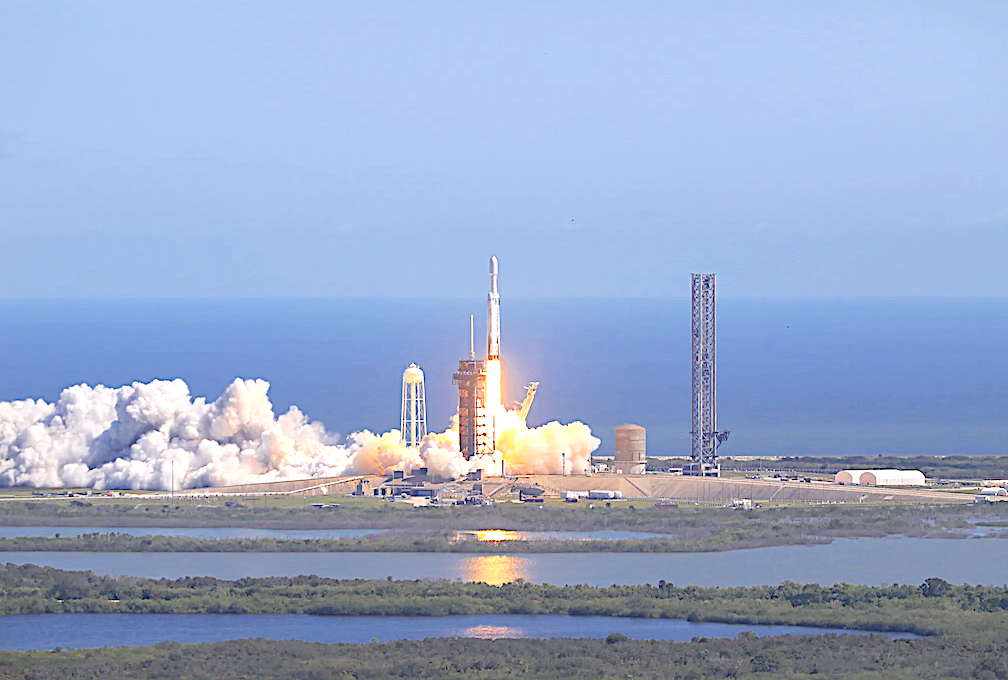
A SpaceX Falcon Heavy rocket carrying NASA’s Europa Clipper spacecraft lifts off from Launch Complex 39A at NASA’s Kennedy Space Center in Florida at 12:06 p.m. EDT on Monday, Oct. 14, 2024. After launch, the spacecraft plans to fly by Mars in February 2025, then back by Earth in December 2026, using the gravity of each planet to increase its momentum. With help of these “gravity assists,” Europa Clipper will achieve the velocity needed to reach Jupiter in April 2030.
Credit: NASA/Kim Shiflett

“Congratulations to our Europa Clipper team for beginning the first journey to an ocean world beyond Earth,” said NASA Administrator Bill Nelson. “NASA leads the world in exploration and discovery, and the Europa Clipper mission is no different. By exploring the unknown, Europa Clipper will help us better understand whether there is the potential for life not just within our solar system, but among the billions of moons and planets beyond our Sun.”

Approximately five minutes after liftoff, the rocket’s second stage fired up and the payload fairing, or the rocket’s nose cone, opened to reveal Europa Clipper. About an hour after launch, the spacecraft separated from the rocket. Ground controllers received a signal soon after, and two-way communication was established at 1:13 p.m. with NASA’s Deep Space Network facility in Canberra, Australia. Mission teams celebrated as initial telemetry reports showed Europa Clipper is in good health and operating as expected.

“We could not be more excited for the incredible and unprecedented science NASA’s Europa Clipper mission will deliver in the generations to come,” said Nicky Fox, associate administrator, Science Mission Directorate at NASA Headquarters in Washington. “Everything in NASA science is interconnected, and Europa Clipper’s scientific discoveries will build upon the legacy that our other missions exploring Jupiter — including Juno, Galileo, and Voyager — created in our search for habitable worlds beyond our home planet.”

The main goal of the mission is to determine whether Europa has conditions that could support life. Europa is about the size of our own Moon, but its interior is different. Information from NASA’s Galileo mission in the 1990s showed strong evidence that under Europa’s ice lies an enormous, salty ocean with more water than all of Earth’s oceans combined. Scientists also have found evidence that Europa may host organic compounds and energy sources under its surface.

If the mission determines Europa is habitable, it may mean there are more habitable worlds in our solar system and beyond than imagined.

“We’re ecstatic to send Europa Clipper on its way to explore a potentially habitable ocean world, thanks to our colleagues and partners who’ve worked so hard to get us to this day,” said Laurie Leshin, director, NASA’s Jet Propulsion Laboratory in Southern California. “Europa Clipper will undoubtedly deliver mind-blowing science. While always bittersweet to send something we’ve labored over for years off on its long journey, we know this remarkable team and spacecraft will expand our knowledge of our solar system and inspire future exploration.”
In 2031, the spacecraft will begin conducting its science-dedicated flybys of Europa. Coming as close as 16 miles (25 kilometers) to the surface, Europa Clipper is equipped with nine science instruments and a gravity experiment, including an ice-penetrating radar, cameras, and a thermal instrument to look for areas of warmer ice and any recent eruptions of water. As the most sophisticated suite of science instruments NASA has ever sent to Jupiter, they will work in concert to learn more about the moon’s icy shell, thin atmosphere, and deep interior.

To power those instruments in the faint sunlight that reaches Jupiter, Europa Clipper also carries the largest solar arrays NASA has ever used for an interplanetary mission. With arrays extended, the spacecraft spans 100 feet (30.5 meters) from end to end. With propellant loaded, it weighs about 13,000 pounds (5,900 kilograms).

In all, more than 4,000 people have contributed to Europa Clipper mission since it was formally approved in 2015.

“As Europa Clipper embarks on its journey, I’ll be thinking about the countless hours of dedication, innovation, and teamwork that made this moment possible,” said Jordan Evans, project manager, NASA JPL. “This launch isn’t just the next chapter in our exploration of the solar system; it’s a leap toward uncovering the mysteries of another ocean world, driven by our shared curiosity and continued search to answer the question, ‘are we alone?’”

More About Europa Clipper

Europa Clipper’s three main science objectives are to determine the thickness of the moon’s icy shell and its interactions with the ocean below, to investigate its composition, and to characterize its geology. The mission’s detailed exploration of Europa will help scientists better understand the astrobiological potential for habitable worlds beyond our planet.

Managed by Caltech in Pasadena, California, NASA JPL leads the development of the Europa Clipper mission in partnership with the Johns Hopkins Applied Physics Laboratory (APL) in Laurel, Maryland, for NASA’s Science Mission Directorate in Washington. The main spacecraft body was designed by APL in collaboration with NASA JPL and NASA’s Goddard Space Flight Center in Greenbelt, Maryland, NASA’s Marshall Space Flight Center in Huntsville, Alabama, and NASA’s Langley Research Center in Hampton, Virginia. The Planetary Missions Program Office at Marshall executes program management of the Europa Clipper mission.

NASA’s Launch Services Program, based at NASA Kennedy, managed the launch service for the Europa Clipper spacecraft.

Learn more about NASA’s Europa Clipper mission here:

Filed Under: Exploration & Science Missions, Government & Regulation Tagged With: Featured

Primary Sidebar

Coverage

  • Missions & Constellations
  • Business & Finance
  • Military & Defense
  • Launch
  • Software Automation & Ground Systems
  • Government & Regulation
  • Services & Applications

Most Read Stories

  • SpaceX Loses Contact With Starlink Satellite
  • L3Harris Unveils XL-300P: The First P25 Handheld with 5G and Satellite Direct-to-Device Connectivity
  • Rocket Lab Emerging as Potential Bus Provider for 2,800-Satellite Equatys Constellation
  • Rheinmetall Walked Away. Germany Should Take the Hint.
  • SpaceX Accelerates Record-Breaking IPO Following Trillion-Dollar xAI Merger

Secondary Sidebar

Footer


Satnews is a leading provider of satellite news, events, publications, research and other satellite industry information in both commercial and military enterprises worldwide.

Stories By Category

  • Business & Finance
  • Government & Regulation
  • Launch
  • Military & Defense
  • Missions & Constellations
  • Services & Applications
  • Software Automation & Ground Systems
  • Spectrum & Licensing
  • Startups & NewSpace Business

About Us

  • Leadership & Editorial Team
  • SatNews History
  • Free Satnews Subscription
  • SatNews Events
  • Magazines

Navigation

  • Latest Stories
  • Magazines
  • Events
  • Contact
  • Cookie & Privacy Policy for Satnews

We use cookies to ensure that we give you the best experience on our website. If you continue to use this site we will assume that you are happy with it.
x
Sign up Now (For Free)
Access daily or weekly satellite news updates covering all aspects of the commercial and military satellite industry.
Invalid email address
Notify Me Regarding ( At least one ):
We value your privacy and will not sell or share your email or other information with any other company. You may also unsubscribe at anytime.

Click Here to see our full privacy policy.
Thanks for subscribing!