

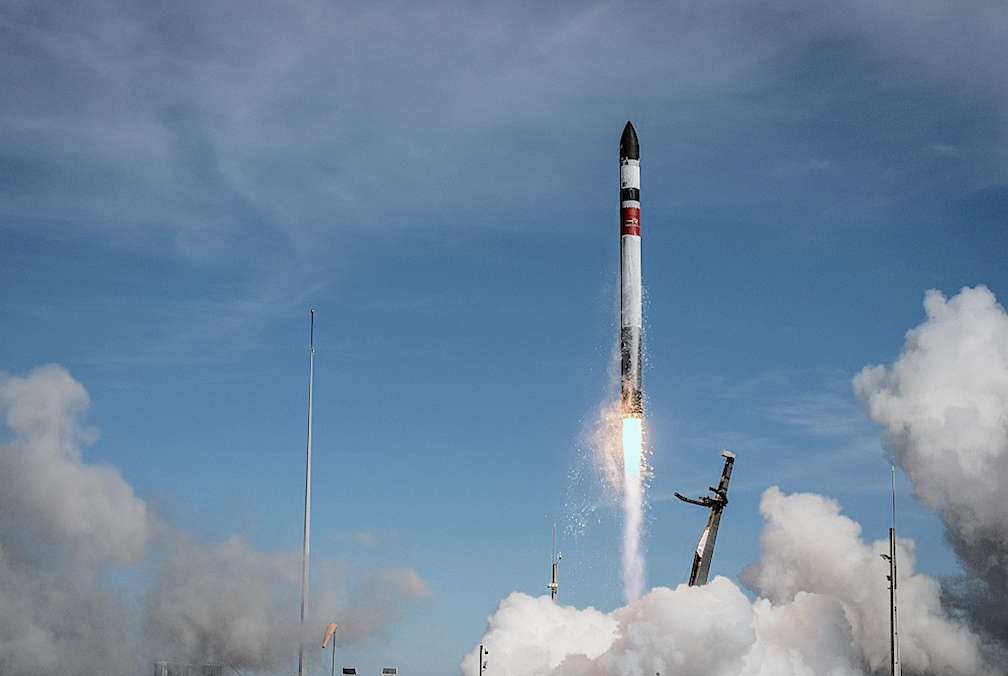

Rocket Lab USA, Inc. (Nasdaq: RKLB) , a global leader in launch services and space systems, today deployed two satellites to two different orbits approximately 500km apart on its 47th Electron mission.
The ‘Beginning Of The Swarm’ (B.T.S) mission lifted-off from Rocket Lab Launch Complex 1 in Mahia, New Zealand at 10:32 NZST on April 24th, 2024 with payloads for the Korea Advanced Institute of Science and Technology (KAIST) and NASA. The primary payload, NEONSAT-1 by KAIST, was first deployed by Electron to a 520km circular Earth orbit before Electron deployed NASA’s Advanced Composite Solar Sail System to a higher circular orbit at 1,000km.
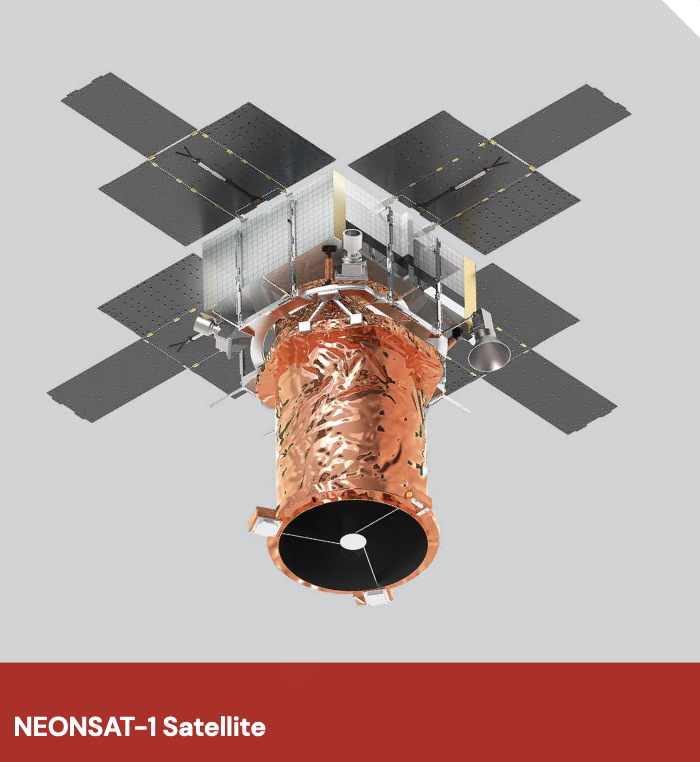
NEONSAT-1 will perform Earth-observation of the Korean Peninsula for KAIST, which will then pair the satellite’s data with artificial intelligence to monitor for natural disasters in the region. NEONSAT-1 is the first of 11 satellites for KAIST’s planned constellation to image the Korean Peninsula several times daily.
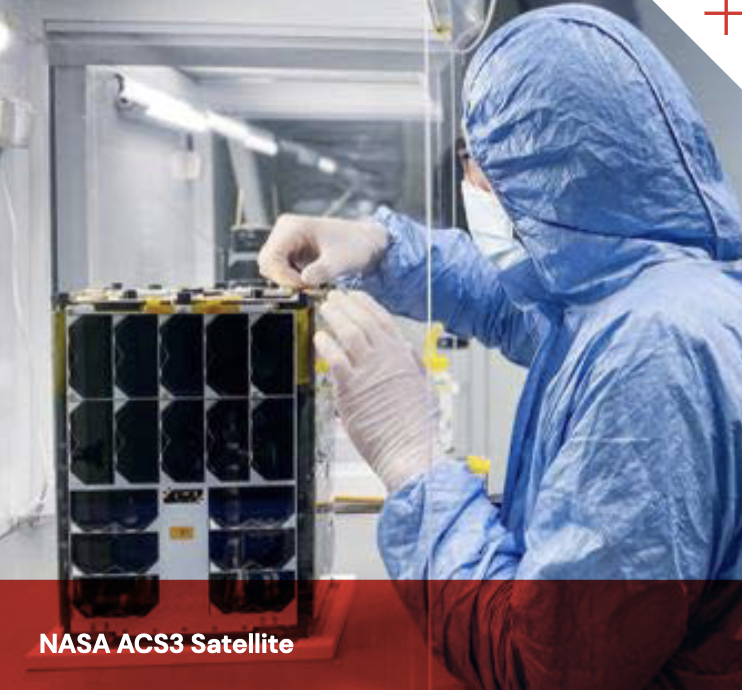
The second mission deployed today was NASA’s Advanced Composite Solar Sail System, which is a technology demonstration of new materials that use sunlight to propel a spacecraft. Much like a sailboat is powered by wind pushing against a sail, solar sails employ the pressure of sunlight for propulsion to move around. This mission plans to test how well new composite booms unfurl the sail from the spacecraft – which is about the size of a toaster – to an area about the size of a small apartment. Data from this mission will be used for designing future larger-scale composite solar sail systems for space weather early warning satellites, asteroid and other small body reconnaissance missions, and missions to observe the polar regions of the Sun.
The capability to deploy two satellites more than 500km apart on the same launch is enabled by Electron’s Kick Stage, a small stage with engine relight capability to enable last-mile delivery. After deploying NEONSAT-1, Electron’s Kick Stage completed multiple in-space burns of its Curie engine to raise its apogee and circularize its orbit before deploying the Advanced Composite Solar Sail System spacecraft. The Kick Stage then completed a [fourth] and final engine light to perform a deorbit maneuver that returned the stage closer to Earth to speed up its eventual deorbit, helping to reduce long term orbital debris.
Today’s successful mission was Rocket Lab’s fifth launch of 2024, continuing Electron’s streak as the United States’ second-most frequently launched rocket annually.
Details of Rocket Lab’s next Electron mission will be announced shortly
Rocket Lab’s ‘Beginning Of The Swarm’ mission launch window is open and ready for business

All is ready for the window of opportunity to occur during a 14-day launch window that opens on April 24th in order to launch Rocket Lab’s Beginning of the Swarm mission for South Korea and NASA. Rocket Lab Launch Complex 1 in Mahia, New Zealand is the site in which the Electron will carry two satellites for two separate customers: NEONSAT-1, an Earth observation satellite for the Satellite Technology Research Center (SaTReC) at the Korea Advanced Institute of Science and Technology (KAIST), and NASA’s Advanced Composite Solar Sail System (ACS3).

Rocket Lab updates ‘Beginning Of The Swarm’ mission for Korea’s KAIST and NASA’s ACS 3
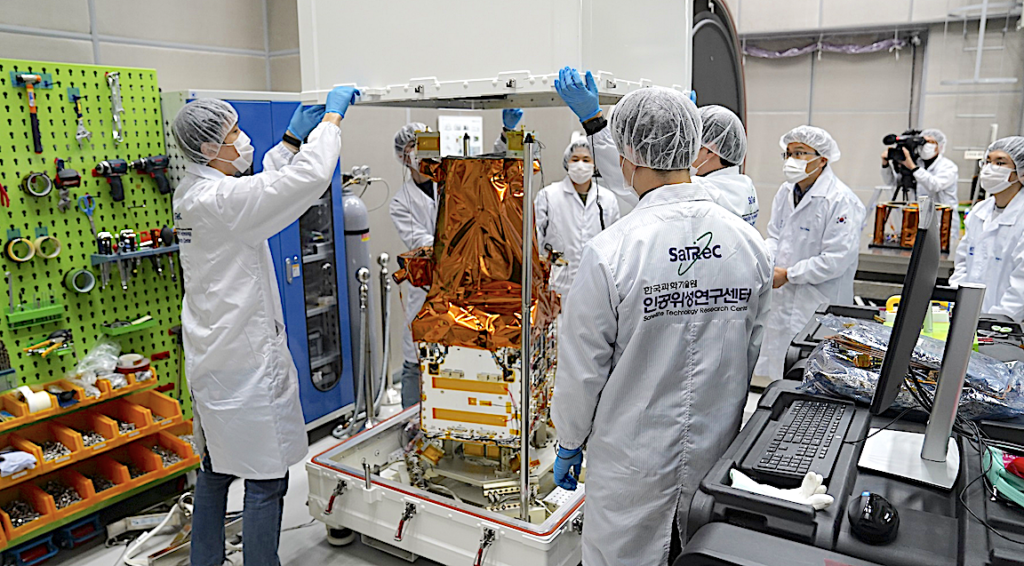
Rocket Lab USA, Inc. (Nasdaq: RKLB) has set the launch window for its next Electron launch.
The ‘Beginning Of The Swarm’ mission is scheduled to launch from Rocket Lab Launch Complex 1 in Mahia, New Zealand during a 14-day launch window that opens on April 24th. Electron will carry two satellites for two separate customers: NEONSAT-1, an Earth observation satellite for the Satellite Technology Research Center (SaTReC) at the Korea Advanced Institute of Science and Technology (KAIST), and NASA’s Advanced Composite Solar Sail System (ACS3).
The primary payload for this mission, NEONSAT-1, is an Earth observation satellite with a high-resolution optical camera designed to monitor for natural disasters along the Korean Peninsula by pairing its images with artificial intelligence. NEONSAT-1 is the first satellite developed under the NEONSAT program by SaTReC and KAIST, Korea’s leading university in science and technology, which developed and operated Korea’s very first satellite KITSAT-1 more than 30 years ago. Other NEONSAT satellites are planned to be launched in 2026 and 2027 to build out the NEONSAT constellation. The program is a collaboration across multiple Korean academic, industry, and research institutions including SaTReC in KAIST, which is leading the program’s system design and engineering; the Satrec Initiative, a Korean satellite manufacturer that has successfully developed seven previous remote sensing satellites for low Earth orbit; and the Korea Aerospace Research Institute (KARI), which is managing the mission’s ground segments and technology supervision for the NEONSAT program. NEONSAT is funded by the Koren government’s Ministry of Science and ICT (MSIT).
NASA’s ACS3 is a technology demonstration of new materials and deployable structures for solar sail propulsion systems that use sunlight to propel the spacecraft. Much like a sailboat is powered by wind pushing against a sail, solar sails employ the pressure of sunlight for propulsion, eliminating the need for conventional rocket propellant. The mission plans to test the deployment of new composite booms that will unfurl the solar sail to measure approximately 30 feet per side, or about the size of a small apartment in total. Flight data obtained during the demonstration will be used for designing future larger-scale composite solar sail systems for space weather early warning satellites, asteroid and other small body reconnaissance missions, and missions to observe the polar regions of the sun. The ACS3 was designed and built at NASA’s Langley Research Center in Hampton, Virginia, and the technology demonstration is managed and funded by the Small Spacecraft Technology program at and with NASA’s Ames Research Center in Silicon Valley. NASA’s Science Mission Directorate, interested in larger solar sail missions in the future, is funding an extended operations component to execute a series of maneuvers to raise and lower the spacecraft’s orbit, demonstrating the practicality of solar sailing.
The capability of Electron’s Kick Stage to perform multiple engine burns in space and deploy individual satellites to unique orbits is critical to this mission. The Kick Stage will first ignite its Curie engine to deploy NEONSAT-1 to its target 520km circular Earth orbit. After the payload’s separation, it will ignite its Curie engine again to perform an apogee raise to 1,000km. Once in this phasing orbit, the Curie will ignite a third time to circularise before deploying the solar sail demonstration spacecraft. The Kick Stage will then ignite Curie a fourth and final time to perform a deorbit burn that returns the Kick Stage closer to Earth, speeding up its eventual deorbit and removal from space to support a more sustainable space environment. Rocket Lab has demonstrated similar orbit raises, inclination changes, and deorbit maneuvers across previous Electron missions and most recently with its successful spacecraft re-entry for Varda on February 21, 2024.
‘Beginning Of The Swarm’ will be Rocket Lab’s fifth mission of 2024 and the 47th Electron launch overall.
‘Beginning Of The Swarm’ details:
- Launch window: opens no-earlier-than April 24, 2024.
- Customers: The Korea Advanced Institute of Science and Technology (KAIST) and NASA.
- Satellites: NEONSAT-1 for SaTReC/KAIST and the Advanced Composite Solar Sail System (ACS3) for NASA.
- Target orbits: NEONSAT-1 to 520km circular Earth orbit, ACS3 to 1,000km circular Earth orbit.
- Launch broadcast: The launch will broadcast live at www.rocketlabusa.com/live-stream
Rocket Lab schedules Electron launch Beginning Of The Swarm with NASA’s ACS3 and NEONSAT-1
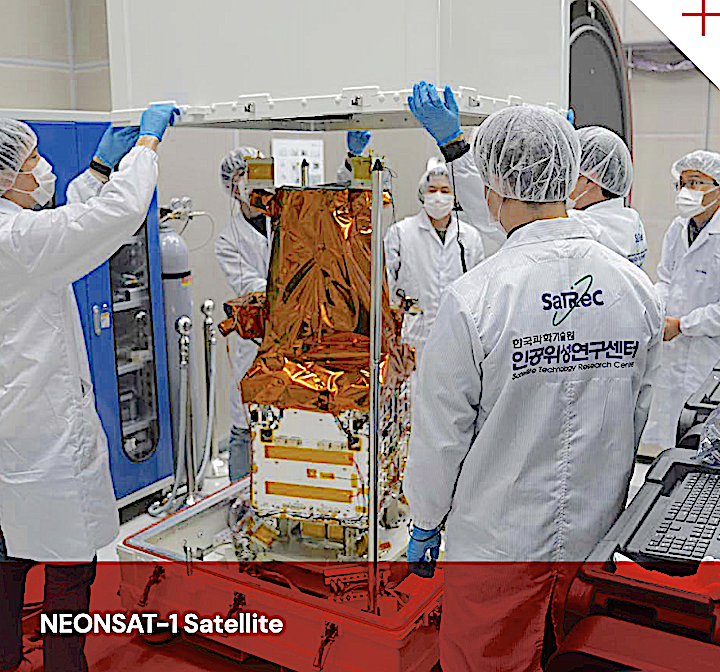
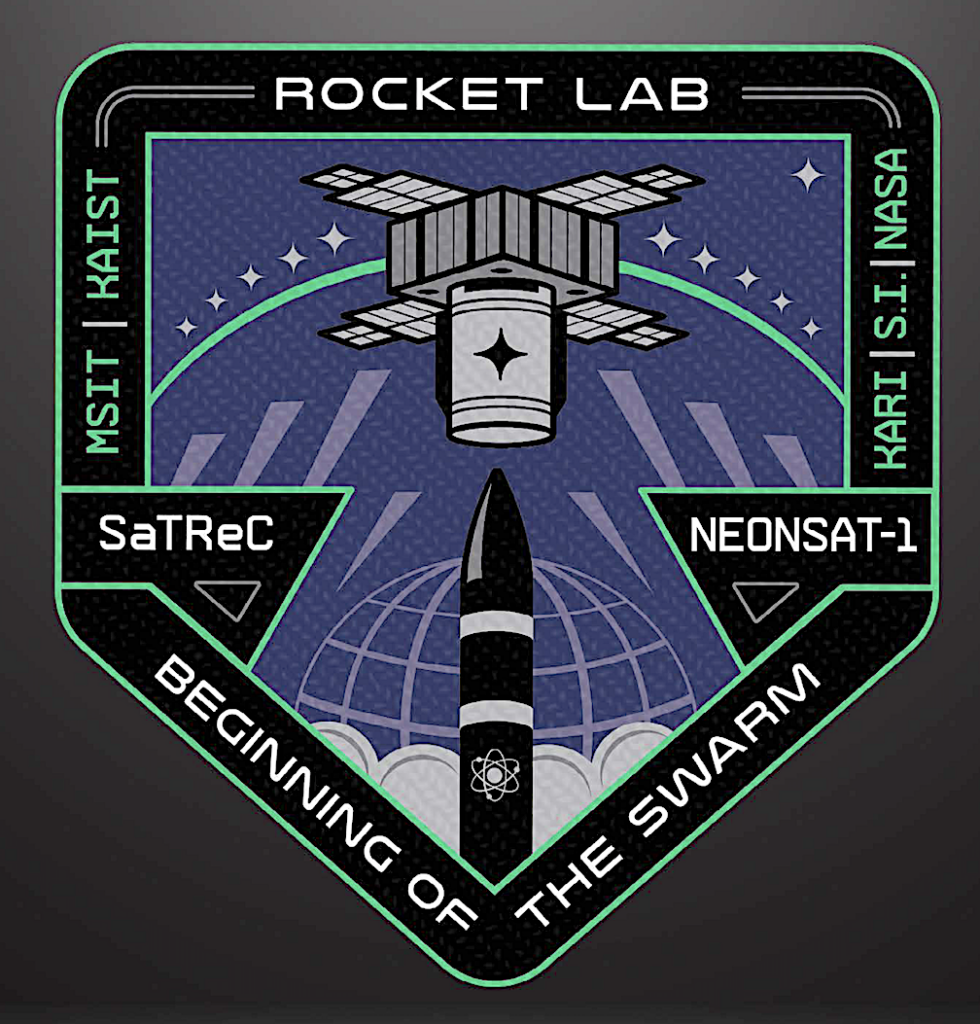
The ‘Beginning Of The Swarm’ mission is scheduled to launch from Rocket Lab Launch Complex 1 in Mahia, New Zealand during a 14-day launch window that opens on April 24th. Electron will carry two satellites for two separate customers: NEONSAT-1, an Earth observation satellite for the Satellite Technology Research Center (SaTReC) at the Korea Advanced Institute of Science and Technology (KAIST), and NASA’s Advanced Composite Solar Sail System (ACS3).
The primary payload for this mission, NEONSAT-1, is an Earth observation satellite with a high-resolution optical camera designed to monitor for natural disasters along the Korean Peninsula by pairing its images with artificial intelligence.
NEONSAT-1 is the first satellite developed under the NEONSAT program by SaTReC and KAIST, Korea’s leading university in science and technology, which developed and operated Korea’s very first satellite KITSAT-1 more than 30 years ago. Other NEONSAT satellites are planned to be launched in 2026 and 2027 to build out the NEONSAT constellation.
The secondary payload is NASA’s ACS3, a technology demonstration of new materials and deployable structures for solar sail propulsion systems that use sunlight to propel the spacecraft. Much like a sailboat is powered by wind pushing against a sail, solar sails employ the pressure of sunlight for propulsion, eliminating the need for conventional rocket propellant.
The mission plans to test the deployment of new composite booms that will unfurl the solar sail to measure approximately 30 feet per side, or about the size of a small apartment in total. Flight data obtained during the demonstration will be used for designing future larger-scale composite solar sail systems for space weather early warning satellites, asteroid and other small body reconnaissance missions, and missions to observe the polar regions of the sun.
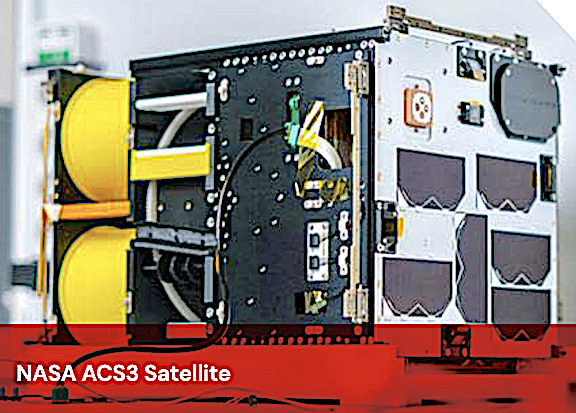
NASA’s Advanced Composite Solar Sail System (ACS3) is a technology demonstration mission tasked with deploying a composite boom solar sail.
NeonSat-1 is a high-resolution optical satellite by South Korea’s KAIST that will be deployed as a technology demonstration for a planned future Earth observation constellation.
