

• Skip to primary navigation
  • Skip to main content
  • Skip to primary sidebar
  • Skip to secondary sidebar
  • Skip to footer
  • NEWS:
  • SatNews
  • SatMagazine
  • MilSatMagazine
  • SmallSat News
  • |     EVENTS:
  • SmallSat Symposium
  • Satellite Innovation
  • MilSat Symposium
  • SmallSat Europe

SatNews

Satellite Industry Intelligence Since 1983

Subscribe
  • LATEST
  • SatNews Events
  • Magazines
  • Calendar
  • Subscribe
  • Missions & Constellations
    • Exploration & Science Missions
    • In-Orbit Servicing & Orbital Operations
    • LEO Constellations
    • Mission Autonomy & Onboard Systems
    • Mission Deployments & Manifests
    • Navigation & PNT
    • SmallSat
    • Spacecraft & Payload Technology
    View All in Missions & Constellations →
    NASA Shuts Off Instrument on Voyager 1 to Extend Interstellar MissionNASA Shuts Off Instrument on Voyager 1 to Extend Interstellar Mission
    Starlink Outages Disrupt Navy Drone Tests as Pentagon Dependency GrowsStarlink Outages Disrupt Navy Drone Tests as Pentagon Dependency Grows
    Iridium Unveils Role in Artemis II and Next-Gen PNT at Space Symposium 2026Iridium Unveils Role in Artemis II and Next-Gen PNT at Space Symposium 2026
    Boeing and Millennium Unveil Resolute Mid-Class Satellite PlatformBoeing and Millennium Unveil Resolute Mid-Class Satellite Platform
  • Business
    • Contracts & Commercial Deals
    • Earnings & Financial Reporting
    • Events & Conferences
    • Funding & Venture Capital
    • Market Forecasts
    • Mergers & Acquisitions
    • Personnel Moves & Appointments
    View All in Business & Finance →
    SmallSat Europe Speaker Focus: Carsten Drachmann, GomSpaceSmallSat Europe Speaker Focus: Carsten Drachmann, GomSpace
    Meink: Space Force Programs Ready to Execute Once FY27 Budget LandsMeink: Space Force Programs Ready to Execute Once FY27 Budget Lands
    SDA’s Sandhoo: Tranche 1 Launches Resume in May or JuneSDA’s Sandhoo: Tranche 1 Launches Resume in May or June
    Gen. Stephen Whiting: First USSPACECOM Operational Staff Arrive at Redstone This WeekGen. Stephen Whiting: First USSPACECOM Operational Staff Arrive at Redstone This Week
  • Defense
    • Counterspace & ASAT
    • Defense Budgets & Procurement
    • ISR & Reconnaissance
    • MILSATCOM
    • Missile Warning & Defense
    • National Security Programs
    • Space Domain Awareness
    View All in Military & Defense →
    USSF Finalizes GPS III Constellation with Successful SV-10 DeploymentUSSF Finalizes GPS III Constellation with Successful SV-10 Deployment
    Saltzman Rolls Out Space Force Objective Force, Flags CR as Top RiskSaltzman Rolls Out Space Force Objective Force, Flags CR as Top Risk
    GMV Secures Lead Role in Seven 2025 European Defence Fund InitiativesGMV Secures Lead Role in Seven 2025 European Defence Fund Initiatives
    SmallSat Europe Speaker Focus: Gen. Michel Friedling, Look Up SpaceSmallSat Europe Speaker Focus: Gen. Michel Friedling, Look Up Space
  • Gov
    • Export Controls & Compliance
    • International Space Agreements
    • National Space Policy
    • Space Law & Treaties
    • Space Sustainability & Debris Policy
    • Space Traffic Management / Debris Removal
    View All in Government & Regulation →
    SmallSat Europe Speaker Focus: Col. Marcin Mazur, Polish Space AgencySmallSat Europe Speaker Focus: Col. Marcin Mazur, Polish Space Agency
    SmallSat Europe Speaker Focus: Chris Quilty, Quilty SpaceSmallSat Europe Speaker Focus: Chris Quilty, Quilty Space
    NRL to Showcase Sovereign Space Capabilities at 41st Space SymposiumNRL to Showcase Sovereign Space Capabilities at 41st Space Symposium
    FCC Modernizes Satellite Spectrum Rules to Unleash Next-Generation BroadbandFCC Modernizes Satellite Spectrum Rules to Unleash Next-Generation Broadband
  • Launch
    • Launch Providers
    • Launch Schedule & Calendars
    • Launch Sites & Infrastructure
    • Rocket Technology & Vehicles
    View All in Launch →
    Blue Origin Achieves First Booster Reuse but Satellite Enters Off-Nominal OrbitBlue Origin Achieves First Booster Reuse but Satellite Enters Off-Nominal Orbit
    Ensign-Bickford Hardware Supports Successful Artemis II Lunar MissionEnsign-Bickford Hardware Supports Successful Artemis II Lunar Mission
    China Accelerates Orbital Internet Deployment with Successful Smart Dragon-3 Sea LaunchChina Accelerates Orbital Internet Deployment with Successful Smart Dragon-3 Sea Launch
    What the SpaceX IPO Changes for Every Satellite OperatorWhat the SpaceX IPO Changes for Every Satellite Operator
  • Software
    • Autonomous Ground Operations
    • Data Processing & AI/ML
    • Digital Twins & Modeling
    • Ground Segment & Teleports
    • Mission Planning & Simulation
    • Space Systems Software Engineering
    • Spectrum & Licensing
    View All in Software Automation & Ground Systems →
    RF-Design Launches FiberLink CompactLine FCLR1811S4 for Ground Segment OptimizationRF-Design Launches FiberLink CompactLine FCLR1811S4 for Ground Segment Optimization
    Sat-Lite Technologies adds  Richard Rader to Spearhead Sales ExpansionSat-Lite Technologies adds Richard Rader to Spearhead Sales Expansion
    Blue Origin Unveils Project Quartz Global Ground Station NetworkBlue Origin Unveils Project Quartz Global Ground Station Network
    Cloudcomputing Targets 1.5M Identities in Spain and Finalizes Innovate IT AcquisitionCloudcomputing Targets 1.5M Identities in Spain and Finalizes Innovate IT Acquisition
  • Services & Apps
    • Climate & Environmental Monitoring
    • Disaster Response & Security Mapping
    • Earth Observation & Imaging
    • Maritime & Aviation Satcom
    • Satellite Communications
    View All in Services & Applications →
    ISS National Lab Launches 2026 Orbital Edge Accelerator to Scale Space-Based R&DISS National Lab Launches 2026 Orbital Edge Accelerator to Scale Space-Based R&D
    Kymeta Chief Scientist Discusses Metamaterial Antenna Evolution and Orbital SustainabilityKymeta Chief Scientist Discusses Metamaterial Antenna Evolution and Orbital Sustainability
    SmallSat Europe Speaker Focus: Martin Langer, OroraTechSmallSat Europe Speaker Focus: Martin Langer, OroraTech
    SmallSat Europe Speaker Focus: Jaume Sanpera, SateliotSmallSat Europe Speaker Focus: Jaume Sanpera, Sateliot

The main body of NASA’s Europa Clipper spacecraft is completed

June 8, 2022

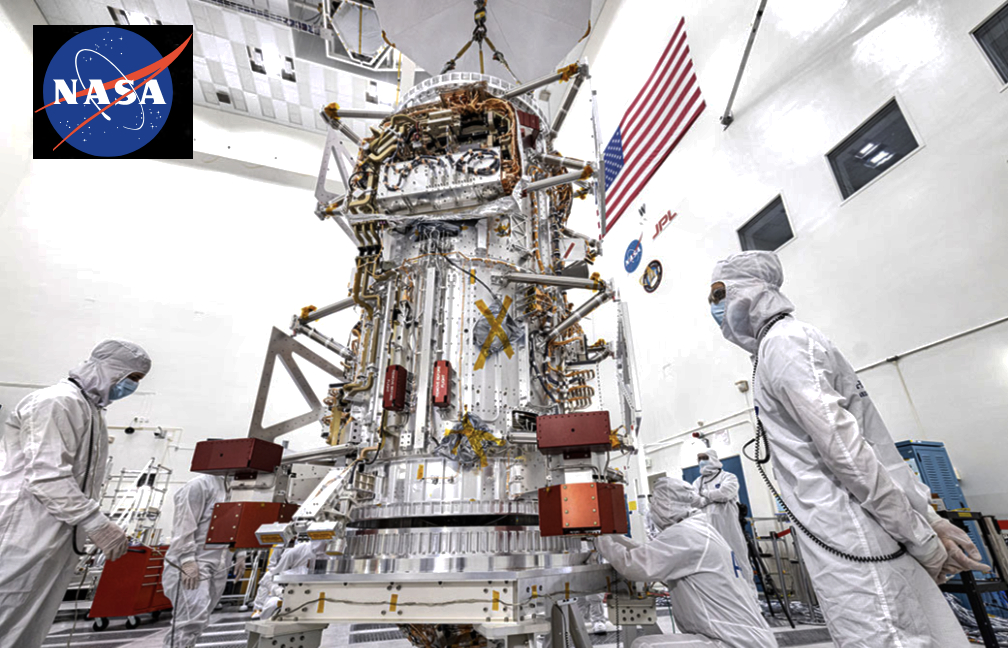
Engineers and technicians inspect the main body of NASA’s Europa Clipper spacecraft Engineers and technicians inspect the main body of NASA’s Europa Clipper spacecraft after it was built and delivered by the Johns Hopkins Applied Physics Laboratory (APL) in Laurel, Maryland, to the agency’s Jet Propulsion Laboratory in Southern California in early June. Photo is courtesy of NASA/JPL-Caltech/Johns Hopkins APL/Ed Whitman

The agency’s mission to explore Jupiter’s icy moon takes a big step forward as engineers deliver a major component of the spacecraft.

The main body of NASA’s Europa Clipper spacecraft has been delivered to the agency’s Jet Propulsion Laboratory in Southern California. Over the next two years there, engineers and technicians will finish assembling the craft by hand before testing it to make sure it can withstand the journey to Jupiter’s icy moon Europa.
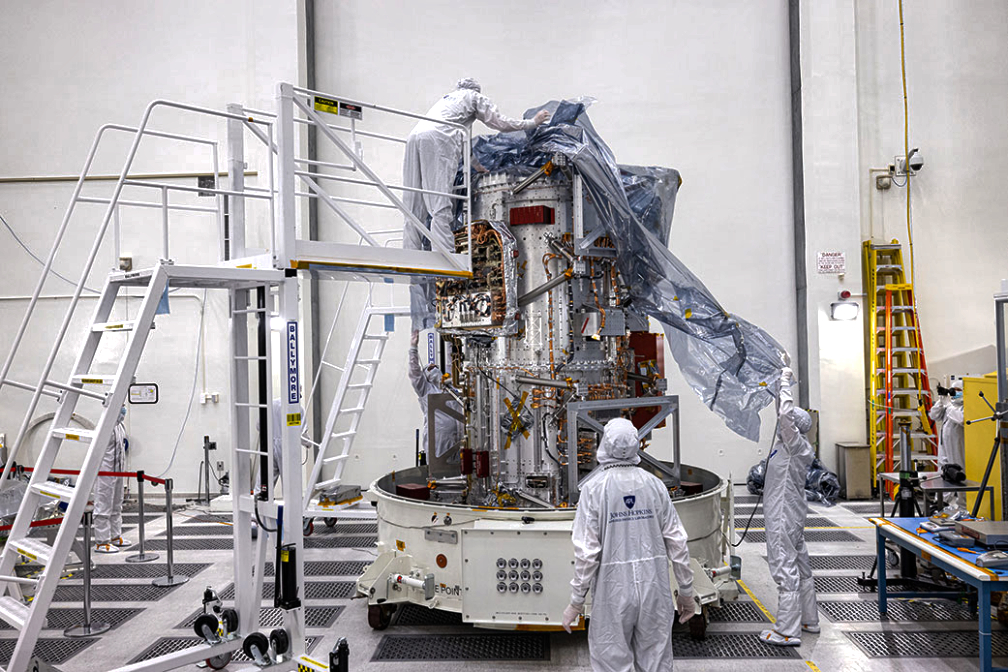
Engineers and technicians unwrap and inspect the main body of NASA’s Europa Clipper spacecraft after it was built and delivered by the Johns Hopkins Applied Physics Laboratory (APL) in Laurel, Maryland, to the agency’s Jet Propulsion Laboratory in Southern California in early June. Photo is courtesy of NASA/JPL-Caltech/Johns Hopkins APL/Ed Whitman

The spacecraft body is the mission’s workhorse. Standing 10 feet (3 meters) tall and 5 feet (1.5 meters) wide, it’s an aluminum cylinder integrated with electronics, radios, thermal loop tubing, cabling, and the propulsion system. With its solar arrays and other deployable equipment stowed for launch, Europa Clipper will be as large as an SUV; when extended, the solar arrays make the craft the size of a basketball court. This is the largest NASA spacecraft ever developed for a planetary mission.

“It’s an exciting time for the whole project team and a huge milestone,” said Jordan Evans, the mission’s project manager at JPL. “This delivery brings us one step closer to launch and the Europa Clipper science investigation.”
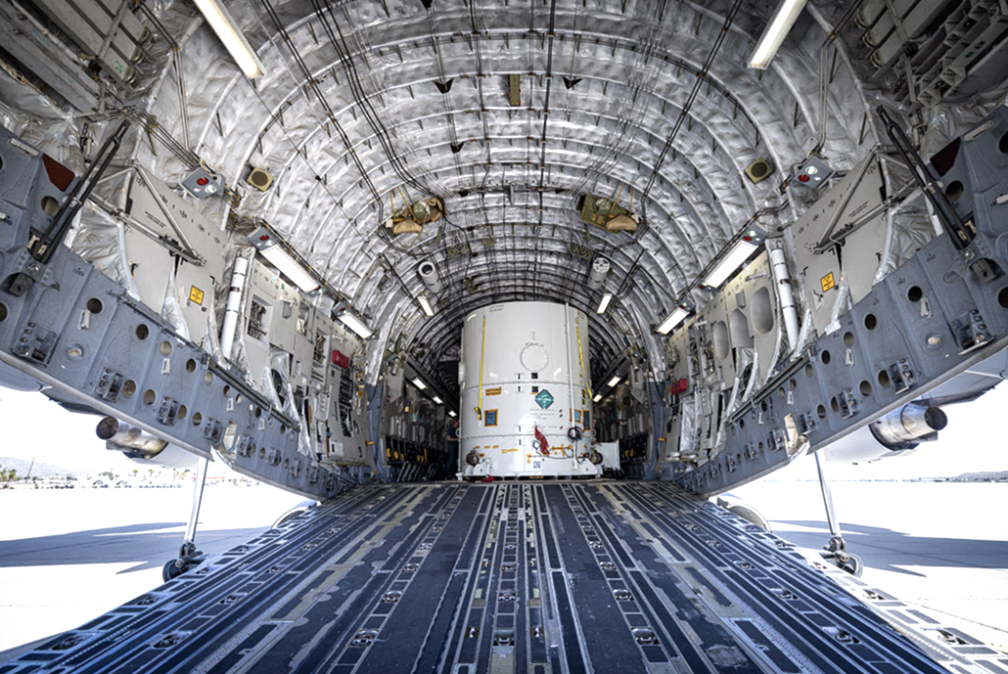
Main body of NASA’s Europa Clipper spacecraft The main body of NASA’s Europa Clipper spacecraft is seen in its shipping container, just after arriving aboard a C-17 cargo plane at March Air Reserve Base in Riverside County, California. Photo is courtesy of NASA/JPL-Caltech/Johns Hopkins APL/Ed Whitman.

Set to launch in October 2024, Europa Clipper will conduct nearly 50 flybys of Europa, which scientists are confident harbors an internal ocean containing twice as much water as Earth’s oceans combined. Plus, the ocean may currently have conditions suitable for supporting life. The spacecraft’s nine science instruments will gather data on Europa’s atmosphere, surface, and interior – information that scientists will use to gauge the depth and salinity of the ocean, the thickness of the ice crust, and potential plumes that may be venting subsurface water into space.
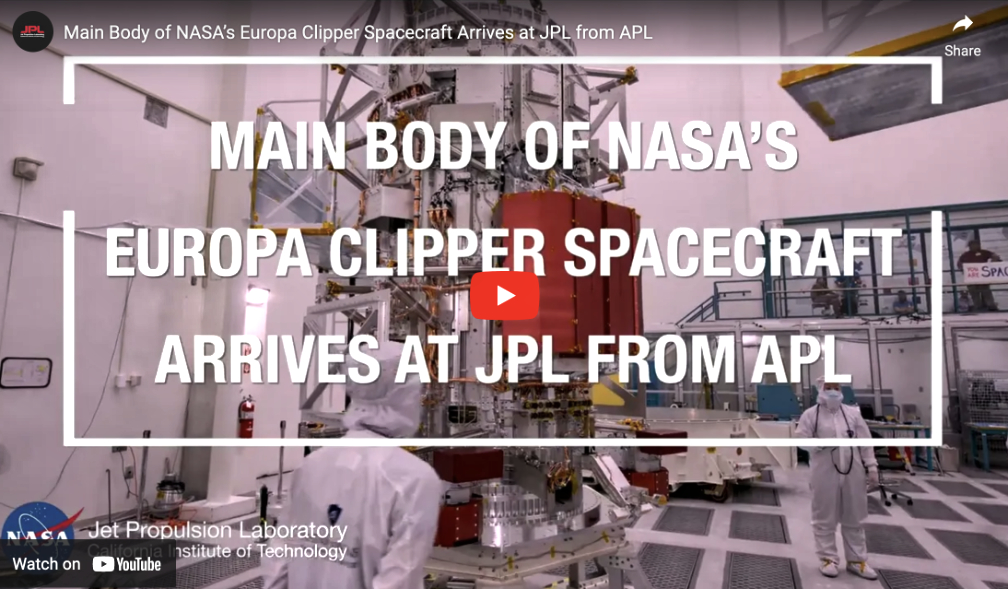
This video captures the delivery of the core of NASA’s Europa Clipper spacecraft to the agency’s Jet Propulsion Laboratory in Southern California. The Johns Hopkins Applied Physics Laboratory designed and built the spacecraft body in collaboration with JPL and NASA’s Goddard Space Flight Center. Credits: NASA/JPL-Caltech

Those instruments already have begun arriving at JPL, where the phase known as assembly, test, and launch operations has been underway since March. The ultraviolet spectrograph, called Europa-UVS, arrived in March. Next came the spacecraft’s thermal emission imaging instrument, E-THEMIS, delivered by the scientists and engineers leading its development at Arizona State University. E-THEMIS is a sophisticated infrared camera designed to map Europa’s temperatures and help scientists find clues about the moon’s geological activity – including regions where liquid water may be near the surface.

By the end of 2022, most of the flight hardware and the remainder of the science instruments are expected to be complete.

The Entire Package

The Johns Hopkins Applied Physics Laboratory (APL) in Laurel, Maryland, designed Europa Clipper’s body in collaboration with JPL and NASA’s Goddard Space Flight Center in Greenbelt, Maryland.

“The flight system designed, built, and tested by APL – using a team of hundreds of engineers and technicians – was the physically largest system ever built by APL,” said APL’s Tom Magner, the mission’s assistant project manager.
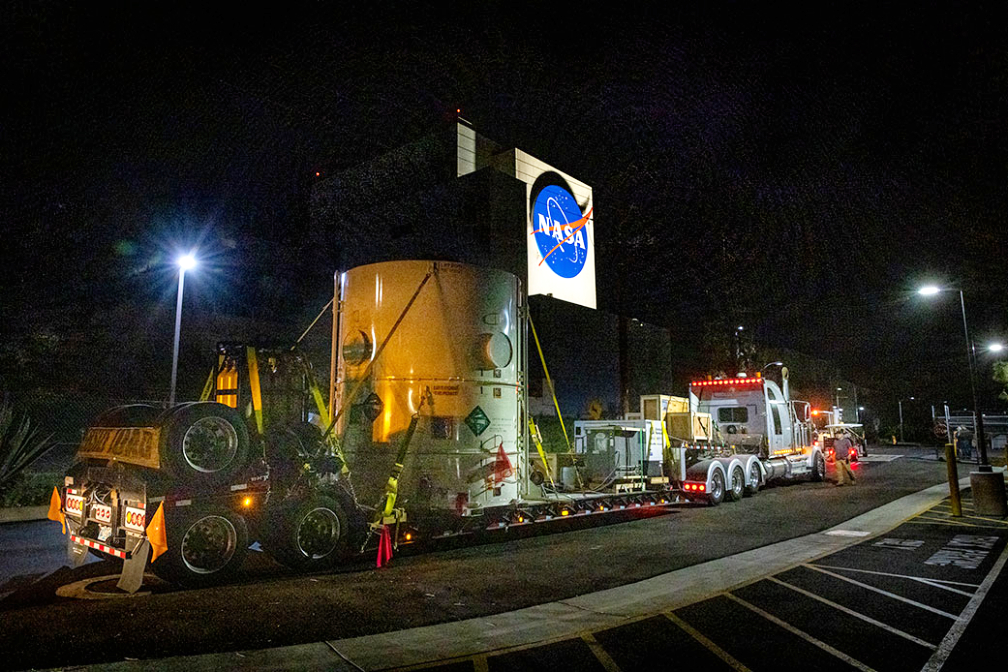
NASA’s Europa Clipper spacecraft The main body of NASA’s Europa Clipper spacecraft is seen in its shipping container as it rolls into the agency’s Jet Propulsion Laboratory in Southern California. Photo is courtesy of NASA/JPL-Caltech/Johns Hopkins APL/Ed Whitman.

The work on the main module continues now at JPL.

“What arrived at JPL represents essentially an assembly phase unto itself. Under APL’s leadership, this delivery includes work by that institution and two NASA centers. Now the team will take the system to an even higher level of integration,” said Evans.

The main structure is actually two stacked aluminum cylinders dotted with threaded holes for bolting on the spacecraft’s cargo: the radio frequency module, radiation monitors, propulsion electronics, power converters, and wiring. The radio frequency subsystem will power eight antennas, including an enormous high-gain antenna that measures 10 feet (3 meters) wide. The structure’s web of electrical wires and connectors, called the harness, weighs 150 pounds (68 kilograms) by itself; if stretched out, it would run almost 2,100 feet (640 meters) – twice the perimeter of a football field.

The heavy-duty electronics vault, built to withstand the intense radiation of the Jupiter system, will be integrated with the main spacecraft structure along with the science instruments.

Inside the main body of the spacecraft are two tanks – one to hold fuel, one for oxidizer – and the tubing that will carry their contents to an array of 24 engines, where they will combine to create a controlled chemical reaction that produces thrust.

“Our engines are dual purpose,” said JPL’s Tim Larson, the deputy project manager. “We use them for big maneuvers, including when we approach Jupiter and need a large burn to be captured in Jupiter’s orbit. But they’re also designed for smaller maneuvers to manage the attitude of the spacecraft and to fine tune the precision flybys of Europa and other solar system bodies along the way.”

Those big and small maneuvers will come into play a lot during the six-year, 1.8-billion-mile (2.9-billion-kilometer) journey to this ocean world, which Europa Clipper will begin investigating in earnest in 2031.

More About the Mission

Missions such as Europa Clipper contribute to the field of astrobiology, the interdisciplinary research on the variables and conditions of distant worlds that could harbor life as we know it. While Europa Clipper is not a life-detection mission, it will conduct detailed reconnaissance of Europa and investigate whether the icy moon, with its subsurface ocean, has the capability to support life. Understanding Europa’s habitability will help scientists better understand how life developed on Earth and the potential for finding life beyond our planet.

Managed by Caltech in Pasadena, California, JPL leads the development of the Europa Clipper mission in partnership with APL for NASA’s Science Mission Directorate in Washington. The Planetary Missions Program Office at NASA’s Marshall Space Flight Center in Huntsville, Alabama, executes program management of the Europa Clipper mission.

Filed Under: Exploration & Science Missions, Government & Regulation

Primary Sidebar

Coverage

  • Missions & Constellations
  • Business & Finance
  • Military & Defense
  • Launch
  • Software Automation & Ground Systems
  • Government & Regulation
  • Services & Applications

Most Read Stories

  • SpaceX Loses Contact With Starlink Satellite
  • Rocket Lab Emerging as Potential Bus Provider for 2,800-Satellite Equatys Constellation
  • SpaceX Accelerates Record-Breaking IPO Following Trillion-Dollar xAI Merger
  • Planet Labs Imposes Indefinite Blackout on Iran Satellite Imagery at U.S. Request
  • Amazon in Reported Talks to Acquire Globalstar in $9 Billion Move to Challenge Starlink

Secondary Sidebar

Footer


Satnews is a leading provider of satellite news, events, publications, research and other satellite industry information in both commercial and military enterprises worldwide.

Stories By Category

  • Business & Finance
  • Government & Regulation
  • Launch
  • Military & Defense
  • Missions & Constellations
  • Services & Applications
  • Software Automation & Ground Systems
  • Spectrum & Licensing
  • Startups & NewSpace Business

About Us

  • Leadership & Editorial Team
  • SatNews History
  • Free Satnews Subscription
  • SatNews Events
  • Magazines

Navigation

  • Latest Stories
  • Magazines
  • Events
  • Contact
  • Cookie & Privacy Policy for Satnews

We use cookies to ensure that we give you the best experience on our website. If you continue to use this site we will assume that you are happy with it.
x
Sign up Now (For Free)
Access daily or weekly satellite news updates covering all aspects of the commercial and military satellite industry.
Invalid email address
Notify Me Regarding ( At least one ):
We value your privacy and will not sell or share your email or other information with any other company. You may also unsubscribe at anytime.

Click Here to see our full privacy policy.
Thanks for subscribing!