

• Skip to primary navigation
  • Skip to main content
  • Skip to primary sidebar
  • Skip to secondary sidebar
  • Skip to footer
  • NEWS:
  • SatNews
  • SatMagazine
  • MilSatMagazine
  • SmallSat News
  • |     EVENTS:
  • SmallSat Symposium
  • Satellite Innovation
  • MilSat Symposium
  • SmallSat Europe

SatNews

Satellite Industry Intelligence Since 1983

Subscribe
  • LATEST
  • Missions & Constellations
    • Exploration & Science Missions
    • In-Orbit Servicing & Orbital Operations
    • LEO Constellations
    • Mission Autonomy & Onboard Systems
    • Mission Deployments & Manifests
    • Navigation & PNT
    • SmallSat
    • Spacecraft & Payload Technology
    View All in Missions & Constellations →
    Kepler Commissions First NVIDIA-Powered “Cloud Infrastructure” Across Optical ConstellationKepler Commissions First NVIDIA-Powered “Cloud Infrastructure” Across Optical Constellation
    The “Physics Wall”: Orbiting Data Centers Face a Massive Cooling ChallengeThe “Physics Wall”: Orbiting Data Centers Face a Massive Cooling Challenge
    Lynk Global Files for FCC Experimental License to Test Multi-Orbit D2D RelayLynk Global Files for FCC Experimental License to Test Multi-Orbit D2D Relay
    Hanwha Re-Enters KAI Shareholder Registry to Accelerate ‘Korean SpaceX’ StrategyHanwha Re-Enters KAI Shareholder Registry to Accelerate ‘Korean SpaceX’ Strategy
  • Business
    • Contracts & Commercial Deals
    • Earnings & Financial Reporting
    • Events & Conferences
    • Funding & Venture Capital
    • Market Forecasts
    • Mergers & Acquisitions
    • Personnel Moves & Appointments
    View All in Business & Finance →
    Nigus and Elmirate Partner on $200 Million Defense and Satellite Manufacturing Initiative in NigeriaNigus and Elmirate Partner on $200 Million Defense and Satellite Manufacturing Initiative in Nigeria
    Rheinmetall Walked Away. Germany Should Take the Hint.Rheinmetall Walked Away. Germany Should Take the Hint.
    Lynk Global Files for FCC Experimental License to Test Multi-Orbit D2D RelayLynk Global Files for FCC Experimental License to Test Multi-Orbit D2D Relay
    MDA Space Completes $300 Million U.S. IPO and NYSE Dual-ListingMDA Space Completes $300 Million U.S. IPO and NYSE Dual-Listing
  • Defense
    • Counterspace & ASAT
    • Defense Budgets & Procurement
    • ISR & Reconnaissance
    • MILSATCOM
    • Missile Warning & Defense
    • National Security Programs
    • Space Domain Awareness
    View All in Military & Defense →
    Rheinmetall Walked Away. Germany Should Take the Hint.Rheinmetall Walked Away. Germany Should Take the Hint.
    ICEYE Targets €1 Billion Revenue Threshold as Defense Demand Drives Production ScalingICEYE Targets €1 Billion Revenue Threshold as Defense Demand Drives Production Scaling
    Air Force Triples AEHF Terminal Contract Ceiling to Nearly $3 BillionAir Force Triples AEHF Terminal Contract Ceiling to Nearly $3 Billion
    Your Teleport Can’t Dodge a MissileYour Teleport Can’t Dodge a Missile
  • Gov
    • Export Controls & Compliance
    • International Space Agreements
    • National Space Policy
    • Space Law & Treaties
    • Space Sustainability & Debris Policy
    • Space Traffic Management / Debris Removal
    View All in Government & Regulation →
    Rheinmetall Walked Away. Germany Should Take the Hint.Rheinmetall Walked Away. Germany Should Take the Hint.
    Saying Goodbye to the ISS, and Hello to the Orbital Tenancy Trap Saying Goodbye to the ISS, and Hello to the Orbital Tenancy Trap 
    FAA Rescinds Proposed Orbital Debris Rule Amid Industry Pressure and Regulatory ReassessmentFAA Rescinds Proposed Orbital Debris Rule Amid Industry Pressure and Regulatory Reassessment
    The Iran Precedent: Operation Epic Fury and the Law of Armed Conflict in SpaceThe Iran Precedent: Operation Epic Fury and the Law of Armed Conflict in Space
  • Launch
    • Launch Providers
    • Launch Schedule & Calendars
    • Launch Sites & Infrastructure
    • Rocket Technology & Vehicles
    View All in Launch →
    L3Harris Honors Goddard Centennial with Advances in Nuclear and Electric PropulsionL3Harris Honors Goddard Centennial with Advances in Nuclear and Electric Propulsion
    Firefly Aerospace Returns to Flight with Successful “Stairway to Seven” MissionFirefly Aerospace Returns to Flight with Successful “Stairway to Seven” Mission
    SpaceX Evolves Beyond Broadband with “Million-Satellite” AI Data Center Plan; Amazon Mounts Legal ChallengeSpaceX Evolves Beyond Broadband with “Million-Satellite” AI Data Center Plan; Amazon Mounts Legal Challenge
    Times Microwave Systems Launches Levitate™ Ultra-Lightweight Cables for UAV and Defense AvionicsTimes Microwave Systems Launches Levitate™ Ultra-Lightweight Cables for UAV and Defense Avionics
  • Software
    • Autonomous Ground Operations
    • Data Processing & AI/ML
    • Digital Twins & Modeling
    • Ground Segment & Teleports
    • Mission Planning & Simulation
    • Space Systems Software Engineering
    • Spectrum & Licensing
    View All in Software Automation & Ground Systems →
    Your Teleport Can’t Dodge a MissileYour Teleport Can’t Dodge a Missile
    Missile Strike Targets Strategic SES Ha’Ela Teleport in Central IsraelMissile Strike Targets Strategic SES Ha’Ela Teleport in Central Israel
    ATLAS Space Operations Establishes South Pacific Hub with New Ground Station in American SamoaATLAS Space Operations Establishes South Pacific Hub with New Ground Station in American Samoa
    Danish Army Selects BAE Systems OneArc for 7-Year Simulation Modernization ProgramDanish Army Selects BAE Systems OneArc for 7-Year Simulation Modernization Program
  • Services & Apps
    • Climate & Environmental Monitoring
    • Disaster Response & Security Mapping
    • Earth Observation & Imaging
    • Maritime & Aviation Satcom
    • Satellite Communications
    View All in Services & Applications →
    L3Harris Unveils XL-300P: The First P25 Handheld with 5G and Satellite Direct-to-Device ConnectivityL3Harris Unveils XL-300P: The First P25 Handheld with 5G and Satellite Direct-to-Device Connectivity
    Your Teleport Can’t Dodge a MissileYour Teleport Can’t Dodge a Missile
    Jazz Secures Industry-Leading 190 MHz in Pakistan’s Landmark $507M 5G Spectrum AuctionJazz Secures Industry-Leading 190 MHz in Pakistan’s Landmark $507M 5G Spectrum Auction
    Spring Forward: Legacy Operators Are Killing GEO. That’s the Plan.Spring Forward: Legacy Operators Are Killing GEO. That’s the Plan.
  • SatNews Events
  • Magazines
  • Calendar
  • Jobs

NASA Space Probe Unexpectedly Glimpses The Surface of Venus in Stunning New First

February 13, 2022

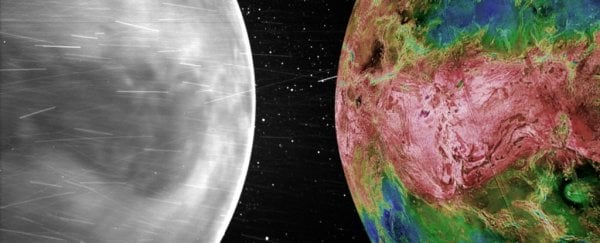
New images recorded by NASA’s Parker Solar Probe have revealed the red-hot glow of Venus‘ surface radiating through its shroud of toxic clouds – a finding that could help us better understand the minerals making up this rocky and mysterious planet.

Using data from the Wide-field Imager for Parker Solar Probe (WISPR) instrument, scientists were able to peer beneath the planet’s thick atmosphere, discovering geological features such as highlands, plateaus, and plains.

“Venus is the third brightest thing in the sky, but until recently we have not had much information on what the surface looked like because our view of it is blocked by a thick atmosphere,” says astrophysicist and WISPR team member Brian Wood of the US Naval Research Laboratory.

“Now, we finally are seeing the surface in visible wavelengths for the first time from space.”

Although relatively close to Earth, Venus has proven very difficult to study. It’s known as Earth’s “evil twin“, because, while similar to Earth in size, mass, structure, and composition, it’s deeply hostile to life.

Earth is temperate and wet; Venus is dry and possibly volcanic, with surface temperatures averaging 471 degrees Celsius (880 degrees Fahrenheit).

Venus’s sky is filled with thick, toxic clouds that rain sulfuric acid. These features make the planet difficult to investigate up close. Landers have been sent; they kind of end up melting. And those suffocating clouds make external observations of the surface, not impossible, but tricky.

This is where WISPR ended up surprising scientists. Last year, it took some images of Venus‘s night side that seemed to show surface features through the cloud layers.

WISPR is optimized for visible light; that is, it takes images in wavelengths that the human eye can see. But it turned out that the instrument can also see a little bit further, into the near-infrared part of the spectrum invisible to human eyes. Infrared and near-infrared are the wavelengths of thermal energy; in other words, heat.

On Venus’ day side, warmed by the Sun, any infrared emissions from the surface would be lost. But on the night side, it seems temperature variations on the planet’s surface are unexpectedly detectable by the instrument.

“It’s so hot that the rocky surface of Venus is visibly glowing, like a piece of iron pulled from a forge,” Wood explains.

Other technologies, such as radar imaging conducted by the Magellan probe in the 1990s, and infrared imaging conducted by the current JAXA Akatsuki probe, have given us a pretty good map of Venus’ surface geology. WISPR’s contribution, the researchers say, brings our understanding right to the very edge of the visible spectrum.

The flyby last year revealed a region called the Aphrodite Terra, the largest highland region on the surface of the planet. It showed up as a dark smudge against the luminous clouds. This is because the Aphrodite Terra, with its higher altitude, is a lot cooler than the surrounding terrain, so in infrared or near-infrared images of the planet, it’s visible.

Those images show other features, too. The Tellus Regio plateau and the Aino Planitia plains also feature variations in altitude that make them visible through the clouds in infrared wavelengths.

Although the images haven’t revealed anything new in terms of topography, the data can still help us better understand Venus. Because different minerals conduct and release heat differently, the emissions can be used to try to reconstruct the planet’s surface mineralogy.

This, in turn, can help us understand its history. We know, for example, that Venus has been highly volcanically active in the past.

Studying its surface can help us understand how widespread, and how recent, that activity was. Adding visible and near-infrared data to the currently available dataset expands the range of wavelengths scientists can use to do this.

Parker’s primary objective is to explore the Sun; its Venus observations are almost incidental. The probe is using the planet to make gravity assist maneuvers, using Venus’s gravity to make velocity and course adjustments on its solar mission.

It is scheduled to make seven of these maneuvers in total; so far it has made five. Only two of those have been suitable for these night-side images so far.

Of the two remaining gravity assists, only one will allow for more observations: the final gravity assist, scheduled for 6 November 2024. We’ll be fascinated to see what else WISPR might find.

“We’re thrilled with the science insights Parker Solar Probe has provided thus far,” says physicist Nicola Fox of NASA’s Heliophysics Division.

“Parker continues to outperform our expectations, and we are excited that these novel observations taken during our gravity assist maneuver can help advance Venus research in unexpected ways.”

Please note this story via NASA.

Filed Under: Government & Regulation

Primary Sidebar

Coverage

  • Missions & Constellations
  • Business & Finance
  • Military & Defense
  • Launch
  • Software Automation & Ground Systems
  • Government & Regulation
  • Services & Applications

Most Read Stories

  • Global Shift Toward Sovereign Launch Gains Momentum Amid Geopolitical Tensions
  • SpaceX Unveils ‘Stargaze’ System to Revolutionize Space Traffic Management
  • AST SpaceMobile Encapsulates BlueBird 7 Satellite for Inaugural New Glenn Mission
  • SpaceX Prepares for Record-Breaking $1.75 Trillion Confidential IPO Filing in March
  • Bidding War Intensifies for Mynaric as Rheinmetall Challenges Rocket Lab Acquisition

Secondary Sidebar

Footer


Satnews is a leading provider of satellite news, events, publications, research and other satellite industry information in both commercial and military enterprises worldwide.

Stories By Category

  • Business & Finance
  • Government & Regulation
  • Launch
  • Military & Defense
  • Missions & Constellations
  • Services & Applications
  • Software Automation & Ground Systems
  • Spectrum & Licensing
  • Startups & NewSpace Business

About Us

  • Leadership & Editorial Team
  • SatNews History
  • Free Satnews Subscription
  • SatNews Events
  • Magazines

Navigation

  • Latest Stories
  • Magazines
  • Events
  • Contact
  • Cookie & Privacy Policy for Satnews

We use cookies to ensure that we give you the best experience on our website. If you continue to use this site we will assume that you are happy with it.
x
Sign up Now (For Free)
Access daily or weekly satellite news updates covering all aspects of the commercial and military satellite industry.
Invalid email address
Notify Me Regarding ( At least one ):
We value your privacy and will not sell or share your email or other information with any other company. You may also unsubscribe at anytime.

Click Here to see our full privacy policy.
Thanks for subscribing!