

• Skip to primary navigation
  • Skip to main content
  • Skip to primary sidebar
  • Skip to secondary sidebar
  • Skip to footer
  • NEWS:
  • SatNews
  • SatMagazine
  • MilSatMagazine
  • SmallSat News
  • |     EVENTS:
  • SmallSat Symposium
  • Satellite Innovation
  • MilSat Symposium
  • SmallSat Europe

SatNews

Satellite Industry Intelligence Since 1983

Subscribe
  • LATEST
  • SatNews Events
  • Magazines
  • Calendar
  • Subscribe
  • Missions & Constellations
    • Exploration & Science Missions
    • In-Orbit Servicing & Orbital Operations
    • LEO Constellations
    • Mission Autonomy & Onboard Systems
    • Mission Deployments & Manifests
    • Navigation & PNT
    • SmallSat
    • Spacecraft & Payload Technology
    View All in Missions & Constellations →
    Amazon to Acquire Globalstar for $11.6 Billion to Fuel D2D ExpansionAmazon to Acquire Globalstar for $11.6 Billion to Fuel D2D Expansion
    SmallSat Europe Speaker Focus: Daniel Metzler, Isar AerospaceSmallSat Europe Speaker Focus: Daniel Metzler, Isar Aerospace
    Webb Observations Challenge Fundamental Mass LimitsWebb Observations Challenge Fundamental Mass Limits
    Dawn Aerospace Unveils “Loop” Refueling Network to Combat Orbital ObsolescenceDawn Aerospace Unveils “Loop” Refueling Network to Combat Orbital Obsolescence
  • Business
    • Contracts & Commercial Deals
    • Earnings & Financial Reporting
    • Events & Conferences
    • Funding & Venture Capital
    • Market Forecasts
    • Mergers & Acquisitions
    • Personnel Moves & Appointments
    View All in Business & Finance →
    Oklahoma Positions as Commercial Space Manufacturing Hub at Space SymposiumOklahoma Positions as Commercial Space Manufacturing Hub at Space Symposium
    Global Defense Leaders Convene as Space Symposium 41 Addresses Orbital SecurityGlobal Defense Leaders Convene as Space Symposium 41 Addresses Orbital Security
    SmallSat Europe Speaker Focus: Chris Quilty, Quilty SpaceSmallSat Europe Speaker Focus: Chris Quilty, Quilty Space
    “SpaceX and the biggest IPO in history”“SpaceX and the biggest IPO in history”
  • Defense
    • Counterspace & ASAT
    • Defense Budgets & Procurement
    • ISR & Reconnaissance
    • MILSATCOM
    • Missile Warning & Defense
    • National Security Programs
    • Space Domain Awareness
    View All in Military & Defense →
    General Atomics Completes Pre-Ship Review for Space Force Weather PayloadGeneral Atomics Completes Pre-Ship Review for Space Force Weather Payload
    NRL to Showcase Sovereign Space Capabilities at 41st Space SymposiumNRL to Showcase Sovereign Space Capabilities at 41st Space Symposium
    Northrop Grumman Minotaur IV Lofted USSF Tech Demonstration Payloads to OrbitNorthrop Grumman Minotaur IV Lofted USSF Tech Demonstration Payloads to Orbit
    The End of the VSAT Parts BinThe End of the VSAT Parts Bin
  • Gov
    • Export Controls & Compliance
    • International Space Agreements
    • National Space Policy
    • Space Law & Treaties
    • Space Sustainability & Debris Policy
    • Space Traffic Management / Debris Removal
    View All in Government & Regulation →
    FCC Modernizes Satellite Spectrum Rules to Unleash Next-Generation BroadbandFCC Modernizes Satellite Spectrum Rules to Unleash Next-Generation Broadband
    SmallSat Europe Speaker Focus: Daniel Bock, Morpheus SpaceSmallSat Europe Speaker Focus: Daniel Bock, Morpheus Space
    SmallSat Europe Speaker Focus: Dr. Ane Aanesland, ThrustMeSmallSat Europe Speaker Focus: Dr. Ane Aanesland, ThrustMe
    Isaacman’s Budget Math: How NASA Plans to Reach the Moon With a Quarter Less MoneyIsaacman’s Budget Math: How NASA Plans to Reach the Moon With a Quarter Less Money
  • Launch
    • Launch Providers
    • Launch Schedule & Calendars
    • Launch Sites & Infrastructure
    • Rocket Technology & Vehicles
    View All in Launch →
    Ensign-Bickford Hardware Supports Successful Artemis II Lunar MissionEnsign-Bickford Hardware Supports Successful Artemis II Lunar Mission
    China Accelerates Orbital Internet Deployment with Successful Smart Dragon-3 Sea LaunchChina Accelerates Orbital Internet Deployment with Successful Smart Dragon-3 Sea Launch
    What the SpaceX IPO Changes for Every Satellite OperatorWhat the SpaceX IPO Changes for Every Satellite Operator
    €30 million Financing for PLD Space’s Small Satellite Launcher€30 million Financing for PLD Space’s Small Satellite Launcher
  • Software
    • Autonomous Ground Operations
    • Data Processing & AI/ML
    • Digital Twins & Modeling
    • Ground Segment & Teleports
    • Mission Planning & Simulation
    • Space Systems Software Engineering
    • Spectrum & Licensing
    View All in Software Automation & Ground Systems →
    Cloudcomputing Targets 1.5M Identities in Spain and Finalizes Innovate IT AcquisitionCloudcomputing Targets 1.5M Identities in Spain and Finalizes Innovate IT Acquisition
    Archangel Lightworks Secures £10M Series A to Scale Optical Ground InfrastructureArchangel Lightworks Secures £10M Series A to Scale Optical Ground Infrastructure
    Keysight and Sateliot Win ESA and GSMA Foundry Challenge for 6G InnovationKeysight and Sateliot Win ESA and GSMA Foundry Challenge for 6G Innovation
    Automation and Agility: How SSC Space Go is Designed for the New Age of GroundAutomation and Agility: How SSC Space Go is Designed for the New Age of Ground
  • Services & Apps
    • Climate & Environmental Monitoring
    • Disaster Response & Security Mapping
    • Earth Observation & Imaging
    • Maritime & Aviation Satcom
    • Satellite Communications
    View All in Services & Applications →
    Kraken Robotics Integrates KATFISH Sonar on SEFINE RD-22 USV Following Multi-Naval DemonstrationsKraken Robotics Integrates KATFISH Sonar on SEFINE RD-22 USV Following Multi-Naval Demonstrations
    Astroscale Plans World-First Multi-Orbit Satellite Inspection MissionAstroscale Plans World-First Multi-Orbit Satellite Inspection Mission
    The Downlink Deficit: The Pentagon’s Optical Mesh Network and the Terrestrial BottleneckThe Downlink Deficit: The Pentagon’s Optical Mesh Network and the Terrestrial Bottleneck
    Cinemo Reimagines the Vehicle as a Software-Defined Entertainment HubCinemo Reimagines the Vehicle as a Software-Defined Entertainment Hub

Leadership Change @ U.S. Space Command

August 24, 2020

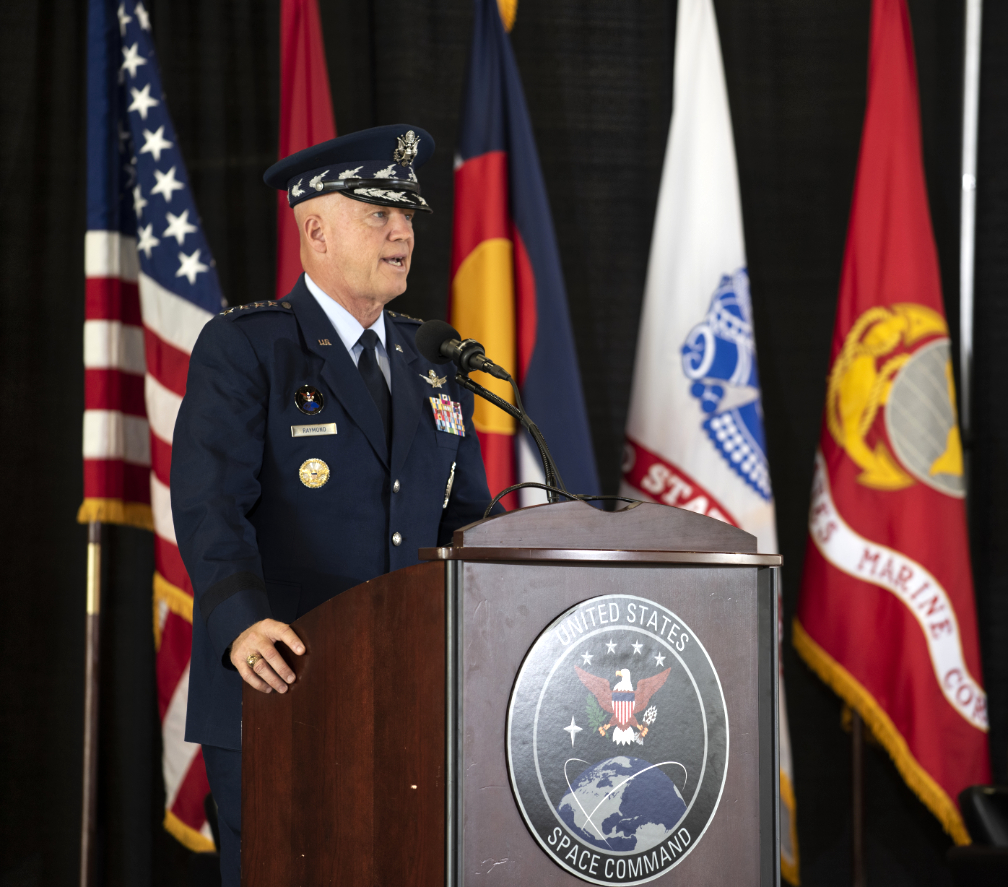
Gen. John “Jay” Raymond. Chief of Space Operations, U.S. Space Force, Commander, U.S. Space Command, provides remarks at the USSPACECOM Change of Command. Gen. Raymond relinquished command of USSPACECOM to GEN James Dickinson. GEN Dickinson now leads the next generation of space warfighters. Peterson Air Force Base, Colorado Springs, CO. August 20th, 2020. Photo by USSPACECOM Public Affairs.
Department of Defense photo by Lewis Carlyle.

In a ceremony that was both crisp and solemn, Army Gen. James H. Dickinson took the reins August 20 of U.S. Space Command, and in the process, further cemented space’s ever-enlarging importance in national defense and in countless familiar acts of everyday life.

GEN James Dickinson, newly appointed commander U.S. Space Command addresses the attendees of the USSPACECOM Change of Command ceremony. During the event, Gen. John “Jay” Raymond, Chief of Space Operations, U.S. Space Force and Commander, U.S. Space Command, relinquished command of USSPACECOM to GEN James Dickinson. GEN Dickinson now leads the next generation of space warfighters. Peterson Air Force Base, Colorado Springs, CO. August 20th, 2020. Photo by USSPACECOM Public Affairs.
Department of Defense photo by Lewis Carlyle.

Less obvious, but perhaps ultimately more significant, was a second outcome. By stepping up to lead U.S. Space Command, Dickinson enabled the previous commander, Gen. John “Jay” Raymond to remove one of his “dual hats” and focus exclusively on his job as Chief of Space Operations, the highest ranking officer of the newly formed U.S. Space Force.

The hand-off in Colorado arrived at a crucial moment for Raymond and the nascent Space Force, created December 20, 2019, as the first new and independent branch of the U.S. military since 1947.

“I really believe Congress got it right when they said I could be commander (of U.S. Space Command) for up to a year,” Raymond said during an interview after the ceremony, in which he discussed his roles re-establishing Space Command as a separate, stand-alone warfighting organization while also directing creation of the Space Force. “Now that we’ve got the plans in place and the structure in place for both the U.S. Space Force and the U.S. Space Command, and both are delivering advantage, I think it’s actually the perfect time to split the hats.”

This new phase is one that Raymond says will build on the hard-to-see foundation the Space Force has been painstakingly laying for months.

The foundation focuses on policy, budgets, decisions on assigning personnel such as how many and where, command structure, and establishing a lean bureaucracy that must exist for Space Force to succeed. The effort, which has been underway since December, is crafted to ensure that “we don’t … break the integration we’ve enjoyed” with the Air Force and other services, allies, partners and industry.

Now Space Force is moving to grow beyond the 90 people who comprise the Force today. Space Professionals in the service and Airmen assigned to support the service will total about 16,000. The purpose, Raymond says, is to move with speed and focus to organize, train and equip space operators, commanders and support staff to ensure U.S. superiority in a domain that is rapidly changing, becoming far more contested and congested and dangerous.

“We have an opportunity to start with a clean sheet of paper and build something that’s purpose-built for this domain,” Raymond said. “As I tell my team, we have two risks. The first risk is that we don’t think bold enough; that we miss this opportunity with incremental advancements. The other risk is, we have to get that bold agenda through and implemented. And that’s going to require people to think differently.”

Much differently.

It wasn’t long ago when space was an exclusive club, limited almost entirely to the United States and Russia (and before that, the Soviet Union). With only two “players” roaming the vast reaches of space it was considered a challenging but peaceful environment.

That picture of space has almost no comparison today.

There are now 72 countries actively operating in space. That number is growing as the cost of launching vehicles into space is falling to the point that more nations, along with many commercial enterprises, are jumping in. As congestion in space increases, so too are the intentions for being there. All of that is raising the stakes for being able to operate freely and without threat in space.

The stakes are indeed high. It’s no exaggeration to say space is as crucial to everyday life and commerce as electricity, water, modern highways and agriculture. Without the constellation of 31 GPS satellites operated by Airmen at Schriever Air Force Base, Colorado, first responders would not be able to provide assistance as fast or as reliably; commercial air service would be less reliable and more dangerous without the precise navigation GPS provides.

Without reliable access to satellites and the “position, navigation and timing” data they provide, credit card purchases would be disrupted, and the stock market would not be able to operate as it does today. Internet service and communication would be disrupted or, in some cases, severed. Everything from the way electric power grids operate to the way the military is able to communicate and operate to e-commerce, tele-medicine and many more necessities of daily life would be compromised.

That explains why space has become such a linchpin, why it is now deemed “contested” and why the Space Force was created to focus exclusively on protecting national interests and operations.

“The reason why it was important for both the U.S. Space Command and Space Force to be elevated is that space became a warfighting domain,” is Raymond’s blunt answer to why the U.S. is shifting its posture in space. “If you look at what China and Russia are doing in space they have clearly made it a warfighting domain. That requires us to do business differently.”

The goal, he says, is for the U.S. to demonstrate unquestioned superiority in a way that translates into a potent deterrent.

“Our goal is to make sure that any potential adversary would say they are not going to be successful negating our access to space and therefore they shouldn’t even try,” he said.

As Raymond and the Space Force enter this new phase, the emphasis will be equal parts technological, cultural and education.

“What you have today is a different context that requires a different level of training, a different warfighting culture; the ability to go fast to stay ahead of a growing threat, to be agile, to develop partnerships that we haven’t had before with our allies and intelligence community. Everything about what we’re doing has to change to operate effectively in this strategic environment,” Raymond said. “On the organize, train and equip, side, that’s what the Space Force is all about.”

At the same time, Raymond is working to solve the thorny issue of over-classification, which prevents the public, allies and adversaries from clearly understanding what the Space Force is doing and why.

“One of the things we’re working really hard to do is lower the classification to allow us to be more effective” in publicly demonstrating capabilities that generate deterrence,” he said. “We do not want to get into a conflict that begins and extends into space. If you want to deter, you have to do it from a position of strength.”

Finding the balance, however, is difficult.

“We have a saying in the space business, ‘Satellites don’t have a mother.’ You can’t hug it. You can’t touch it. You can’t hear it, you can’t love it. It’s hard for the average person to understand just how reliant their life is on space. It’s not tangible. So I think it’s very important that we do a better job of making sure Americans understand how reliant they are, how their American way of life is fueled by space, and that our job is to make sure it’s always there,” he said.

Raymond says he is certain Space Force will succeed. He also acknowledges it won’t be easy. While the Space Force is being created “from a clean sheet of paper” it must incorporate hardware – and philosophies – that in some cases are decades old.

Asked about near-term priorities, Raymond said, “We have to develop a bridging strategy to make that shift from old architecture to new architecture. One marker of success is answering the question, are our constellations becoming more defendable and more distributed? The second thing is, I would like to see us capitalize on innovative commercial industry to a greater extent. There will be a measure of success there as well.”

Driving all of it is speed.

“How long does it take us to move from requirement to on-orbit capability? Today it takes too long. If we’re going to take a GPS satellite and buy a clone of that satellite, it will take us five years or so. That’s not fast enough,” Raymond said.

If his blueprint and ambition play out as hoped, Raymond said the Space Force will provide more than simply the assurance of U.S. superiority in space.

“We want to be an organization that’s the disruptive innovator that can drive this change. And in doing so, if we’re successful, we’ll benefit all the other services and the nation as well,” he said.

Story by Charles Pope, Secretary of the Air Force Public Affairs.

Filed Under: National Security Programs, Personnel Moves & Appointments

Primary Sidebar

Coverage

  • Missions & Constellations
  • Business & Finance
  • Military & Defense
  • Launch
  • Software Automation & Ground Systems
  • Government & Regulation
  • Services & Applications

Most Read Stories

  • SpaceX Loses Contact With Starlink Satellite
  • L3Harris Unveils XL-300P: The First P25 Handheld with 5G and Satellite Direct-to-Device Connectivity
  • Rocket Lab Emerging as Potential Bus Provider for 2,800-Satellite Equatys Constellation
  • Rheinmetall Walked Away. Germany Should Take the Hint.
  • SpaceX Accelerates Record-Breaking IPO Following Trillion-Dollar xAI Merger

Secondary Sidebar

Footer


Satnews is a leading provider of satellite news, events, publications, research and other satellite industry information in both commercial and military enterprises worldwide.

Stories By Category

  • Business & Finance
  • Government & Regulation
  • Launch
  • Military & Defense
  • Missions & Constellations
  • Services & Applications
  • Software Automation & Ground Systems
  • Spectrum & Licensing
  • Startups & NewSpace Business

About Us

  • Leadership & Editorial Team
  • SatNews History
  • Free Satnews Subscription
  • SatNews Events
  • Magazines

Navigation

  • Latest Stories
  • Magazines
  • Events
  • Contact
  • Cookie & Privacy Policy for Satnews

We use cookies to ensure that we give you the best experience on our website. If you continue to use this site we will assume that you are happy with it.
x
Sign up Now (For Free)
Access daily or weekly satellite news updates covering all aspects of the commercial and military satellite industry.
Invalid email address
Notify Me Regarding ( At least one ):
We value your privacy and will not sell or share your email or other information with any other company. You may also unsubscribe at anytime.

Click Here to see our full privacy policy.
Thanks for subscribing!