

Dramatic proof that some of these could strike Earth came on February 15th, when an unknown object thought to be 17–20m in diameter exploded high above Chelyabinsk, Russia, with 20 to 30 times the energy of the Hiroshima atomic bomb. The resulting shock wave caused widespread damage and injuries, making it the largest known natural object to have entered the atmosphere since the 1908 Tunguska event.
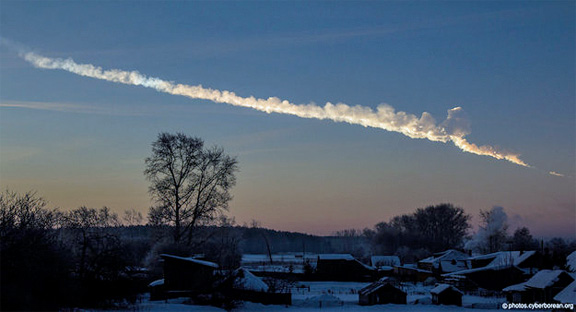
An object entered the atmosphere over the Urals early in the morning of 15 February 2013. The fireball exploded above Chelyabinsk city, and the resulting overpressure caused damage to buildings and injuries to hundreds of people. This photo was taken by Alex Alishevskikh from about a minute after noticing the blast.
Copyright BY-SA 2.0 via Flickr.
The NEO Coordination Centre will serve as the central access point to a network of European NEO data sources and information providers being established under ESA’s Space Situational Awareness (SSA) Programme. This is the second centre to be opened under SSA leadership after the Space Weather Coordination Centre that opened in Brussels last month.
Located at ESRIN, ESA’s centre for Earth observation, the centre was formally inaugurated by Thomas Reiter, ESA Director of Human Spaceflight and Operations, together with Augusto Cramarossa, Italian Delegate to the ESA Council, and Claudio Portelli, Italian Delegate to the SSA Programme, both of ASI, the Italian space agency. The event was hosted by Volker Liebig, ESA Director of Earth Observation Programmes and Head of the ESRIN Establishment.
The new centre will support experts in the field by federating new and existing European assets, systems and sensors into a future NEO system. It will support the integration and initial operation of ESA’s NEO information distribution network. The Centre is also the focus point for scientific studies needed to improve NEO warning services and provide near-realtime data to European and international customers, including scientific bodies, international organizations and decision-makers.
