

• Skip to primary navigation
  • Skip to main content
  • Skip to primary sidebar
  • Skip to secondary sidebar
  • Skip to footer
  • NEWS:
  • SatNews
  • SatMagazine
  • MilSatMagazine
  • SmallSat News
  • |     EVENTS:
  • SmallSat Symposium
  • Satellite Innovation
  • MilSat Symposium
  • SmallSat Europe

SatNews

Satellite Industry Intelligence Since 1983

Subscribe
  • LATEST
  • SatNews Events
  • Magazines
  • Calendar
  • Subscribe
  • Missions & Constellations
    • Exploration & Science Missions
    • In-Orbit Servicing & Orbital Operations
    • LEO Constellations
    • Mission Autonomy & Onboard Systems
    • Mission Deployments & Manifests
    • Navigation & PNT
    • SmallSat
    • Spacecraft & Payload Technology
    View All in Missions & Constellations →
    Gen Z Influence on AI-Driven Audio MarketGen Z Influence on AI-Driven Audio Market
    SmallSat Europe Speaker Focus: Stefano Antonetti, D-OrbitSmallSat Europe Speaker Focus: Stefano Antonetti, D-Orbit
    Satellite and the Upcoming Spectrum AuctionSatellite and the Upcoming Spectrum Auction
    ExoMars 2028 Structural Models Arrive in Cannes for Environmental TestingExoMars 2028 Structural Models Arrive in Cannes for Environmental Testing
  • Business
    • Contracts & Commercial Deals
    • Earnings & Financial Reporting
    • Events & Conferences
    • Funding & Venture Capital
    • Market Forecasts
    • Mergers & Acquisitions
    • Personnel Moves & Appointments
    View All in Business & Finance →
    Gilat Wins Big Military Contracts, Expands India FootprintGilat Wins Big Military Contracts, Expands India Footprint
    SmallSat Europe Speaker Focus: Gregg Burgess, Orion Space SolutionsSmallSat Europe Speaker Focus: Gregg Burgess, Orion Space Solutions
    Space42 Taps Skylo for Standards-Based Direct-to-Device Services via Thuraya-4Space42 Taps Skylo for Standards-Based Direct-to-Device Services via Thuraya-4
    SmallSat Europe Speaker Focus: Frank M. Salzgeber, Nadir Space VentureSmallSat Europe Speaker Focus: Frank M. Salzgeber, Nadir Space Venture
  • Defense
    • Counterspace & ASAT
    • Defense Budgets & Procurement
    • ISR & Reconnaissance
    • MILSATCOM
    • Missile Warning & Defense
    • National Security Programs
    • Space Domain Awareness
    View All in Military & Defense →
    iDirect Government Launches 450 Rackmount Software-Defined Modem for Multi-Orbit DefenseiDirect Government Launches 450 Rackmount Software-Defined Modem for Multi-Orbit Defense
    US Air Force Taps L3Harris to Bolster ABMS Digital InfrastructureUS Air Force Taps L3Harris to Bolster ABMS Digital Infrastructure
    U.S. and Australia Expand Space Surveillance Network to Counter Emerging ASAT ThreatsU.S. and Australia Expand Space Surveillance Network to Counter Emerging ASAT Threats
    U.S. Space Force Awards $3.2 Billion for Space-Based Interceptor LayerU.S. Space Force Awards $3.2 Billion for Space-Based Interceptor Layer
  • Gov
    • Export Controls & Compliance
    • International Space Agreements
    • National Space Policy
    • Space Law & Treaties
    • Space Sustainability & Debris Policy
    • Space Traffic Management / Debris Removal
    View All in Government & Regulation →
    SES Extends IRIS² Review as Consortium Reaches Initial Project MilestoneSES Extends IRIS² Review as Consortium Reaches Initial Project Milestone
    FCC Approves Landmark Spectrum Sharing and Direct-to-Device FrameworksFCC Approves Landmark Spectrum Sharing and Direct-to-Device Frameworks
    ATVA Urges FCC to Close “Affiliation-Swap” Loopholes Impacting Satellite OperatorsATVA Urges FCC to Close “Affiliation-Swap” Loopholes Impacting Satellite Operators
    UAE Space Agency Drives Public-Private Collaboration at MIITE 2026UAE Space Agency Drives Public-Private Collaboration at MIITE 2026
  • Launch
    • Launch Providers
    • Launch Schedule & Calendars
    • Launch Sites & Infrastructure
    • Rocket Technology & Vehicles
    View All in Launch →
    AST SpaceMobile Pivots to SpaceX for Mid-June Launch of Three BlueBird SatellitesAST SpaceMobile Pivots to SpaceX for Mid-June Launch of Three BlueBird Satellites
    SpaceX Accelerates Transition from Falcon 9 to Next-Generation Starship FleetSpaceX Accelerates Transition from Falcon 9 to Next-Generation Starship Fleet
    NanoAvionics Satellites Reach Orbit on SpaceX CAS500-2 MissionNanoAvionics Satellites Reach Orbit on SpaceX CAS500-2 Mission
    GalaxEye Successfully Launches “Mission Drishti” OptoSAR SatelliteGalaxEye Successfully Launches “Mission Drishti” OptoSAR Satellite
  • Software
    • Autonomous Ground Operations
    • Data Processing & AI/ML
    • Digital Twins & Modeling
    • Ground Segment & Teleports
    • Mission Planning & Simulation
    • Space Systems Software Engineering
    • Spectrum & Licensing
    View All in Software Automation & Ground Systems →
    SpinLaunch Partners with Aalyria for Meridian Constellation Network OrchestrationSpinLaunch Partners with Aalyria for Meridian Constellation Network Orchestration
    Your anomaly detection isn’t the problemYour anomaly detection isn’t the problem
    SmallSat Europe Speaker Focus: Olaf Eckart, BMW GroupSmallSat Europe Speaker Focus: Olaf Eckart, BMW Group
    SES Accelerates Multi-Orbit IFC Strategy with meoSphere and Next-Gen ESA DevelopmentSES Accelerates Multi-Orbit IFC Strategy with meoSphere and Next-Gen ESA Development
  • Services & Apps
    • Climate & Environmental Monitoring
    • Disaster Response & Security Mapping
    • Earth Observation & Imaging
    • Maritime & Aviation Satcom
    • Satellite Communications
    View All in Services & Applications →
    Consumer NPU Boom Accelerates Autonomous Satellite ProcessingConsumer NPU Boom Accelerates Autonomous Satellite Processing
    Ted Turner: “Shake with Terror”Ted Turner: “Shake with Terror”
    Satellite Technology and the Legacy of the Media PioneerSatellite Technology and the Legacy of the Media Pioneer
    SmallSat Europe Speaker Focus: Massimo Comparini, Leonardo Space DivisionSmallSat Europe Speaker Focus: Massimo Comparini, Leonardo Space Division

Arianespace + UK Space Agency… Galileo Gets Going (Launch)

October 13, 2012


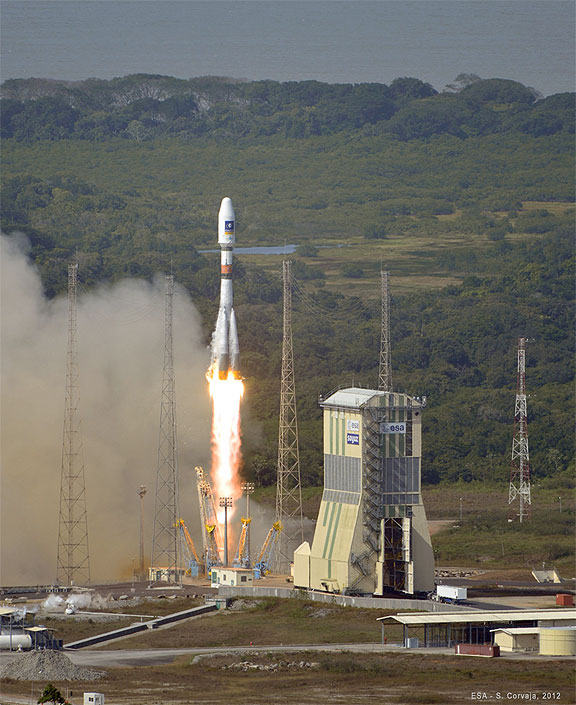
Soyuz begins its ascent from French Guiana with the payload of two Galileo In-Orbit Validation (IOV) satellites.
Photo is courtesy of Arianespace.
[SatNews] Arianespace’s third Soyuz mission from French Guiana, and the company’s seventh flight…

…so far in 2012 with its Ariane 5 and Soyuz launchers, successfully orbited two satellites today for the European Galileo navigation network. Lifting off at 3:15:01 p.m. local time, which was the planned precise moment of launch, the Russian-built Soyuz ST vehicle was put through its paces to deploy the pair of Galileo In-Orbit Validation spacecraft during a flight of just under 3 hrs. 45 min. Noting that today’s mission occurred almost exactly one year after Soyuz’ historic first flight from the Spaceport, Arianespace Chairman & CEO Jean-Yves Le Gall said this new success underscored the “exemplary character” of his company’s cooperation with Russia. “In less than one year, three perfect launch successes from the Guiana Space Center have enabled us to demonstrate the operational effectiveness of this new launch system, and to confirm the relevance of our launcher family strategy,” he added.

Good weather offered picture-perfect conditions for the Soyuz liftoff and climb-out from French Guiana, with tracking cameras following the vehicle through its jettison of the four first-stage boosters at almost two minutes into the flight. After the propulsive phases of Soyuz’ second and third stages, the Fregat upper stage took over to perform two burns—separated by a 3-plus-hour ballistic phase—enabling the two 700kg. Galileo satellites to be released in a circular medium-Earth orbit, with an altitude targeted at 23,222km.

This mission is designated VS03 in Arianespace’s launcher family numbering system, and was performed from the purpose-built ELS launch facility for its medium-lift Soyuz, located in the Spaceport’s northern sector near the city of Sinnamary. The pair of Galileo satellites was carried side-by-side on a dual-payload dispenser system, with their release performed in opposite directions by a pyrotechnic separation system that released them at the proper orbital insertion point.

These spacecraft joined the initial two Galileo spacecraft orbited on Arianespace’s milestone VS01 flight on October 21, 2011, which marked Soyuz’ introduction at the Spaceport. Together, the four satellites launched by Arianespace will form an operational mini-constellation—creating the minimum number required to allow navigational fixes for validations of the Galileo system.

An Astrium-led consortium produced the satellites, with assembly and testing performed by Thales Alenia Space. Galileo is a European initiative, with the constellation of navigation spacecraft being developed in a collaborative effort of the European Union and the European Space Agency.

“With our launch last year and the mission today, we have launched these initial four Galileo spacecraft, and beginning next year we will undertake the orbiting of the following 22, using five more Soyuz, along with three Ariane 5 launches,” Le Gall said in post-launch comments at the Spaceport’s mission control center. “This makes Galileo our largest customer.”

Arianespace is keeping up the mission pace in 2012, with this VS03 flight added to five Ariane 5 launches already performed from the Spaceport so far this year, which orbited eight telecommunications satellites, along with an Automated Transfer Vehicle for servicing of the International Space Station. In addition, the Starsem affiliate of Arianespace used a Soyuz ST vehicle from Baikonur Cosmodrome in Kazakhstan to orbit a European weather satellite last month. Complementing this activity was the qualification flight of Arianespace’s lightweight Vega launcher in February, performed under responsibility of the European Space Agency with support from Arianespace.

Arianespace’s next flight is set for November 9th from the Spaceport, employing an Ariane 5 to orbit the EUTELSAT 21B and Star One C3 telecom satellites. While preparations for this mission —designated VA210—are underway, the Ariane 5 for the subsequent VA211 heavy-lift mission was delivered to French Guiana yesterday by the MN Toucan sea-going transport ship.

The announcement of the launch was also prepared by the UK Space Agency and relates that Europe’s second pair of fully operational Galileo satellites was successfully launched on October 12, 2012, from the European spaceport in French Guiana, South America.

The satellites’ payloads were designed, manufactured and tested in the UK by Astrium and will be used with the two other satellites launched last year to validate the Galileo system design before becoming part of the final Galileo system. UK company SSTL is building the navigation payloads for the next 22 satellites which will form the operational constellation. Four is the minimum number of satellites needed to achieve a navigational fix on the ground, with one satellite each to measure latitude, longitude, altitude and provide a time reference. Once this second pair of satellites has been commissioned and tested, the quartet will form a completely operational mini-constellation that will be used to validate the Galileo system. These two new satellites are also the first to carry search and rescue antennas to pinpoint aircraft and ships in distress as part of the international Cospas–Sarsat system.

The technologies that the constellation will use have already been demonstrated with two British-built test satellites called GIOVE-A and -B, launched in 2005 and 2008, respectively. GIOVE-A has remained operational long after its expected lifespan and GIOVE-B contains the most reliable timing device ever launched into space.

A joint initiative of the European Commission (EC) and the European Space Agency (ESA), Galileo is the European Union’s answer to the American global satellite navigation system GPS. It is designed to provide a highly accurate global positioning system under civilian control with worldwide coverage and is one of the biggest space projects ever initiated in Europe.

The UK has made a considerable investment in the project and is involved at every level in developing this next generation of satellite navigation technologies. The EC plans for further satellites to be launched every 3 months from spring 2013, until 18 are in orbit and Initial Operational Capability (IOC) is reached around 2015. At this point, initial Galileo services should be certified as ready for use.

At the heart of each Galileo satellite are the atomic clocks which will allow people using receivers, for example, built into smart phones, to know their position to within a metre. These ultra-precise clocks will all beat in rhythm, rigorously synchronized with the ground network of control stations. That is why Galileo has been described as “one vast space clock”. Galileo will offer a number of services from 2015 onwards including an open signal, a search and rescue service, a public regulated service for Government approved users and also a prototype commercial service.

The European Commission (EC) estimates that six to seven percent of European GDP—around 800 billion euros by value—is already dependent on satellite navigation currently provided by US GPS or Russian Glonass satellites. The Government is supporting the industry’s ambitious goals for growth in the UK space sector, growing revenues from 7.5bn pounds to 40bn pounds by 2030 and creating 100,000 high-value jobs in the sector. Much of this growth will come from applications based on space services such as Galileo. The Government wants to see Galileo services start as quickly as possible to stimulate the development of new technologies and space-based solutions.

Filed Under: Launch Providers, Navigation & PNT

Primary Sidebar

Coverage

  • Missions & Constellations
  • Business & Finance
  • Military & Defense
  • Launch
  • Software Automation & Ground Systems
  • Government & Regulation
  • Services & Applications

Most Read Stories

  • NASA Shuts Off Instrument on Voyager 1 to Extend Interstellar Mission
  • Bad news, but good news followed
  • Amazon to Acquire Globalstar for $11.6 Billion to Fuel D2D Expansion
  • Blue Origin Achieves First Booster Reuse but Satellite Enters Off-Nominal Orbit
  • The Smartest Money in the Room Is Looking Up

Secondary Sidebar

Footer


Satnews is a leading provider of satellite news, events, publications, research and other satellite industry information in both commercial and military enterprises worldwide.

Stories By Category

  • Business & Finance
  • Government & Regulation
  • Launch
  • Military & Defense
  • Missions & Constellations
  • Services & Applications
  • Software Automation & Ground Systems
  • Spectrum & Licensing
  • Startups & NewSpace Business

About Us

  • Leadership & Editorial Team
  • SatNews History
  • Free Satnews Subscription
  • SatNews Events
  • Magazines

Navigation

  • Latest Stories
  • Magazines
  • Events
  • Contact
  • Cookie & Privacy Policy for Satnews

We use cookies to ensure that we give you the best experience on our website. If you continue to use this site we will assume that you are happy with it.
x
Sign up Now (For Free)
Access daily or weekly satellite news updates covering all aspects of the commercial and military satellite industry.
Invalid email address
Notify Me Regarding ( At least one ):
We value your privacy and will not sell or share your email or other information with any other company. You may also unsubscribe at anytime.

Click Here to see our full privacy policy.
Thanks for subscribing!