

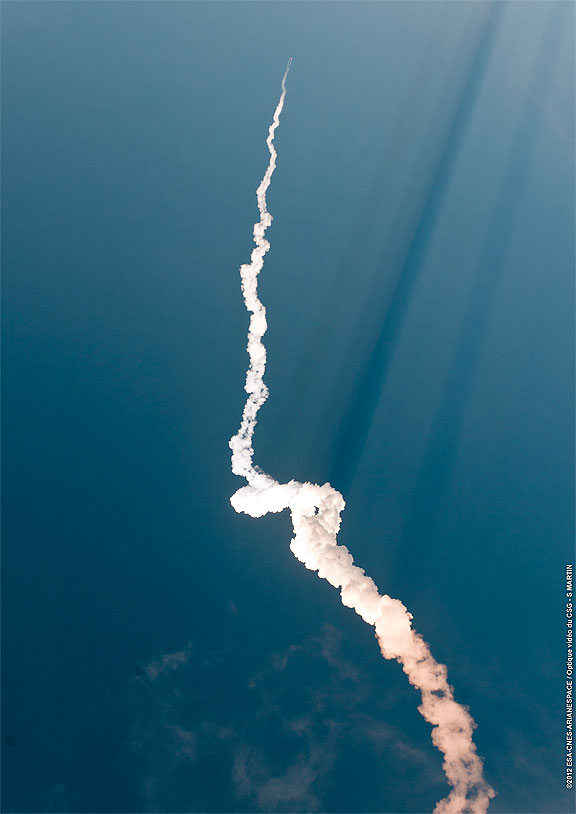
Ariane 5’s climb-out from the Spaceport is traced by its plume, which is twisted by upper-level winds. At the plume’s top, Ariane 5 is visible just after the jettison of its two solid propellant boosters. Photo courtesy of Arianespace.
This marks the 65th launch to date for Arianespace’s heavy-lift workhorse. Lifting off in late afternoon sunlight at 6:18 p.m. from the Spaceport in French Guiana, Ariane 5 deployed its ASTRA 2F and GSAT-10 satellite passengers during a flight lasting 30 minutes. This timing just prior to sunset provided a clear view of Ariane 5’s initial trajectory as it cleared a low cloud deck and continued the ascent, enabling tracking cameras to view the solid propellant booster’s separation at an altitude of 67.5km., as well as the payload fairing’s jettison at nearly 110km. above French Guiana. The launcher’s total payload lift performance was more than 10,200kg.,which included a combined mass of some 9,400kg. for the two spacecraft, along with Ariane 5’s multi-payload dispenser system and associated integration hardware.
Chairman & CEO Jean-Yves Le Gall said that this mission marked the 51st consecutive success for Ariane 5, “demonstrating Arianespace’s unrelenting efforts to insure reliability for its customers that is unequaled in the launch services industry.” Le Gall noted tonight’s flight represents a highpoint during Arianespace’s particularly successful month of September, in which the company announced new launch contracts at the World Satellite Business Week event in Paris, and its Starsem affiliate lofted the European Metop-B weather satellite from Kazakhstan’s Baikonur Cosmodrome.
ASTRA 2F was deployed first during the flight sequence, with its separation from Ariane 5 occurring 27 minutes after liftoff. It is the 36th satellite entrusted to Arianespace by the SES group, continuing a successful relationship that originated with the 1988 launch of ASTRA 1A using an Ariane 4 vehicle. With an estimated liftoff mass of 6,000kg., ASTRA 2F uses Astrium’s Eurostar E3000 satellite bus and carries Ku- and Ka-band payloads for the delivery of high performance DTH and next-generation broadband services in Europe, the Middle East and Africa. It will be operated by Luxembourg-based SES from an orbital location of 28.2 degrees East, which is one of the operator’s prime positions that serves such premium broadcasters as BSkyB, the BBC, ITV and Channel 5. From this geostationary slot, SES delivers programming to almost 13 million satellite homes and over three million cable homes, as well as 700,000 Internet Protocol television (IPTV) homes in the U.K. and Ireland. Additionally, 28.2 degrees East is used by SES to broadcast numerous channels for the growing DTH platforms in sub-Saharan Africa.
GSAT-10 was the second satellite orbited during Arianespace’s mission tonight from the Spaceport on its way to an orbital position of 83 degrees East, where it is to be operated by the Indian Space Research Organisation (ISRO). With this latest success, Arianespace has now lofted 15 spacecraft for ISRO, which designed, assembled and integrated GSAT-10 in Bangalore, India. Based on the I-3K satellite bus, GSAT-10 weighed approximately 3,400kg. at liftoff and carries 30 transponders as well as the GAGAN (GPS and GEO augmented navigation) system. It will provide Ku- and C-band relay capacity when it joins the Indian National Satellite (INSAT) system of geostationary spacecraft.
The next Arianespace flight is now set for October 12, using the Soyuz member of its launcher family on a mission from the Spaceport to loft two European Galileo navigation satellites.
