

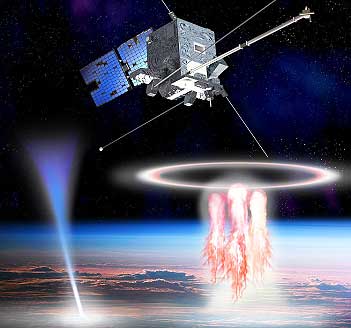
TARANIS will observe “elves” and other transient luminous events in Earth’s upper atmosphere. Credits: CNES/Ill. D. Ducros.
…CNES for the scientific satellite Taranis. Jean-Yves Le Gall, Chairman and CEO of Arianespace, and Marc Pircher, Director of the Toulouse Space Center, made the contract announcement which also includes options for the launch of two other CNES satellites, Microscope and Merlin.
Taranis is being developed by CNES using the Myriade platform and will weigh about 200kg at launch. It will be launched from the Guiana Space Center in a multiple launch by a Soyuz or Vega rocket, into a quasi-sun-synchronous orbit at an altitude of 700km between the end of 2015 and the end of 2016.
Taranis (Tool for the Analysis of RAdiation from lightNIng and Sprites) will study magnetosphere-ionosphere-atmosphere coupling via transient processes. The Taranis mission will focus in particular on two aspects: determining the characteristics and frequency of transient luminous events (TLE) involved in the coupling between the ionosphere and atmosphere, and characterizing the electron beams accelerated from the atmosphere to the magnetosphere.
