

• Skip to primary navigation
  • Skip to main content
  • Skip to primary sidebar
  • Skip to secondary sidebar
  • Skip to footer
  • NEWS:
  • SatNews
  • SatMagazine
  • MilSatMagazine
  • SmallSat News
  • |     EVENTS:
  • SmallSat Symposium
  • Satellite Innovation
  • MilSat Symposium
  • SmallSat Europe

SatNews

Satellite Industry Intelligence Since 1983

Subscribe
  • LATEST
  • SatNews Events
  • Magazines
  • Calendar
  • Subscribe
  • Missions & Constellations
    • Exploration & Science Missions
    • In-Orbit Servicing & Orbital Operations
    • LEO Constellations
    • Mission Autonomy & Onboard Systems
    • Mission Deployments & Manifests
    • Navigation & PNT
    • SmallSat
    • Spacecraft & Payload Technology
    View All in Missions & Constellations →
    The Silent Overhaul: How Software-Defined Routing and Cloud Ingestion Flattened the Aerospace Hardware StackThe Silent Overhaul: How Software-Defined Routing and Cloud Ingestion Flattened the Aerospace Hardware Stack
    Hybrid Earth Intelligence: NASA Expands Commercial Satellite Data Integration in $476M Cloud-Driven PushHybrid Earth Intelligence: NASA Expands Commercial Satellite Data Integration in $476M Cloud-Driven Push
    Hybrid Edge Mobility: Contrivian Launches “Horizon Plus” to Deliver Intelligent Multi-Orbit Field CommunicationsHybrid Edge Mobility: Contrivian Launches “Horizon Plus” to Deliver Intelligent Multi-Orbit Field Communications
    Space Tech vs. Biothreat: GMV Deploys Earth Observation and AI Core to Fight Invasive Pacific Seaweed in PortugalSpace Tech vs. Biothreat: GMV Deploys Earth Observation and AI Core to Fight Invasive Pacific Seaweed in Portugal
  • Business
    • Contracts & Commercial Deals
    • Earnings & Financial Reporting
    • Events & Conferences
    • Funding & Venture Capital
    • Market Forecasts
    • Mergers & Acquisitions
    • Personnel Moves & Appointments
    View All in Business & Finance →
    The Spatial Photonics Crunch: Inside the Invisible Supply Chain Threatening Orbital Laser NetworksThe Spatial Photonics Crunch: Inside the Invisible Supply Chain Threatening Orbital Laser Networks
    Sovereign Space Expansion: Spain’s FOSSA Systems Secures €9.25M to Scale Defense Constellation and SIGINT InfrastructureSovereign Space Expansion: Spain’s FOSSA Systems Secures €9.25M to Scale Defense Constellation and SIGINT Infrastructure
    Next-Gen Spatial Intelligence: BAE Systems Secures Agreement to Build High-Resolution Vantage Satellite Buses for VantorNext-Gen Spatial Intelligence: BAE Systems Secures Agreement to Build High-Resolution Vantage Satellite Buses for Vantor
    New Lobbying Force: Top NGSO Operators Unveil “SpaceConnect Association” in WashingtonNew Lobbying Force: Top NGSO Operators Unveil “SpaceConnect Association” in Washington
  • Defense
    • Counterspace & ASAT
    • Defense Budgets & Procurement
    • ISR & Reconnaissance
    • MILSATCOM
    • Missile Warning & Defense
    • National Security Programs
    • Space Domain Awareness
    View All in Military & Defense →
    Digital Twins for Space Command: Sedaro Tapped by Space Force to Build Federated Engineering PlatformDigital Twins for Space Command: Sedaro Tapped by Space Force to Build Federated Engineering Platform
    The Strategic Redistribution of Iranian Aerospace CapabilityThe Strategic Redistribution of Iranian Aerospace Capability
    Navigating Contested Battlespaces: Military GPS Receiver Market Approaches $3 Billion Amid Electronic Warfare SurgeNavigating Contested Battlespaces: Military GPS Receiver Market Approaches $3 Billion Amid Electronic Warfare Surge
    Preparing for Day One: DARPA Solicits Tech to Rebuild Destroyed Satellite Fleets Within HoursPreparing for Day One: DARPA Solicits Tech to Rebuild Destroyed Satellite Fleets Within Hours
  • Gov
    • Export Controls & Compliance
    • International Space Agreements
    • National Space Policy
    • Space Law & Treaties
    • Space Sustainability & Debris Policy
    • Space Traffic Management / Debris Removal
    View All in Government & Regulation →
    $3.57 Billion Milestone: FCC Advanced Wireless Services (AWS-3) Spectrum Auction Concludes$3.57 Billion Milestone: FCC Advanced Wireless Services (AWS-3) Spectrum Auction Concludes
    Who Has Authority to Intervene in a Space-Based Emergency?Who Has Authority to Intervene in a Space-Based Emergency?
    Staying in Their Lanes: SpaceX and Globalstar Join Forces to Defend Spectrum ExclusivityStaying in Their Lanes: SpaceX and Globalstar Join Forces to Defend Spectrum Exclusivity
    Orbital Paperwork War: China’s Spectrum Squatting Reserves 244,000 Satellite Slots to Combat SpaceX’s LEO MonopolyOrbital Paperwork War: China’s Spectrum Squatting Reserves 244,000 Satellite Slots to Combat SpaceX’s LEO Monopoly
  • Launch
    • Launch Providers
    • Launch Schedule & Calendars
    • Launch Sites & Infrastructure
    • Rocket Technology & Vehicles
    View All in Launch →
    Arianespace fights back – possibly!Arianespace fights back – possibly!
    Direct-to-Device Momentum: AST SpaceMobile Successfully Launches Giant Next-Gen BlueBird Satellites Atop SpaceX Falcon 9Direct-to-Device Momentum: AST SpaceMobile Successfully Launches Giant Next-Gen BlueBird Satellites Atop SpaceX Falcon 9
    SpaceX’s Secret ‘Starfall’ Capsule Wins FAA Approval for Pacific Reentry TestsSpaceX’s Secret ‘Starfall’ Capsule Wins FAA Approval for Pacific Reentry Tests
    Breaking the TRL Bottleneck: Space Phoenix Systems Debuts Cost-Effective Space Test-and-Return ServiceBreaking the TRL Bottleneck: Space Phoenix Systems Debuts Cost-Effective Space Test-and-Return Service
  • Software
    • Autonomous Ground Operations
    • Data Processing & AI/ML
    • Digital Twins & Modeling
    • Ground Segment & Teleports
    • Mission Planning & Simulation
    • Space Systems Software Engineering
    • Spectrum & Licensing
    View All in Software Automation & Ground Systems →
    Powering the Automated Floor: Intralogistics Operators Must Unify AGV Charging InfrastructurePowering the Automated Floor: Intralogistics Operators Must Unify AGV Charging Infrastructure
    Poland Sovereignty: GMV to Develop Core Ground Control Platform for CAMILA ConstellationPoland Sovereignty: GMV to Develop Core Ground Control Platform for CAMILA Constellation
    Software Over the Air: FatPipe Launches Acceleration Tool to Unclog Starlink and Amazon LEO LinksSoftware Over the Air: FatPipe Launches Acceleration Tool to Unclog Starlink and Amazon LEO Links
    Three LEO Operators Bet 2026 on a Supply Chain Built for 2027Three LEO Operators Bet 2026 on a Supply Chain Built for 2027
  • Services & Apps
    • Climate & Environmental Monitoring
    • Disaster Response & Security Mapping
    • Earth Observation & Imaging
    • Maritime & Aviation Satcom
    • Satellite Communications
    View All in Services & Applications →
    National SAR Defense: Norway Selects ICEYE for Nationwide Space-Based Flood and Hazard Monitoring SystemNational SAR Defense: Norway Selects ICEYE for Nationwide Space-Based Flood and Hazard Monitoring System
    Sovereign Milestone: OQ Technology Achieves Europe’s First Drone Video Transmission via 3GPP NTN LEO SatelliteSovereign Milestone: OQ Technology Achieves Europe’s First Drone Video Transmission via 3GPP NTN LEO Satellite
    Ghost Viewers trigger secondary ripple effect on Satellite Communications (SatCom)Ghost Viewers trigger secondary ripple effect on Satellite Communications (SatCom)
    Fleet-Wide Hybrid Networks: Marlink Integrates Starlink Across 80+ Oldendorff Carriers VesselsFleet-Wide Hybrid Networks: Marlink Integrates Starlink Across 80+ Oldendorff Carriers Vessels

UPDATE: United Launch Alliance… More Insight For Earth (Launch)

October 27, 2011

[SatNews] This event occurred with launch vehicle aplomb…


The Delta II launch of NASA’s NPP spacecraft. Photo by William G. Hartenstein, United Launch Alliance.
A United Launch Alliance Delta II rocket carrying the NPOESS Preparatory Project (NPP) spacecraft for NASA lifted off from Space Launch Complex-2W at Vandenberg AFB at 2:48 a.m. PDT today (Friday, October 28th). This is ULA’s 10th launch of the year and marked the 55th successful launch for the company.


Photo by William G. Hartenstein, United Launch Alliance
“ULA is proud to have served NASA with 50 Delta II launches, achieving 100 percent mission success for a very diverse array of exceptionally important science missions,” said Jim Sponnick, ULA vice president, Mission Operations. “Today’s successful NPP launch is a critical first step in demonstrating our country’s next-generation earth-observing satellite system. NPP will monitor weather conditions and gather climate data to greatly improve our knowledge of Earth’s systems.”

This mission was launched aboard a Delta II 7920-10 configuration vehicle featuring a ULA first stage booster powered by a Pratt & Whitney Rocketdyne RS-27A main engine and nine Alliant Techsystems (ATK) strap-on solid rocket motors. An Aerojet AJ10-118K engine powered the second stage. The payload was encased by a 10-foot-diameter composite payload fairing.

“In addition to the NPP spacecraft, the Delta II also carried three Poly Picosatellite Orbital Deployers (P-POD) dispensers on the upper stage that deployed six cubesats following completion of the primary NPP mission,” said Sponnick. “We are pleased that ULA can provide access to space for these university research satellites and expand the reach of the science community.”

NPP will extend and improve upon the Earth climate data records established by NASA’s Earth Observing System (EOS) fleet of satellites that have provided critical insights into the dynamics of the entire Earth system: clouds, oceans, vegetation, ice, solid Earth and atmosphere. “The Delta II vehicle continues to offer excellent reliability and best value to our customers,” said Sponnick. “We look forward to working with our customers to provide future Delta II launches here at Vandenberg.”

ULA’s next launch is the Atlas V Mars Science Laboratory mission for NASA, scheduled for November 25, 2011, from Space Launch Complex-41 at Cape Canaveral Air Force Station, Florida. ULA program management, engineering, test, and mission support functions are headquartered in Denver, Colorado. Manufacturing, assembly and integration operations are located at Decatur, Alabama., and Harlingen, Texas. Launch operations are located at Cape Canaveral AFS, Florida, and Vandenberg AFB, California.

Previously reported regarding this important launch and satellite…

Jim Sponnick VP of Mission Operations at ULA writes…
United Launch Alliance (ULA) is proud to launch the NPOESS Preparatory Project (NPP) mission. The Delta II will deliver the NPP spacecraft into a polar earth orbit, where it will begin its mission to create a next-generation U.S. climate and weather monitoring system. NPP is the fourth of five critical missions ULA is scheduled to launch for NASA in 2011. These missions will address important questions of science — ranging from climate and weather on planet earth to life on other planets and the origins of the solar system. We are delighted that NASA has chosen the Delta II for this mission developed by the Goddard Space Flight Center (GSFC) and manufactured by the Ball Aerospace and Technology Corporation.
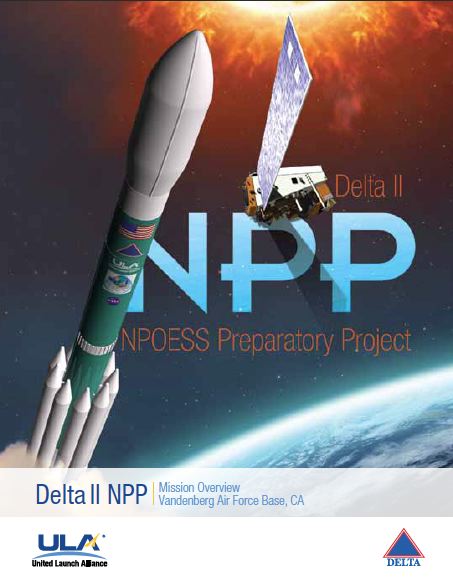
ULA is focused on attaining Perfect Product Delivery for the NPP mission, which includes a relentless focus on mission success (the perfect product) one launch at a time, and also excellence and continuous improvement in meeting all of the needs of our customers (the perfect delivery).

I congratulate the entire ULA team and our mission partners for their significant efforts in bringing NPP to launch. Go Delta, Go NPP!


Delta ii 7920-10C launch vehicle — Overview Delta II 7920-10C launch vehicle
NPP will carry a diverse payload of scientific instruments to perform atmospheric temperature and moisture sounding, cloud imaging, sea surface temperature measurements, as well as measurements of ozone, land and ocean biological productivity, aerosol concentrations, and climate system radiation balance. Data from NPP will be distributed to meteorologists at the National Oceanic and Atmospheric Administration (NOAA) and the U.S. Department of Defense (DOD), as well as to climate researchers around the globe.


The NPP spacecraft stands atop the Delta II rocket that will lift it into Earth orbit. Photo credit: NASA/Don Kososka, VAFB
Many of NPP’s measurements continue long-term climate data records from existing Earth-observing missions such as Terra, Aqua and Aura. By flying a suite of new, advanced-technology remote sensing instruments, the NPP mission will continue critical weather and climate measurements and reduce risk for the next-generation meteorological satellite system. The measurements taken by NPP will provide critical data to support operational weather forecasting, as well as long-term climate research.

NPP’s five-year mission duration will help to bridge critical weather data collection requirements until the Joint Polar Satellite System (JPSS), managed by the (NOAA), is launched in 2015.

The five instruments manifested for flight on the NPP spacecraft trace their heritage to instruments on NASA’s Terra, Aqua and Aura missions, on NOAA’s Polar Operational Environmental Satellite (POES) spacecraft, and on the DOD’s Defense Meteorological Satellite Program (DMSP). These instruments are: • Visible/Infrared Imager Radiometer Suite (VIIRS) • Cross-track Infrared Sounder (CrIS) • Advanced Technology Microwave Sounder (ATMS) • Ozone Mapping and Profiler Suite (OMPS) • Clouds and Earth Radiant Energy System (CERES) The NPP spacecraft was built for the NASA Goddard Space Flight Center by the Ball Aerospace and Technologies Corporation of Boulder, Colorado.

Expanded View

The Delta II vehicle will launch the NPP spacecraft from Space Launch Complex 2 West (SLC- 2W) at Vandenberg Air Force Base down an initial flight azimuth of 196° from true north. Six solid rocket motors (SRM) are lit on the ground and burn for approximately 64.0 seconds. Jettison occurs at 86.0 seconds after launch in order to satisfy range safety trajectory shaping constraints.

Three air-lit SRMs are ignited at 65.5 seconds, burn until 130 seconds and are jettisoned 2 seconds after burnout. Main engine cutoff (MECO) occurs 263.4 seconds after liftoff when booster propellants are depleted. First stage separation follows 8 seconds later with second stage ignition occurring at 276.9 seconds.

Payload fairing jettison occurs at 280 seconds when the free molecular heating rate has dropped below 0.1 BTU/ft2-sec (1135 W/m2). Following the first cut-off of the second-stage engine (SECO-1) at 623.7 seconds, the second stage performs an attitude reorientation maneuver and begins a thermal conditioning roll.

Upon completion of the thermal conditioning roll a maneuver is performed to orientate the second stage to the correct attitude for the first restart. Following the first restart, the second stage is re-oriented to the desired attitude for spacecraft separation, which occurs at 3,525 seconds in view of the TDRS satellites for telemetry coverage. Spacecraft separation ends the primary portion of this Delta II mission at just short of 59 minutes after liftoff.

Filed Under: Launch Providers

Primary Sidebar

Coverage

  • Missions & Constellations
  • Business & Finance
  • Military & Defense
  • Launch
  • Software Automation & Ground Systems
  • Government & Regulation
  • Services & Applications

Most Read Stories

  • SpaceX’s Secret ‘Starfall’ Capsule Wins FAA Approval for Pacific Reentry Tests
  • American military space closed around one company in seven days
  • Analyst Projects Massive Subscription Growth for Starlink Ahead of Imminent SpaceX IPO
  • Major opportunities for 2 GHz over Europe
  • Amazon Leo Constellation Surpasses 330 Satellites Following Latest Atlas V Launch

Secondary Sidebar

Footer


Satnews is a leading provider of satellite news, events, publications, research and other satellite industry information in both commercial and military enterprises worldwide.

Stories By Category

  • Business & Finance
  • Government & Regulation
  • Launch
  • Military & Defense
  • Missions & Constellations
  • Services & Applications
  • Software Automation & Ground Systems
  • Spectrum & Licensing
  • Startups & NewSpace Business

About Us

  • Leadership & Editorial Team
  • SatNews History
  • Free Satnews Subscription
  • SatNews Events
  • Magazines

Navigation

  • Latest Stories
  • Magazines
  • Events
  • Contact
  • Cookie & Privacy Policy for Satnews

We use cookies to ensure that we give you the best experience on our website. If you continue to use this site we will assume that you are happy with it.
x
Sign up Now (For Free)
Access daily or weekly satellite news updates covering all aspects of the commercial and military satellite industry.
Invalid email address
Notify Me Regarding ( At least one ):
We value your privacy and will not sell or share your email or other information with any other company. You may also unsubscribe at anytime.

Click Here to see our full privacy policy.
Thanks for subscribing!