• Skip to primary navigation
  • Skip to main content
  • Skip to primary sidebar
  • Skip to secondary sidebar
  • Skip to footer
  • NEWS:
  • SatNews
  • SatMagazine
  • MilSatMagazine
  • SmallSat News
  • |     EVENTS:
  • SmallSat Symposium
  • Satellite Innovation
  • MilSat Symposium
  • SmallSat Europe

SatNews

Satellite Industry Intelligence Since 1983

Subscribe
  • LATEST
  • SatNews Events
  • Magazines
  • Calendar
  • Subscribe
  • Missions & Constellations
    • Exploration & Science Missions
    • In-Orbit Servicing & Orbital Operations
    • LEO Constellations
    • Mission Autonomy & Onboard Systems
    • Mission Deployments & Manifests
    • Navigation & PNT
    • SmallSat
    • Spacecraft & Payload Technology
    View All in Missions & Constellations →
    The Astronaut Wears Prada. Axiom Space and the Inner Layer of Next-Generation Lunar SpacesuitThe Astronaut Wears Prada. Axiom Space and the Inner Layer of Next-Generation Lunar Spacesuit
    Analyst Projects Massive Subscription Growth for Starlink Ahead of Imminent SpaceX IPOAnalyst Projects Massive Subscription Growth for Starlink Ahead of Imminent SpaceX IPO
    Emergency Alert on the ISS: NASA Orders Safe Haven Amid Russian Module Leak RepairsEmergency Alert on the ISS: NASA Orders Safe Haven Amid Russian Module Leak Repairs
    KSAT and iQPS Expand Strategic Alliance to Accelerate High-Frequency SAR ConstellationKSAT and iQPS Expand Strategic Alliance to Accelerate High-Frequency SAR Constellation
  • Business
    • Contracts & Commercial Deals
    • Earnings & Financial Reporting
    • Events & Conferences
    • Funding & Venture Capital
    • Market Forecasts
    • Mergers & Acquisitions
    • Personnel Moves & Appointments
    View All in Business & Finance →
    Brian Hughes Appointed as New Director of NASA’s Kennedy Space Center to Oversee Surging Launch DemandBrian Hughes Appointed as New Director of NASA’s Kennedy Space Center to Oversee Surging Launch Demand
    Beyond Mega-Constellations: Iridium and Globalstar Emerge as Prime Defense and IoT Investment PlaysBeyond Mega-Constellations: Iridium and Globalstar Emerge as Prime Defense and IoT Investment Plays
    SpaceX IPO: Will all that glitters turn to…….?SpaceX IPO: Will all that glitters turn to…….?
    Pilot Photonics Secures €1M ESA Contract to Advance Space PhotonicsPilot Photonics Secures €1M ESA Contract to Advance Space Photonics
  • Defense
    • Counterspace & ASAT
    • Defense Budgets & Procurement
    • ISR & Reconnaissance
    • MILSATCOM
    • Missile Warning & Defense
    • National Security Programs
    • Space Domain Awareness
    View All in Military & Defense →
    American military space closed around one company in seven daysAmerican military space closed around one company in seven days
    MDA Space Selected by BAE Systems for U.S. Space Force Missile Warning ConstellationMDA Space Selected by BAE Systems for U.S. Space Force Missile Warning Constellation
    ParaZero Secures First DefendAir Order from U.S. Tier-1 Defense CorporationParaZero Secures First DefendAir Order from U.S. Tier-1 Defense Corporation
    Northrop Grumman Partners with Apex for Space-Based Interceptors Targeting 2027 DeliveryNorthrop Grumman Partners with Apex for Space-Based Interceptors Targeting 2027 Delivery
  • Gov
    • Export Controls & Compliance
    • International Space Agreements
    • National Space Policy
    • Space Law & Treaties
    • Space Sustainability & Debris Policy
    • Space Traffic Management / Debris Removal
    View All in Government & Regulation →
    Major opportunities for 2 GHz over EuropeMajor opportunities for 2 GHz over Europe
    “Dual-use” is the funding word. It’s also the label operators want off.“Dual-use” is the funding word. It’s also the label operators want off.
    Sovereignty got an answer on Day 3. Two answers, actually, and a commercial veto.Sovereignty got an answer on Day 3. Two answers, actually, and a commercial veto.
    Dependency killed the old debate. Sovereignty is the new one, and Europe hasn’t agreed what it means.Dependency killed the old debate. Sovereignty is the new one, and Europe hasn’t agreed what it means.
  • Launch
    • Launch Providers
    • Launch Schedule & Calendars
    • Launch Sites & Infrastructure
    • Rocket Technology & Vehicles
    View All in Launch →
    Twelve Scientific Payloads Experience Microgravity Aboard SubOrbital Express-5Twelve Scientific Payloads Experience Microgravity Aboard SubOrbital Express-5
    Amazon Leo Constellation Surpasses 330 Satellites Following Latest Atlas V LaunchAmazon Leo Constellation Surpasses 330 Satellites Following Latest Atlas V Launch
    If You Thought Space Was Hard Try to Get Your Satellite On a RocketIf You Thought Space Was Hard Try to Get Your Satellite On a Rocket
    Blue Origin Suffers Major Setback as New Glenn Rocket Explodes During Static Fire TestBlue Origin Suffers Major Setback as New Glenn Rocket Explodes During Static Fire Test
  • Software
    • Autonomous Ground Operations
    • Data Processing & AI/ML
    • Digital Twins & Modeling
    • Ground Segment & Teleports
    • Mission Planning & Simulation
    • Space Systems Software Engineering
    • Spectrum & Licensing
    View All in Software Automation & Ground Systems →
    KSAT and Axelspace Expand Strategic Partnership to Accelerate Earth ObservationKSAT and Axelspace Expand Strategic Partnership to Accelerate Earth Observation
    Europe has ships. SmallSat Europe said it doesn’t have ports.Europe has ships. SmallSat Europe said it doesn’t have ports.
    The orbital data center thesis just became an economics question.The orbital data center thesis just became an economics question.
    AI just reached production in European space. The trust problem is what comes next.AI just reached production in European space. The trust problem is what comes next.
  • Services & Apps
    • Climate & Environmental Monitoring
    • Disaster Response & Security Mapping
    • Earth Observation & Imaging
    • Maritime & Aviation Satcom
    • Satellite Communications
    View All in Services & Applications →
    Viasat Secures Lockheed Martin Contract for NOAA’s Next-Generation AircraftViasat Secures Lockheed Martin Contract for NOAA’s Next-Generation Aircraft
    SES Partners with Viva to Launch Multi-Orbit In-Flight ConnectivitySES Partners with Viva to Launch Multi-Orbit In-Flight Connectivity
    Resolve Optics Delivers Radiation-Resistant Lenses for LEO SatellitesResolve Optics Delivers Radiation-Resistant Lenses for LEO Satellites
    SITAEL Unveils €200 Million Growth Strategy and ESA Mission Contract at SmallSat EuropeSITAEL Unveils €200 Million Growth Strategy and ESA Mission Contract at SmallSat Europe

Spitzer Specials… Dumbell Detection (Imagery)

August 11, 2011

[SatNews] If this were an inkblot test, you might see a bow tie or a butterfly depending on your personality.


An astronomer would likely see the remains of a dying star scattered about space — precisely what this is. NASA‘s Spitzer Space Telescope captured this infrared view of what’s called a planetary nebula, which is a cloud of material expelled by a burnt out star, called a white dwarf. This object is named the Dumbbell nebula after its resemblance to the exercise equipment in visible-light views. “It is interesting how different Spitzer’s view of the Dumbbell looks compared to optical images,” said Dr. Joseph Hora, the principal investigator of the observations from the Harvard Smithsonian Center for Astrophysics, Cambridge, Mass.


In Spitzer’s infrared view, the diffuse green glow, which is brightest near the center, is probably from hot gas atoms being heated by the ultraviolet light from the central white dwarf. A collection of clumps fill the central part of the nebula, and red-colored radial spokes extend well beyond. Astronomers think these features represent molecules of hydrogen gas, mixed with traces of heavier elements. Despite being broken apart by the ultraviolet light from the central white dwarf, much of this molecular material may survive intact and mix back into interstellar gas clouds, helping to fuel the next generation of stars.


NASA’s Jet Propulsion Laboratory, Pasadena, Calif., manages the Spitzer Space Telescope mission for NASA’s Science Mission Directorate, Washington. Science operations are conducted at the Spitzer Science Center at the California Institute of Technology in Pasadena. Caltech manages JPL for NASA.
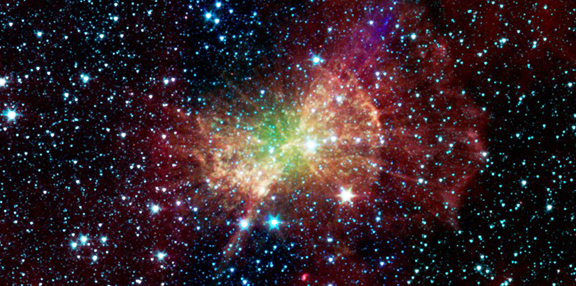


About the image above: The “Dumbbell nebula,” also known as Messier 27, pumps out infrared light in this image from NASA’s Spitzer Space Telescope. It was discovered in 1764 by Charles Messier, who included it as the 27th member of his famous catalog of nebulous objects. Though he did not know it at the time, this was the first in a class of objects, now known as “planetary nebulae,” to make it into the catalog.


Planetary nebulae, historically named for their resemblance to gas-giant planets, are now known to be the remains of stars that once looked a lot like our sun. When sun-like stars die, they puff out their outer gaseous layers. These layers are heated by the hot core of the dead star, called a white dwarf, and shine with infrared and visible-light colors. Our own sun will blossom into a planetary nebula when it dies in about five billion years.


The Dumbbell nebula is 1,360 light-years away in the Vulpecula constellation, and stretches across 4.5 light-years of space. That would more that fill the space between our sun and the nearest star, and it demonstrates how effective planetary nebulae are at returning much of a star’s material back to interstellar space at the end of their lives.


Spitzer’s infrared view shows a different side of this recycled stellar material. The diffuse green glow, which is brightest near the center, is probably from hot gas atoms being heated by the ultraviolet light from the central white dwarf. A collection of clumps fill the central part of the nebula, and red-colored radial spokes extend well beyond. Astronomers think these features represent molecules of hydrogen gas, mixed with traces of heavier elements. Despite being broken apart by the ultraviolet light from the central white dwarf, much of this molecular material may survive intact and mix back into interstellar gas clouds, helping to fuel the next generation of stars. Similar structures are seen in the Helix and other planetary nebulae.


This image was made using data from Spitzer’s infrared array camera. Blue shows infrared light with wavelengths of 3.6 microns, green represents 4.5-micron light and red, 8.0-micron light.


Filed Under: Exploration & Science Missions

Primary Sidebar

Coverage

  • Missions & Constellations
  • Business & Finance
  • Military & Defense
  • Launch
  • Software Automation & Ground Systems
  • Government & Regulation
  • Services & Applications

Most Read Stories

  • SmallSat Europe Speaker Focus: Frank M. Salzgeber, Nadir Space Venture
  • SpaceX Debuts Starship V3: Redefining Heavy-Lift Launch Capability
  • SpaceX Is Worth $1.75 Trillion. Only 7% of That Is Real.
  • FCC Approves Landmark Spectrum Sharing and Direct-to-Device Frameworks
  • SpaceX: 10,000 Launches Annually

Secondary Sidebar

Footer


Satnews is a leading provider of satellite news, events, publications, research and other satellite industry information in both commercial and military enterprises worldwide.

Stories By Category

  • Business & Finance
  • Government & Regulation
  • Launch
  • Military & Defense
  • Missions & Constellations
  • Services & Applications
  • Software Automation & Ground Systems
  • Spectrum & Licensing
  • Startups & NewSpace Business

About Us

  • Leadership & Editorial Team
  • SatNews History
  • Free Satnews Subscription
  • SatNews Events
  • Magazines

Navigation

  • Latest Stories
  • Magazines
  • Events
  • Contact
  • Cookie & Privacy Policy for Satnews

We use cookies to ensure that we give you the best experience on our website. If you continue to use this site we will assume that you are happy with it.
x
Sign up Now (For Free)
Access daily or weekly satellite news updates covering all aspects of the commercial and military satellite industry.
Invalid email address
Notify Me Regarding ( At least one ):
We value your privacy and will not sell or share your email or other information with any other company. You may also unsubscribe at anytime.

Click Here to see our full privacy policy.
Thanks for subscribing!


