

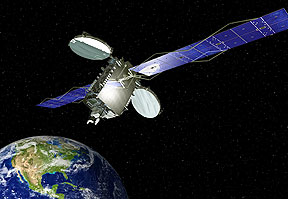
Artistic rendition of the SES-3 satellite, courtesy of Orbital Sciences
SES-3, the 45th satellite in the SES fleet, is part of a total fleet of more than 40 satellites of parent company SES and is scheduled for an International Launch Services launch on July 16th from the Baikonur Cosmodrome. The launch vehicle will be a Proton M/Breeze M, with a launch time of 05:16, Baikonur local time. The client is SES and the satellite manufacturer is Orbital Sciences Corporation.
The satellite is expected to replace AMC-1 at 103 degrees West in mid 2012 and provide continuity of service to the enterprise, government and media sectors from the center of the North American arc. SES-3 will be the home of key media companies delivering educational, international and high definition video channels throughout the U.S. The satellite will also be powering mobile communications, private networks and thousands of VSAT terminals for the enterprise community. SES-3 is the third satellite in a new generation of SES WORLD SKIES satellites bearing the “SES” name, joining the existing line of AMC satellites over North America and the NSS satellites covering the rest of the world.
The Proton M launch vehicle, using a 6-burn Breeze M mission design, will lift off from Pad 39 at Baikonur Cosmodrome, Kazakhstan, with the SES-3 satellite on board. This a shared launch configuration, where the SES-3 satellite is launched while mated to the top of the KazSat-2 satellite. The first three stages of the Proton will use a standard ascent profile to place the orbital unit (Breeze M upper stage and the SES-3 and KazSat-2 satellites) into a sub-orbital trajectory. From this point in the mission, the Breeze M will perform planned mission maneuvers to advance the orbital unit first to an elliptical parking orbit, then to an intermediate orbit, followed by a transfer orbit, and finally to a geosynchronous transfer orbit. Separation of the SES-3 satellite is scheduled to occur approximately 8 hours, 1 minute after liftoff. An hour later, the Breeze M that will place the KazSat-2 satellite directly into geosynchronous orbit. Separation of the KazSat-2 satellite is scheduled to occur approximately 9 hours, 24 minutes after liftoff.
