

• Skip to primary navigation
  • Skip to main content
  • Skip to primary sidebar
  • Skip to secondary sidebar
  • Skip to footer
  • NEWS:
  • SatNews
  • SatMagazine
  • MilSatMagazine
  • SmallSat News
  • |     EVENTS:
  • SmallSat Symposium
  • Satellite Innovation
  • MilSat Symposium
  • SmallSat Europe

SatNews

Satellite Industry Intelligence Since 1983

Subscribe
  • LATEST
  • SatNews Events
  • Magazines
  • Calendar
  • Subscribe
  • Missions & Constellations
    • Exploration & Science Missions
    • In-Orbit Servicing & Orbital Operations
    • LEO Constellations
    • Mission Autonomy & Onboard Systems
    • Mission Deployments & Manifests
    • Navigation & PNT
    • SmallSat
    • Spacecraft & Payload Technology
    View All in Missions & Constellations →
    Europe Space Networks Look to Scale Optical ConnectivityEurope Space Networks Look to Scale Optical Connectivity
    Iridium Opens Commercial Availability for Hardware-Level Assured PNT ModemsIridium Opens Commercial Availability for Hardware-Level Assured PNT Modems
    Air Launch Died the Same Week Responsive Space ArrivedAir Launch Died the Same Week Responsive Space Arrived
    FCC Authorizes Radio Operations for Reflect Orbital’s Light-Reflection Test SatelliteFCC Authorizes Radio Operations for Reflect Orbital’s Light-Reflection Test Satellite
  • Business
    • Contracts & Commercial Deals
    • Earnings & Financial Reporting
    • Events & Conferences
    • Funding & Venture Capital
    • Market Forecasts
    • Mergers & Acquisitions
    • Personnel Moves & Appointments
    View All in Business & Finance →
    MoffettNathanson Initiates Cautious “Neutral” Coverage on Post-IPO SpaceX ValuationsMoffettNathanson Initiates Cautious “Neutral” Coverage on Post-IPO SpaceX Valuations
    Ground Control Deploys RockFLEET for Large-Scale Turkish Fisheries VMS ProgramGround Control Deploys RockFLEET for Large-Scale Turkish Fisheries VMS Program
    Space ISAC to Convene Classified VOSS VII Summit in Colorado SpringsSpace ISAC to Convene Classified VOSS VII Summit in Colorado Springs
    Sat-Lite Technologies Secures $9.9M U.S. Army SATCOM Antenna ContractSat-Lite Technologies Secures $9.9M U.S. Army SATCOM Antenna Contract
  • Defense
    • Counterspace & ASAT
    • Defense Budgets & Procurement
    • ISR & Reconnaissance
    • MILSATCOM
    • Missile Warning & Defense
    • National Security Programs
    • Space Domain Awareness
    View All in Military & Defense →
    Space Rapid Capabilities Office Selects HawkEye 360’s ISA for GEO Radar-Warning Sensor DevelopmentSpace Rapid Capabilities Office Selects HawkEye 360’s ISA for GEO Radar-Warning Sensor Development
    Pulse Space Secures $40 Million U.S. Space Force Contract for Laser-Based Power Beaming TechnologyPulse Space Secures $40 Million U.S. Space Force Contract for Laser-Based Power Beaming Technology
    GAO Report Cites $11 Billion Cost Overruns and Launch Delivery Bottlenecks in Space Force PortfolioGAO Report Cites $11 Billion Cost Overruns and Launch Delivery Bottlenecks in Space Force Portfolio
    Space Force and True Anomaly Complete First Tactical Intercept of VICTUS HAZE MissionSpace Force and True Anomaly Complete First Tactical Intercept of VICTUS HAZE Mission
  • Gov
    • Export Controls & Compliance
    • International Space Agreements
    • National Space Policy
    • Space Law & Treaties
    • Space Sustainability & Debris Policy
    • Space Traffic Management / Debris Removal
    View All in Government & Regulation →
    Balancing Orbit: How Regulators Trade Commercial Viability for National SecurityBalancing Orbit: How Regulators Trade Commercial Viability for National Security
    The Supplemental Mobile Network and The Regional Threat.The Supplemental Mobile Network and The Regional Threat.
    BNP Paribas Outlines Steep Regulatory Obstacles in SpaceX Mobile Integration StrategyBNP Paribas Outlines Steep Regulatory Obstacles in SpaceX Mobile Integration Strategy
    NASA and Small Business Administration Launch SBIC Initiative to Fund Space Industrial BaseNASA and Small Business Administration Launch SBIC Initiative to Fund Space Industrial Base
  • Launch
    • Launch Providers
    • Launch Schedule & Calendars
    • Launch Sites & Infrastructure
    • Rocket Technology & Vehicles
    View All in Launch →
    China Achieves Historic First Orbital Booster Recovery via At-Sea Net SystemChina Achieves Historic First Orbital Booster Recovery via At-Sea Net System
    Blue Origin Insulates Lunar Landers from Launch Pad Recovery FalloutBlue Origin Insulates Lunar Landers from Launch Pad Recovery Fallout
    South Korea Formally Ratifies 2035 “K-Starlink” Low Earth Orbit Constellation PlanSouth Korea Formally Ratifies 2035 “K-Starlink” Low Earth Orbit Constellation Plan
    SEOPS Completes Multi-National Integration of 10 Payloads for SpaceX Transporter-17 MissionSEOPS Completes Multi-National Integration of 10 Payloads for SpaceX Transporter-17 Mission
  • Software
    • Autonomous Ground Operations
    • Data Processing & AI/ML
    • Digital Twins & Modeling
    • Ground Segment & Teleports
    • Mission Planning & Simulation
    • Space Systems Software Engineering
    • Spectrum & Licensing
    View All in Software Automation & Ground Systems →
    Seiren Solidifies Ground Segment Framework for FUSION-1 SmallSat Mission Through SSC and Infostellar PartnershipSeiren Solidifies Ground Segment Framework for FUSION-1 SmallSat Mission Through SSC and Infostellar Partnership
    Powering the Automated Floor: Intralogistics Operators Must Unify AGV Charging InfrastructurePowering the Automated Floor: Intralogistics Operators Must Unify AGV Charging Infrastructure
    Poland Sovereignty: GMV to Develop Core Ground Control Platform for CAMILA ConstellationPoland Sovereignty: GMV to Develop Core Ground Control Platform for CAMILA Constellation
    Software Over the Air: FatPipe Launches Acceleration Tool to Unclog Starlink and Amazon LEO LinksSoftware Over the Air: FatPipe Launches Acceleration Tool to Unclog Starlink and Amazon LEO Links
  • Services & Apps
    • Climate & Environmental Monitoring
    • Disaster Response & Security Mapping
    • Earth Observation & Imaging
    • Maritime & Aviation Satcom
    • Satellite Communications
    View All in Services & Applications →
    Rocket Lab Consolidates Vertical Integration Across Satellite Communications MarketRocket Lab Consolidates Vertical Integration Across Satellite Communications Market
    Astrolight Framework Urges Industrialized Laser Backbone to Protect European Space AutonomyAstrolight Framework Urges Industrialized Laser Backbone to Protect European Space Autonomy
    ESA Backs TUSK IC to Commercialize Made-in-Europe Ka-Band Flat-Panel Antenna SiliconESA Backs TUSK IC to Commercialize Made-in-Europe Ka-Band Flat-Panel Antenna Silicon
    Breaking Orbital Silence: Planet Labs Restores Strategic Middle East Imagery PipelinesBreaking Orbital Silence: Planet Labs Restores Strategic Middle East Imagery Pipelines

NASA | JPL… Cassini Captures More Than A Decade’s Worth Of Imagery

January 3, 2011

[SatNews] Ten years ago, on December 30, 2000, NASA’s Cassini spacecraft made its closest approach to Jupiter on its way to orbiting Saturn.


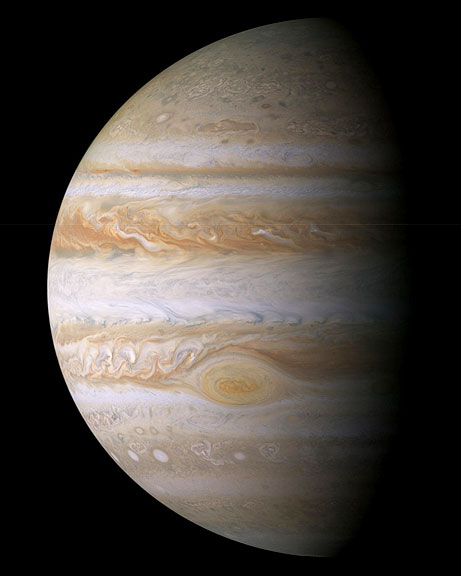
This true color mosaic of Jupiter was constructed from images taken by the narrow angle camera onboard NASA’s Cassini spacecraft on December 29, 2000, during its closest approach to the giant planet at a distance of approximately 10 million kilometers (6.2 million miles).
The main purpose was to use the gravity of the largest planet in our solar system to slingshot Cassini towards Saturn, its ultimate destination. But the encounter with Jupiter, Saturn’s gas-giant big brother, also gave the Cassini project a perfect lab for testing its instruments and evaluating its operations plans for its tour of the ringed planet, which began in 2004. Cassini spent about six months — from October 2000 to March 2001 — exploring the Jupiter system. The closest approach brought Cassini to within about 9.7 million kilometers (6 million miles) of Jupiter’s cloud tops at 2:05 a.m. Pacific Time, or 10:05 a.m. UTC, on Dec. 30, 2000. Cassini captured some 26,000 images of Jupiter and its moons over six months of continual viewing, creating the most detailed global portrait of Jupiter yet.

While Cassini’s images of Jupiter did not have higher resolution than the best from NASA’s Voyager mission during its two 1979 flybys, Cassini’s cameras had a wider color spectrum than those aboard Voyager, capturing wavelengths of radiation that could probe different heights in Jupiter’s atmosphere. The images enabled scientists to watch convective lightning storms evolve over time and helped them understand the heights and composition of these storms and the many clouds, hazes and other types of storms that blanket Jupiter. The Cassini images also revealed a never-before-seen large, dark oval around 60 degrees north latitude that rivaled Jupiter’s Great Red Spot in size. Like the Great Red Spot, the large oval was a giant storm on Jupiter. But, unlike the Great Red Spot, which has been stable for hundreds of years, the large oval showed itself to be quite transient, growing, moving sideways, developing a bright inner core, rotating and thinning over six months. The oval was at high altitude and high latitude, so scientists think the oval may have been associated with Jupiter’s powerful auroras.

The imaging team was also able to amass 70-day movies of storms forming, merging and moving near Jupiter’s north pole. They showed how larger storms gained energy from swallowing smaller storms, the way big fish eat small fish. The movies also showed how the ordered flow of the eastward and westward jet streams in low latitudes gives way to a more disordered flow at high latitudes. Meanwhile, Cassini’s composite infrared spectrometer was able to do the first thorough mapping of Jupiter’s temperature and atmospheric composition. The temperature maps enabled winds to be determined above the cloud tops, so scientists no longer had to rely on tracking features to measure winds. The spectrometer data showed the unexpected presence of an intense equatorial eastward jet (roughly 140 meters per second, or 310 mph) high in the stratosphere, about 100 kilometers (60 miles) above the visible clouds. Data from this instrument also led to the highest-resolution map so far of acetylene on Jupiter and the first detection of organic methyl radical and diacetylene in the auroral hot spots near Jupiter’s north and south poles. These molecules are important to understanding the chemical interactions between sunlight and molecules in Jupiter’s stratosphere.

As Cassini approached Jupiter, its radio and plasma wave instrument also recorded naturally occurring chirps created by electrons coming from a cosmic sonic boom. The boom occurs when supersonic solar wind – charged particles that fly off the sun – is slowed and deflected around the magnetic bubble surroun ding Jupiter. Because Cassini arrived at Jupiter while NASA’s Galileo spacecraft was still orbiting the planet, scientists were also able to take advantage of near-simultaneous measurements from two different spacecraft. This coincidence enabled scientists to make giant strides in understanding the interaction of the solar wind with Jupiter. Cassini and Galileo provided the first two-point measurement of the boundary of Jupiter’s magnetic bubble and showed that it was in the act of contracting as a region of higher solar wind pressure blew on it. In celebrating the anniversary of Cassini’s visit 10 years ago, scientists are also excited about the upcoming and proposed missions to the Jupiter system, including NASA’s Juno spacecraft, to be launched next August, and the Europa Jupiter System Mission, which has been given a priority by NASA.

Filed Under: Exploration & Science Missions

Primary Sidebar

Coverage

  • Missions & Constellations
  • Business & Finance
  • Military & Defense
  • Launch
  • Software Automation & Ground Systems
  • Government & Regulation
  • Services & Applications

Most Read Stories

  • Direct-to-Device Momentum: AST SpaceMobile Successfully Launches Giant Next-Gen BlueBird Satellites Atop SpaceX Falcon 9
  • Orbital Paperwork War: China's Spectrum Squatting Reserves 244,000 Satellite Slots to Combat SpaceX's LEO Monopoly
  • U.S. viewership of the 2026 World Cup via satellite television is strong and easily accessible
  • Arianespace fights back – possibly!
  • Monetizing the Airwaves: EchoStar’s Massive Spectrum Offloads to SpaceX and AT&T Fuel Satellite Sector Rally

Secondary Sidebar

Footer


Satnews is a leading provider of satellite news, events, publications, research and other satellite industry information in both commercial and military enterprises worldwide.

Stories By Category

  • Business & Finance
  • Government & Regulation
  • Launch
  • Military & Defense
  • Missions & Constellations
  • Services & Applications
  • Software Automation & Ground Systems
  • Spectrum & Licensing
  • Startups & NewSpace Business

About Us

  • Leadership & Editorial Team
  • SatNews History
  • Free Satnews Subscription
  • SatNews Events
  • Magazines

Navigation

  • Latest Stories
  • Magazines
  • Events
  • Contact
  • Cookie & Privacy Policy for Satnews

We use cookies to ensure that we give you the best experience on our website. If you continue to use this site we will assume that you are happy with it.
x
Sign up Now (For Free)
Access daily or weekly satellite news updates covering all aspects of the commercial and military satellite industry.
Invalid email address
Notify Me Regarding ( At least one ):
We value your privacy and will not sell or share your email or other information with any other company. You may also unsubscribe at anytime.

Click Here to see our full privacy policy.
Thanks for subscribing!