

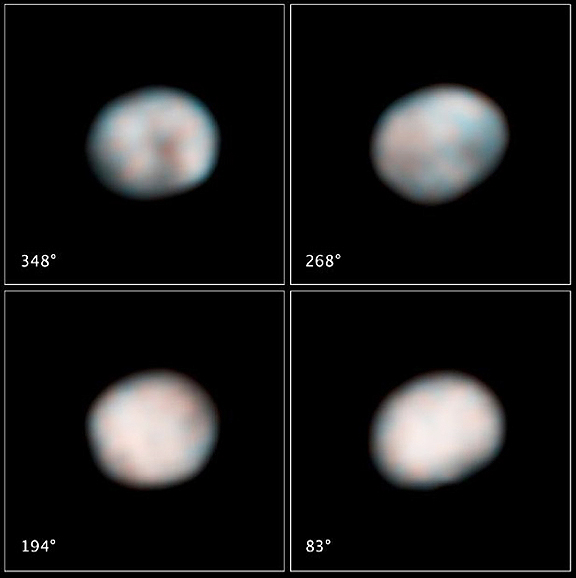
Each of the four Hubble images captures views of Vesta during its 5.34-hour rotation period. Hubble’s sharp “eye” can see features as small as about 40 kilometers (25 miles) across in these images. Vesta was 211 million kilometers (131 million miles) from Earth when Hubble made the observations. The images show the difference in brightness and color on the asteroid’s surface. These characteristics hint at the large-scale features that the Dawn spacecraft will see when it visits the potato-shaped asteroid. Vesta is somewhat like our moon, with ancient lava beds (the dark patches) and powdery debris, the pulverized remains of impacts (the orange-colored areas). The flattened area on one end of Vesta, visible in the top row of images, is a giant impact crater formed by a collision billions of years ago. The crater is 460 kilometers (285 miles) across, which is close to Vesta’s roughly 530-kilometer (330-mile) diameter. Vesta is about the size of Arizona. Credit: NASA/ESA/STScI/UMd
Scientists have constructed a video from the images that will help improve pointing instructions for Dawn as it is placed in a polar orbit around Vesta. Analyses of Hubble images revealed a pole orientation, or tilt, of approximately four degrees more to the asteroid’s east than scientists previously thought. This means the change of seasons between the southern and northern hemispheres of Vesta may take place about a month later than previously expected while Dawn is orbiting the asteroid. The result is a change in the pattern of sunlight expected to illuminate the asteroid. Dawn needs solar illumination for imaging and some mapping activities.
The recent images were obtained by Hubble’s Wide Field Camera 3 in February. The images complemented previous ones of Vesta taken from ground-based telescopes and Hubble’s Wide Field and Planetary Camera 2 between 1983 and 2007. Jian-Yang Li, a scientist participating in the Dawn mission from the University of Maryland in College Park, and his colleagues looked at 216 new images — and a total of 446 Hubble images overall — to clarify how Vesta was spinning. The journal Icarus recently published the report online. Launched in September 2007, Dawn will leave Vesta to encounter the dwarf planet Ceres in 2015. Vesta and Ceres are the most massive objects in the main asteroid belt between Mars and Jupiter. Scientists study these celestial bodies as examples of the building blocks of terrestrial planets like Earth. Dawn is approximately 216 million kilometers (134 million miles) away from Vesta. Next summer, the spacecraft will make its own measurements of Vesta’s rotating surface and allow mission managers to pin down its axis of spin.
