

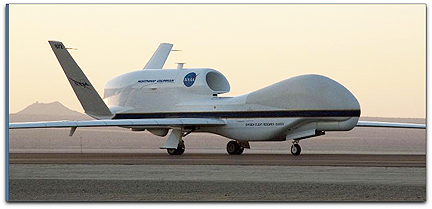
 The flight on October 23rd included checkout of aircraft systems, including engine, flight controls and communication. The flight also included demos of key features of a new ground control segment that introduces Northrop Grumman’s common mission management system architecture. This architecture could serve as the baseline for efforts to support the U.S. Department of Defense common ground station initiative and future unmanned systems. The first Earth science mission will be the joint NASA-NOAA Global Hawk Pacific, or GloPac. This campaign will consist of six long-duration missions over the Pacific and Arctic regions scheduled to begin in early 2010. Eleven NASA and NOAA scientific instruments integrated into one of NASA’s Global Hawk aircraft will collect atmospheric data while flying through the upper troposphere and lower stratosphere. The primary science objective of the mission is to perform calibration of instruments and validation of data from the AURA satellite, one of NASA’s 15 science satellites currently observing the Earth.
The two NASA Global Hawk aircraft were transferred to NASA Dryden by the U.S. Air Force in 2007. NASA announced plans to use them for missions supporting its Science Mission Directorate and the Earth science community that require high-altitude, long-endurance, long-distance airborne capability. Northrop Grumman will share in use of the aircraft to conduct its own flight demonstrations for expanded markets, missions and
