

 The Asteroid Watch site also contains links for the interested public to sign up for NASA‘s new asteroid widget and Twitter account. The new Asteroid Watch site provides information on NASA’s missions to study comets, asteroids, and near-Earth objects, and also provides the basic facts and the very latest in science and research on these objects. News about near-Earth object discoveries and Earth flybys will be available and made accessible on the site via a downloadable widget and RSS feed. And for those who want to learn about their space rocks on the go, a Twitter feed is offered. Asteroid Watch also contains a link to JPL’s more technical Near-Earth Objects Web site, where many scientists and researchers studying near-Earth objects go for information. NASA supports surveys that detect and track asteroids and comets passing close to Earth. The Near-Earth Object Observation Program, commonly called Spaceguard, also plots the orbits of these objects to determine if any could be potentially hazardous to our planet. JPL is a division of the California Institute of Technology in Pasadena.
Watch Out! Mebbe Even Duck And Cover… Asteroids Heading Your Way…
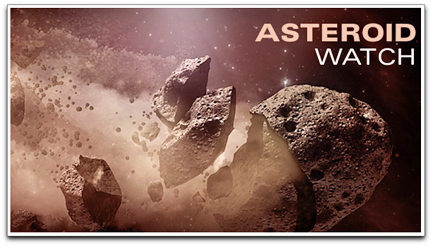
NASA’s Jet Propulsion Laboratory is introducing a new Web site that will provide a centralized resource for information on near-Earth objects — those asteroids and comets that can approach Earth.
The Asteroid Watch site also contains links for the interested public to sign up for NASA‘s new asteroid widget and Twitter account. The new Asteroid Watch site provides information on NASA’s missions to study comets, asteroids, and near-Earth objects, and also provides the basic facts and the very latest in science and research on these objects. News about near-Earth object discoveries and Earth flybys will be available and made accessible on the site via a downloadable widget and RSS feed. And for those who want to learn about their space rocks on the go, a Twitter feed is offered. Asteroid Watch also contains a link to JPL’s more technical Near-Earth Objects Web site, where many scientists and researchers studying near-Earth objects go for information. NASA supports surveys that detect and track asteroids and comets passing close to Earth. The Near-Earth Object Observation Program, commonly called Spaceguard, also plots the orbits of these objects to determine if any could be potentially hazardous to our planet. JPL is a division of the California Institute of Technology in Pasadena.
The Asteroid Watch site also contains links for the interested public to sign up for NASA‘s new asteroid widget and Twitter account. The new Asteroid Watch site provides information on NASA’s missions to study comets, asteroids, and near-Earth objects, and also provides the basic facts and the very latest in science and research on these objects. News about near-Earth object discoveries and Earth flybys will be available and made accessible on the site via a downloadable widget and RSS feed. And for those who want to learn about their space rocks on the go, a Twitter feed is offered. Asteroid Watch also contains a link to JPL’s more technical Near-Earth Objects Web site, where many scientists and researchers studying near-Earth objects go for information. NASA supports surveys that detect and track asteroids and comets passing close to Earth. The Near-Earth Object Observation Program, commonly called Spaceguard, also plots the orbits of these objects to determine if any could be potentially hazardous to our planet. JPL is a division of the California Institute of Technology in Pasadena.
