

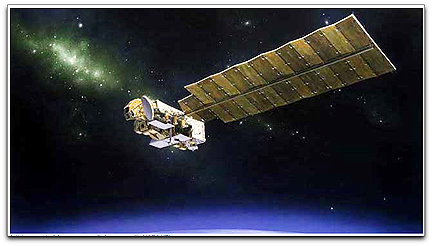
 Aura‘s data are helping scientists address global climate change issues such as global warming; the global transport, distribution and chemistry of polluted air; and ozone depletion in the stratosphere, the layer of Earth’s atmosphere that extends from roughly 15 to 50 kilometers (10 to 30 miles) in altitude. Two of Aura’s four instruments were designed, built and managed by NASA‘s Jet Propulsion Laboratory, Pasadena, California: the Microwave Limb Sounder and the Tropospheric Emission Spectrometer. Five years after launch, both instruments are still going strong, providing a wealth of data to climate scientists around the world.
The Microwave Limb Sounder is a 2G instrument helping scientists improve our understanding of ozone in Earth’s stratosphere, especially how it is depleted by processes of chlorine chemistry. The instrument measures naturally occurring microwave thermal emission from the edge of Earth’s atmosphere to remotely sense vertical profiles of atmospheric gases, temperature, pressure and cloud ice. The Tropospheric Emission Spectrometer is an infrared sensor designed to study Earth’s troposphere, the layer of Earth’s atmosphere where we live. The spectrometer is gathering data on how gases are distributed globally in Earth’s lower atmosphere. These data are being used to create three-dimensional models of the chemistry of the lower atmosphere, the interactions between the lower atmosphere and the biosphere, and the exchange of gases between Earth’s troposphere and stratosphere. NASA’s Goddard Space Flight Center manages the Aura mission for NASA’s Science Mission Directorate.
