

 The planned launch of WorldView-2, DigitalGlobe’s second nexgen class high-resolution satellite, is expected to nearly double DigitalGlobe’s collection capabilities to approximately two million square kilometers per day, enable intra-day revisits to specific geographic areas, and enhance the company’s ability to collect up-to-date imagery in those areas of greatest interest to its customers. The additional capacity and more frequent revisit rate are expected to provide DigitalGlobe’s customers with up-to-date and comprehensive high-resolution satellite imagery products and services. The planned launch of WorldView-2 will make DigitalGlobe the only commercial earth imagery provider with 8-band multi-spectral capability, which has a more robust color palette and enables enhanced analysis of the earth’s surface. The additional multi-spectral band capability of WorldView-2 is expected to enable higher levels of feature identification and extraction, and more accurately reflect the world’s natural color with the potential to benefit many applications, including environmental monitoring, change detection, and defense and intelligence. Upon launch, WorldView-2 will join DigitalGlobe’s two other high-resolution satellites in orbit, QuickBird and WorldView-1. WorldView-2 is expected to be able to collect imagery at 0.46 meter resolution. Due to NOAA operating license restrictions, all imagery will be re-sampled to 0.50 meter resolution unless the U.S. Government has granted a customer-specific waiver of the restriction.
World View From WorldView-2 To Be Accomplished On October 6th
DigitalGlobe (NYSE: DGI) has announced that the Company’s WorldView-2 high-resolution, 8-band multi-spectral satellite is scheduled to launch on October 6th, 2009, from Vandenberg Air Force Base in California.
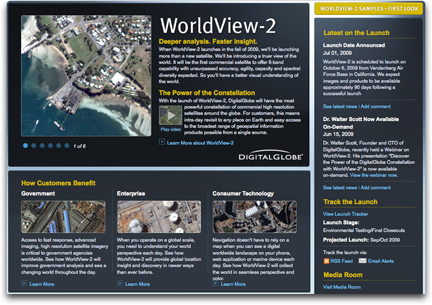
The planned launch of WorldView-2, DigitalGlobe’s second nexgen class high-resolution satellite, is expected to nearly double DigitalGlobe’s collection capabilities to approximately two million square kilometers per day, enable intra-day revisits to specific geographic areas, and enhance the company’s ability to collect up-to-date imagery in those areas of greatest interest to its customers. The additional capacity and more frequent revisit rate are expected to provide DigitalGlobe’s customers with up-to-date and comprehensive high-resolution satellite imagery products and services. The planned launch of WorldView-2 will make DigitalGlobe the only commercial earth imagery provider with 8-band multi-spectral capability, which has a more robust color palette and enables enhanced analysis of the earth’s surface. The additional multi-spectral band capability of WorldView-2 is expected to enable higher levels of feature identification and extraction, and more accurately reflect the world’s natural color with the potential to benefit many applications, including environmental monitoring, change detection, and defense and intelligence. Upon launch, WorldView-2 will join DigitalGlobe’s two other high-resolution satellites in orbit, QuickBird and WorldView-1. WorldView-2 is expected to be able to collect imagery at 0.46 meter resolution. Due to NOAA operating license restrictions, all imagery will be re-sampled to 0.50 meter resolution unless the U.S. Government has granted a customer-specific waiver of the restriction.
The planned launch of WorldView-2, DigitalGlobe’s second nexgen class high-resolution satellite, is expected to nearly double DigitalGlobe’s collection capabilities to approximately two million square kilometers per day, enable intra-day revisits to specific geographic areas, and enhance the company’s ability to collect up-to-date imagery in those areas of greatest interest to its customers. The additional capacity and more frequent revisit rate are expected to provide DigitalGlobe’s customers with up-to-date and comprehensive high-resolution satellite imagery products and services. The planned launch of WorldView-2 will make DigitalGlobe the only commercial earth imagery provider with 8-band multi-spectral capability, which has a more robust color palette and enables enhanced analysis of the earth’s surface. The additional multi-spectral band capability of WorldView-2 is expected to enable higher levels of feature identification and extraction, and more accurately reflect the world’s natural color with the potential to benefit many applications, including environmental monitoring, change detection, and defense and intelligence. Upon launch, WorldView-2 will join DigitalGlobe’s two other high-resolution satellites in orbit, QuickBird and WorldView-1. WorldView-2 is expected to be able to collect imagery at 0.46 meter resolution. Due to NOAA operating license restrictions, all imagery will be re-sampled to 0.50 meter resolution unless the U.S. Government has granted a customer-specific waiver of the restriction.
