

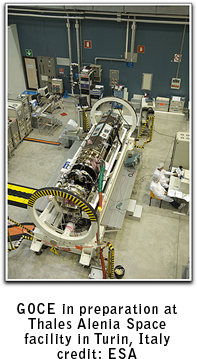
 A new launch date has been set for GOCE. The change of date is due to precautionary measures taken after the malfunction of an upper-stage section of a Russian Proton launcher. Now confirmed not to affect GOCE‘s Rockot launcher, the most advanced gravity mission to date is scheduled for lift-off on September 10th, 2008. As a consequence of the new launch date, the Gravity field and steady-state Ocean Circulation Explorer (GOCE) satellite is currently undergoing final flight reconfiguration at ESA-ESTEC in the Netherlands. Shipment to the Plesetsk launch site in northern Russia will take place in July, from where the five-metre long GOCE spacecraft will be carried into its unusually low orbit on a modified SS-19 Russian Intercontinental Ballistic Missile (ICBM) launcher. The adaptation of the SS-19, called ‘Rockot‘, uses the two original lower stages of the ICBM in conjunction with an upper-stage called Breeze-KM for commercial payloads.
Since August last year, the high-tech GOCE spacecraft has been undergoing extensive testing at ESA’s test facilities in the Netherlands. The program included a wide range of qualification tests to ensure that the satellite could withstand the rigours of launch as well as the harsh environment of space. One such series of tests was carried out in the Large Space Simulator where, under vacuum, the extreme heat of the Sun is simulated by lamps and mirrors – subjecting the satellite to 1400W of power over each square metre of the side of the satellite that faces the Sun. Once launched, GOCE will begin to map global variations in the gravity field with unprecedented detail and accuracy. This will result in a unique model of the geoid, which is the surface of equal gravitational potential defined by the gravity field – crucial for deriving accurate measurements of ocean circulation and sea-level change, both of which are affected by climate change. GOCE-derived data is also much needed to understand more about processes occurring inside the Earth and for use in practical applications such as surveying and levelling.
