

Making Ready For Red Planet Arrival
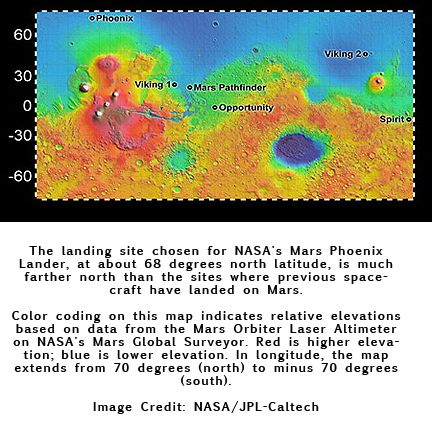
NASA’s Phoenix Mars Lander is preparing to end its long journey and start a three-month mission to taste and sniff fistfuls of Martian soil and buried ice. The lander is scheduled to touch down on the Red Planet May 25. Phoenix will enter the top of the Martian atmosphere at almost 13,000 mph. In seven minutes, the spacecraft must complete a challenging sequence of events to slow to about 5 mph before its three legs reach the ground. Confirmation of the landing could come as early as 7:53 p.m. EDT. Rocks large enough to spoil the landing or prevent opening of the solar panels present the biggest known risk. However, images from the High Resolution Imaging Science Experiment (HiRISE) camera on NASA‘s Mars Reconnaissance Orbiter, detailed enough to show individual rocks smaller than the lander, have helped lessen that risk. Phoenix uses hardware from a spacecraft built for a 2001 launch that was canceled in response to the loss of a similar Mars spacecraft during a 1999 landing attempt. Researchers who proposed the Phoenix mission in 2002 saw the unused spacecraft as a resource for pursuing a new science opportunity—repurposement at its finest!
