Oerlikon Space has delivered the MIE spectrometer (MSP) for the European wind observation satellite ADM-Aeolus. Together with a second Oerlikon Space spectrometer, the MSP is the core element in the payload of the wind observation satellite, which the European Space Agency ESA plans to launch in 2009. The second instrument, the Rayleigh spectrometer, was already delivered in January 2007.
Oerlikon Space devoted four years to the development and construction of the spectrometer. One particular challenge that they faced was the extreme precision with which the instrument had to be manufactured and assembled in order to meet the demanding requirements of space missions. The individual elements had to be aligned with an accuracy of within one arc-second (1/3600th of a degree). There are already a number of satellites in existence that deliver data for weather forecasting and climate research. However, the instruments carried by these satellites have so far not been able to measure the wind patterns around the globe, or only inadequately. ADM-Aeolus will fill this gap.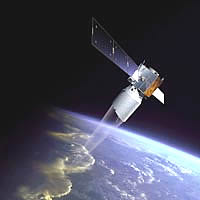
ADM-Aeolus, an Earth Explorer
The two spectrometers
The two spectrometers supplied by Oerlikon Space are part of ALADIN (Atmospheric Laser Doppler Instrument) , a lidar that ADM-Aeolus uses to acquire its data. Lidars are laser devices used for measuring distance and velocity. In principle, the lidar on board the Aeolus satellite works in much the same way as the laser devices used by the police to measure the speed of vehicles. However, ALADIN is far more complex and powerful and is capable of determining wind speeds and wind directions from several hundred kilometers away. To do this, it emits laser pulses that are reflected by the atmosphere. A telescope recaptures this “echo” and passes on the signals to the two spectrometers built by Oerlikon Space. The time taken for the backscattered light to be reflected from the atmosphere and the frequency shift caused by the Doppler effect make it possible to determine the distribution of moisture and the currents and wind conditions in the atmosphere.
The two spectrometers are not the only contribution by Oerlikon Space to the construction of the ADM-Aeolus satellite. The aluminum structure of the satellite, which altogether weighs about one metric ton, is likewise supplied by the company as is ALADIN’s “laser chopper”, a precision mechanism that prevents the receiver optics and electronics from dazzling and destroying themselves on emitting the high-power laser pulse—Zurich, Switzerland
- Skip to primary navigation
- Skip to main content
- Skip to primary sidebar
- Skip to secondary sidebar
- Skip to footer


Satellite Industry Intelligence Since 1983
Footer

Satnews is a leading provider of satellite news, events, publications, research and other satellite industry information in both commercial and military enterprises worldwide.