DAYTON, OHIO: August 20, 2007—Satnews Daily—Hang on for a slew of acronyms… Increment 2 In-Process Review (IPR-2); Integrated overhead Non-Imaging Infrared (ONIR); Tasking, Processing, Exploitation and Dissemination (TPED) Systems (IOTS)—phew, what a mouthful! But Ball Aerospace & Technologies Corporation has managed to complete each and every one of those tasks, otherwise known as the IOTS Increment 2 In-Process Review. They should be congratulated not only on their IPR-2 success, but also simply due to the fact they were able to squeeze all of those acronyms into their documentation!
Uh, oh, we’re not done yet… IOTS is a program of the National Air and Space Intelligence Center (NASIC) and a representative from that organization as well as representatives from the National Geospatial-Intelligence Agency (NGA), the Aerospace Corporation, and Riverside Research Institute all arrived at the same conclusions… the IPR-2 was successful.
The IOTS will provide capabilities to process and exploit existing and future ONIR sensor data. This end-to-end integrated system ingests, archives, processes, analyzes and reports data collected by current and future space-based infrared sensors. This functionality was demo’d within the Ball Aerospace & Technologies facility in Dayton Ohio and the focus was on subsystem interface validation.
We could not complete this tale of victory without a few more acronyms tossed in, just for good measure. The IOTS has been a three-year process. Supporting the company were Booz Allen & Hamilton, Inc., Command Technologies, Inc. (CTI), Northrop Grumman’s Electronic Systems sector, Oracle Federal Systems (OFS), Raytheon Company (RTN), Structural Computing LLC, and Science Applications International Corp. (SAIC).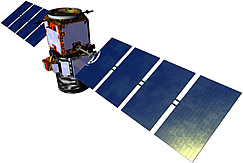
The CALIPSO satellite
NASA has also recognized Ball Aerospace employees for their accomplishments on the successful Cloud-Aerosol LIDAR and Infrared Pathfinder Satellite Observations satellite (CALIPSO) mission. The NASA Group Achievement award was given to the company, and this is the highest honor the agency awards to non-government personnel groups.
The company designed and built CALIPSO’s suite of scientific instruments, including the CALIP LIDAR and Wide-Field Camera. The lidar system provided unique views of the atmosphere, including radiances from each of the instruments and vertical feature mask and cloud layer products not previously available. Lidar is an optical, remote sensing technology measuring the properties of scattered light in order to find the range as well as other information of a distant target. Lidar uses radio waves, rather than light, and as is the case with radar, an object’s range is determined by measuring the time delay between transmission of a pulse and detection of the signal that’s reflected. CALIPS was launched, in tandem, with the CloudSat satellite aboard a Boeing Delta III Rocket on April 28, 2006, from Vandenberg Air Force Base, California.
And last, but far from least, NASA has also recognized the company’s Project Engineer Paul Finley with the Exceptional Public Service Medal for his work on the Spitzer Space Telescope. He has been tracking telemetry and predicting mission lifetime since the 2003 launch of Spitzer.
- Skip to primary navigation
- Skip to main content
- Skip to primary sidebar
- Skip to secondary sidebar
- Skip to footer


Satellite Industry Intelligence Since 1983
Footer

Satnews is a leading provider of satellite news, events, publications, research and other satellite industry information in both commercial and military enterprises worldwide.