

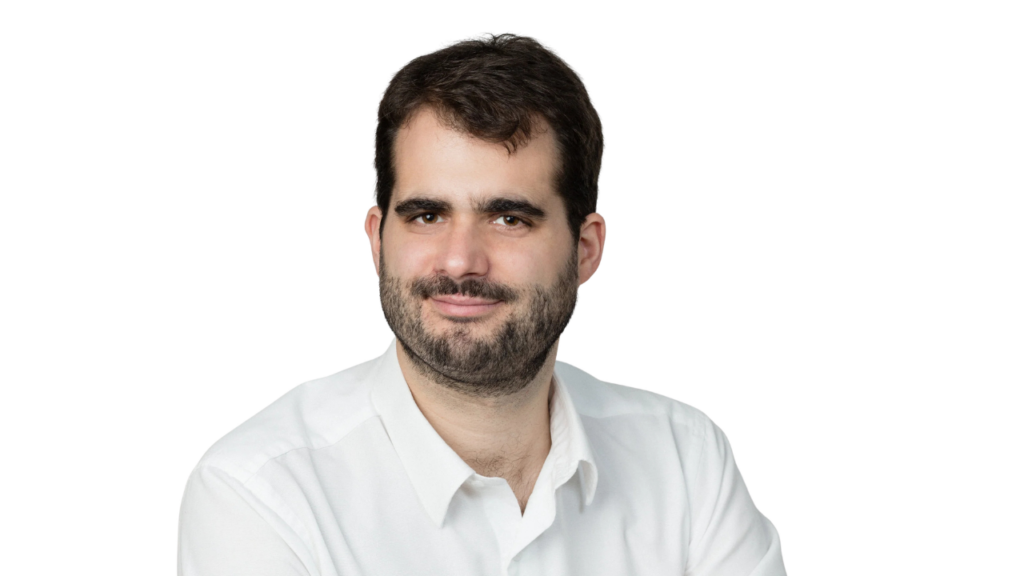
The satellite industry has built roughly 10 percent of the optical ground infrastructure it needs. That estimate, from a SatNews analysis of the Pentagon’s optical mesh network and commercial downlink requirements, puts the global gap at 200 to 500 optical ground stations. Jean-François Morizur co-founded Cailabs in 2013 to close it.
Morizur holds two doctoral degrees in quantum optics, from Sorbonne University and the Australian National University. While working on his thesis at the Kastler Brossel Laboratory in Paris, he co-invented Multi-Plane Light Conversion, a photonics technique that reshapes laser beams to compensate for atmospheric turbulence. That technology underpins the TILBA-OGS L10, Cailabs’ optical ground station, which delivers bidirectional data rates above 10 gigabits per second between satellites in low Earth orbit and the ground. TIME named it one of the Best Inventions of 2025.
Before founding Cailabs, Morizur worked as a senior associate at Boston Consulting Group. The company he built afterward now employs more than 175 people, including over 120 engineers and 40 PhDs, from offices in Rennes, France, and the United States.
In September 2025, Cailabs secured €57 million in funding led by the European Investment Bank, with participation from Bpifrance’s Definvest and Fonds Innovation Defense, NewSpace Capital, the European Innovation Council, and Starquest Capital. The capital is funding production scale-up toward a target of 50 optical ground stations per year by 2027. That same month, SES signed on to test the TILBA-OGS L10 ahead of integrating optical links into commercial satellite services. Cailabs also partnered with DataPath, a Gilat subsidiary, to build transportable optical terminals for military users. On April 3, 2026, South Korea’s CONTEC deployed its second Cailabs-equipped optical ground station at the Asian Space Park.
Defense and government programs represent the largest share of demand. Optical links are harder to intercept and jam than radio frequency signals, and the throughput advantage over RF grows as constellation sizes increase. But commercial operators are following. Cailabs is developing stations capable of data rates above 100 gigabits per second and extending support from LEO to medium and geostationary orbits.
At SmallSat Europe, where Cailabs is an exhibitor, Morizur joins the panel “Quantum-Ready Constellations: Optical Comms and QKD for Unhackable Links,” alongside SES VP of Business Development for Innovation Thierry Draus, Craft Prospect Head of Missions Hazel Quibell, and Odysseus Space Co-Founder and CEO Jordan Vannitsen. The panel explores whether optical communications and quantum key distribution can secure satellite networks against quantum computing threats.
Morizur co-invented the physics during his PhD. Then he built the product. Now he is scaling the factory to meet demand the rest of the industry has not yet built for.
