
On October 13, 2026, the Korea AeroSpace Administration (KASA) confirmed that the SD-1 Sat nanosatellite established successful two-way ground communications on its initial attempt following an October 7 launch from the Naro Space Center.
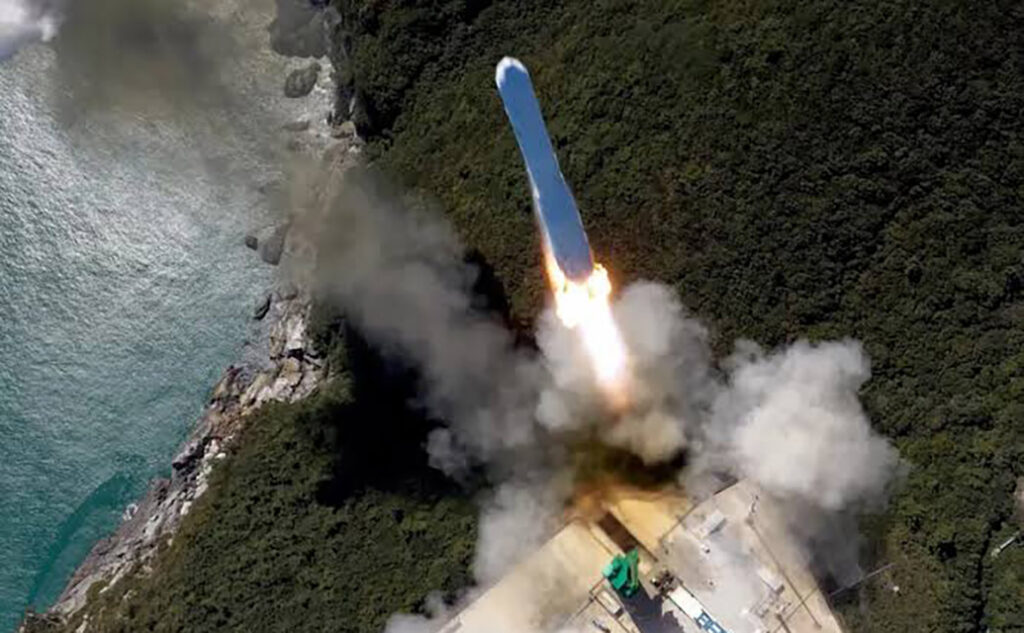
Orbiting aboard SD-1 Sat, a 3U CubeSat operated by Korean space startup Space & Bean, is ArbaLabs’ ArbaEdge payload—an edge-computing module conducting an in-orbit proof-of-concept demonstration for autonomous artificial intelligence (AI) verification.
Orbital Platform and Edge Computing Architecture
The satellite was deployed during the fifth flight of South Korea’s three-stage Nuri (KSLV-II) launch vehicle alongside secondary commercial and academic smallsat missions. Operating as a 3U CubeSat bus, SD-1 Sat provides electrical power, thermal management, and radio frequency communication for the ArbaEdge demonstrator.
ArbaEdge is engineered to generate independent, tamper-evident records of what an onboard AI model executed directly on the physical hardware, operating entirely offline without relying on ground downlinks or cloud connectivity. By running in tandem with on-device inference processes, the system creates verifiable evidence of model identity, operational context, and runtime execution fingerprints to prove computational integrity in remote or disconnected orbital environments.
Korean Launch Cadence and Mission Heritage
The mission reflects expanding commercial activity within South Korea’s space ecosystem under KASA oversight. The launch aligns with South Korea’s accelerated national space strategy, which utilizes domestic Nuri rocket flights to qualify commercial subsystems, imaging hardware, and software payloads in low Earth orbit. Space & Bean’s successful two-way ground acquisition confirms primary spacecraft bus operations, enabling the team to begin payload testing.
In-Orbit Demonstration Timeline
Over its planned four-month operational campaign in low Earth orbit, ArbaEdge will execute standalone verification test cycles to assess offline AI accountability under spaceflight conditions. Because the orbital mission functions as a preliminary technology proof of concept, mission operators indicated that detailed verification metrics and runtime performance data will remain internal for several months before being released publicly.