

On Tuesday, July 7, 2026, SpaceX successfully launched its Transporter-17 dedicated small satellite rideshare mission from Space Launch Complex 4E (SLC-4E) at Vandenberg Space Force Base in California.
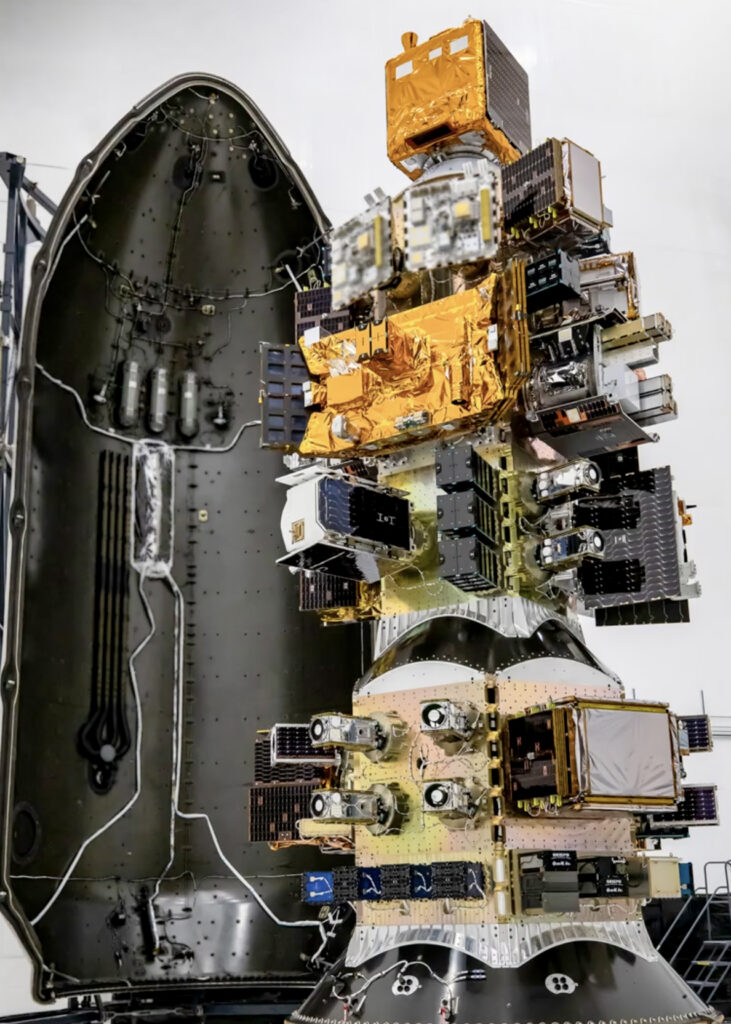
However, concurrent with the milestone deployment, small satellite operators and mission integrators confirmed that SpaceX has stopped accepting new commercial launch bookings for both its Sun-Synchronous Orbit (SSO) Transporter series and mid-inclination Bandwagon missions beyond late 2028.
The unexpected capacity freeze has triggered industry-wide logistical concerns as capital-constrained startups confront a sudden bottleneck to space access.
Transporter-17 Mission Integration Metrics
Despite long-term capacity concerns, the July 7 launch successfully processed a dense multi-satellite manifest:
- Total Payload Volume: The Falcon 9 first-stage booster B1097 successfully injected 81 customer payloads into low-Earth orbit (LEO).
- Integration Profiles: The flight manifest comprised a highly diversified mix of international CubeSats, micro-satellites, hosted payloads, and orbital transfer vehicles (OTVs).
- Integrator Execution: Mission logistics were managed by third-party aggregators, with Exolaunch processing 49 individual customer satellites and SEOPS completing multi-national cleanroom integration for an additional 10 multi-national hulls.
- Recovery Status: Following stage separation, the flight-proven booster executed a nominal vertical touchdown on the autonomous droneship Of Course I Still Love You in the Pacific Ocean.
Shifts in Internal Payload Priorities
The sudden suspension of future commercial rideshare slots stems from a broader reallocation of internal launch infrastructure. Industry analysts report that SpaceX is increasingly prioritizing its internal Falcon 9 and Starship launch capacity to accelerate the deployment of the next-generation Starlink constellation.
Furthermore, the launch provider is devoting significant payload volume toward building out its highly anticipated orbital artificial intelligence (AI) data centers, leaving minimal excess mass margin to support the low-cost commercial smallsat sector beyond the contracts already locked into the 2026–2028 manifests.
The Small Satellite Bottleneck
Since the program’s inception in 2020, SpaceX’s sub-$300,000 baseline price point for standard CubeSat slots completely transformed NewSpace business models, rendering legacy, dedicated small-lift launch vehicles economically non-viable. The halt on new bookings past 2028 leaves a massive supply vacuum in the market.
Startups that have raised capital based on ultra-cheap, highly predictable Transporter flight cadences must now face significantly higher launch costs or prolonged deployment delays, altering the economic baseline for emerging remote sensing and communications constellations.
Competitive Opportunities for Alternative Launchers
The closing of SpaceX’s future rideshare pipeline offers an immediate lifeline to the global small-lift launcher market. Competitors across the United States, Europe, and Asia—many of which have struggled to compete with Falcon 9’s pricing—are positioning their vehicles to absorb the displaced smallsat demand. Micro-launcher developers and emerging solid-fuel operators are actively marketing open manifest slots for 2028 and beyond to shield operators from extended storage overhead.
