

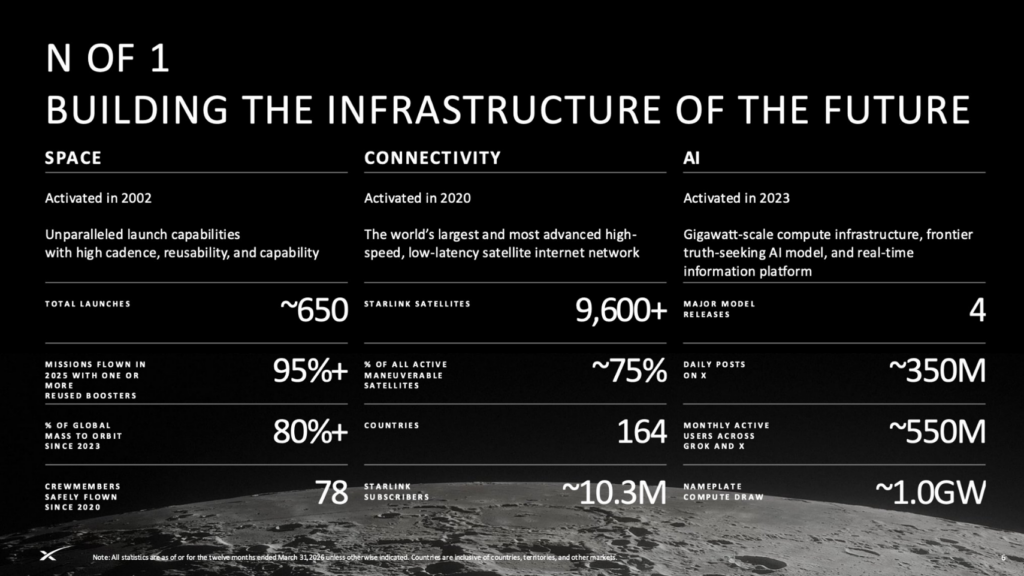
Chris Forrester — Amidst all the hundreds of newspaper and news broadcast items covering the upcoming SpaceX IPO, few have dared to consider that the much-heralded and hyped near-$2 trillion end-valuation for SpaceX might create impacts down the line that have yet realised.
On Wednesday last week (June 3) investment firm Oppenheimer, which operates as a full-service brokerage and investment bank, dared to suggest that there might be troubles ahead, if not for SpaceX and Starlink but in the reshaping of the world’s communications landscape as Starlink grows its coverage and subscriptions.

Oppenheimer identified legacy broadband companies, including AT&T, as among the firms most exposed to the shift. The firm highlighted the increasing competitive threat posed by Elon Musk’s company to traditional broadband providers.
Oppenheimer said SpaceX’s Starlink satellite broadband division is positioned to reshape the US communications landscape as its network expands and gains more customers. The brokerage identified legacy broadband companies as among the firms most exposed to the shift.
The impact of the IPO and growing strength of Starlink could indeed be bad news for investors in the likes of AT&T and the other North American telco giants. Indeed, the Oppenheimer statement sent telco stocks plummeting. AT&T shares fell sharply with worries that investors may be underestimating the long-term competitive risks posed by satellite broadband services.
The impact of a rich and powerful SpaceX on AT&T, Verizon and the other cellular players could then be magnified to a global impact. And that’s not to mention the other satellite-to-cellular players such as AST SpaceMobile and Amazon’s LEO system or Telesat’s Lightspeed system in Canada. Viasat’s upcoming joint-venture with Abu Dhabi’s Space42 is another would be player, and likely to win support in the Gulf and nearby Arab nations.
Coincidentally, last week saw Lynk Global, another would-be direct-to-cellular (D2C) satellite operator, itself in the process to merging with Omnispace which operates with similar objectives, informing the FCC that it has started testing its service in Taiwan.
Its local partner is Taiwan Mobile (however, Taiwan Mobile was recently – March 2026 – saying it was working with AST Space Mobile).
Lynk, which has as a major shareholder SES, was confirming to the FCC that it now has “all the necessary authorisations and agreements” to perform direct-to-device supplementary coverage from space over Taiwan.
Lynk Smallsat System announced its plans to merge with Omnispace in October last year. At the time of the announcement it stated: “Following the merger, SES will become a major strategic shareholder, facilitating a robust deployment of D2D and IoT services for mobile network operator (MNO), enterprise and government customers as part of a multi-orbit, multi-spectrum network architecture.”
“The combined entity will leverage Omnispace’s 60 MHz of globally coordinated S-band spectrum and its high-priority filings with the International Telecommunication Union (ITU), optimized for D2D services. Omnispace’s licensed mobile satellite spectrum is compliant with 3GPP standards for non-terrestrial networks (NTN), and adheres to national regulatory frameworks. It includes the largest S-band market access footprint, reaching over 1 billion people across the Americas, Europe, Africa and Asia. This foundation enables accelerated global deployment and scalable service delivery,” according to Lynk’s October 2025 announcement.
For consumers and businesses, the rise of these many satellite-based internet services could increase competition across the satellite and terrestrial broadband sector. Competition is always a good thing, and although it is much too early to say whether Starlink – or its rivals – can significantly eat into the market share of established telecom providers remains uncertain, but Oppenheimer’s report signals that investors should be very wary and take the possibility seriously.
The bottom line – which is almost certain – is that Starlink and its growing number of rivals will provoke Churn amongst the established players and that’s without even mentioning Starlink’s ability to launch its own range of handsets into the half-a-trillion dollar handset market. The various D2C rivals will build the infrastructure of the future, and the eventual impact for terrestrial players could be dramatic.
“Should SpaceX execute on its mission…it will be the modern-day East India Company of space, controlling routes, infrastructure, and commerce of an entire frontier and giving it a quasi-sovereign reach, far beyond that of any ordinary corporation,” Oppenheimer told clients.
