

On May 21, 2026, senior defense and aerospace officials confirmed that the Defense Advanced Research Projects Agency (DARPA) and Northrop Grumman have finalized the schedule for the historic Robotic Servicing of Geosynchronous Satellites (RSGS) mission.
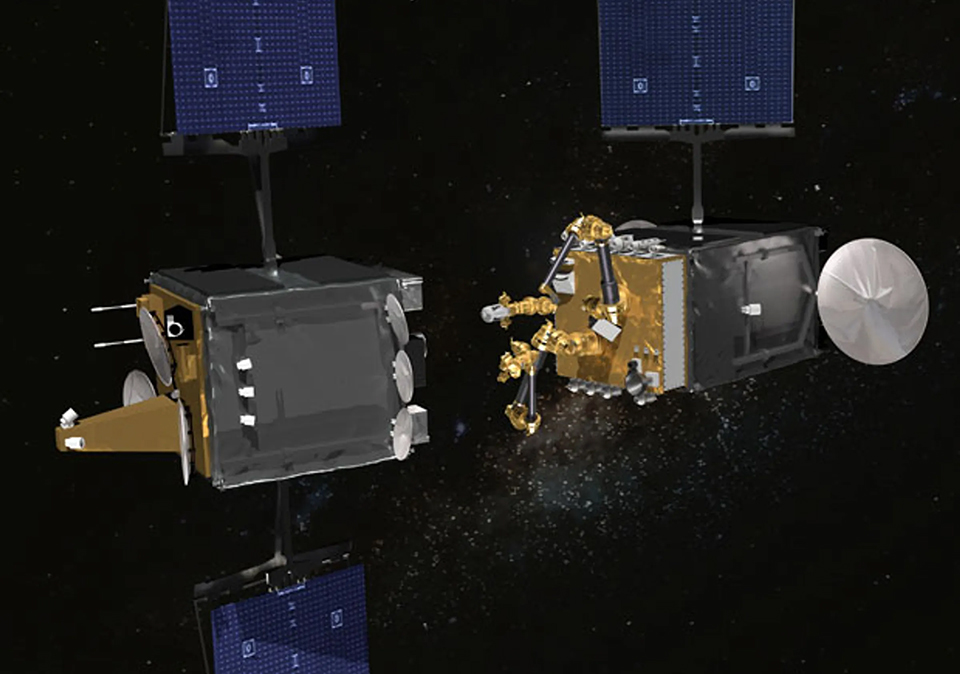
Slated for launch later this summer from Cape Canaveral Space Force Station, Florida, the deployment marks the activation of the United States’ first multi-mission robotic servicing capability in high Earth orbit.
The mission represents a fundamental shift in military and commercial space architecture—transitioning the sector away from its legacy “launch-and-abandon” paradigm toward an infrastructure economy built on modular upgrades, active debris mitigation, and dynamic fleet maneuverability.
The Mechanics of the Mission Robotic Vehicle (MRV)
The operational flagship of the mission is the Mission Robotic Vehicle (MRV), a commercial satellite bus developed by Northrop Grumman’s specialized subsidiary, SpaceLogistics. The integration marks a landmark public-private partnership, mating Northrop’s flight-proven station-keeping platform with a highly advanced, government-funded payload developed by DARPA and the U.S. Naval Research Laboratory (NRL).
The structural core of the MRV is built around an autonomous robotic servicing suite:
- Dual Dexterous Robotic Arms: Engineered by the NRL, these highly agile robotic manipulators can execute sub-centimeter mechanical tasks in zero-gravity conditions, adjusting to components on spacecraft that were never originally designed to be handled by a machine.
- Autonomous Proximity Sensing: Utilizing machine-vision tracking, lidar arrays, and infrared targeting, the MRV can approach non-cooperative, tumbling satellites safely without triggering accidental collisions.
- Modular Multi-Tool Enclosures: The robotic limbs can hot-swap functional mechanical tools in-stride, allowing the vehicle to adapt from close-range structural inspections to cutting protective thermal blankets or clearing jammed solar arrays.
The Mission Profile: Upgrades 36,000 Kilometers Up
The upcoming flight manifest will be launched aboard a dedicated SpaceX Falcon 9 rocket, fully purchased by Northrop Grumman. Because the MRV relies on highly efficient but slow-thrusting electric propulsion, it will take approximately 10 months following orbital injection to systematically motor its way up to the geosynchronous Earth orbit (GEO) belt, roughly 36,000 kilometers above the planet’s surface.
Once in position, the MRV’s primary objective for its initial demonstration phase will be the mechanical installation of three Mission Extension Pods (MEPs), which are also riding along on the Falcon 9 launch vehicle.
Unlike Northrop’s previous generation of massive, integrated Mission Extension Vehicles (MEVs)—which kept client satellites operational by physically latching onto them and acting as a permanent secondary engine—the new MEPs function as compact, low-cost propulsion “jet packs.” Using its robotic arms, the MRV will mechanically bolt an individual MEP directly onto the rear docking ring of a fuel-depleted client satellite. Once attached, the pod assumes all station-keeping and orbital maneuvering tasks for the host, instantly granting an aging, multi-million-dollar communications or national security satellite an extra six years of operational utility. Once installation is complete, the MRV simply detaches and flies away to service the next target.
Dynamic Space Operations and the Fueling Frontier
The arrival of the MRV comes at a critical juncture for the U.S. Space Force, which is aggressively funding “Dynamic Space Operations.” Modern military doctrine requires satellites to actively maneuver through orbit to evade hostile anti-satellite weapons or counter electronic jamming, an operational strategy currently limited by strict onboard fuel constraints.
To break this vulnerability, the MRV is engineered to transition smoothly into the Space Force’s next-generation infrastructure push: Project Elixir. Under a separate 70 million dollar contract, the MRV will serve as the primary orbital testbed for the military’s upcoming hydrazine refueling demonstrations, using a specialized Active Refueling Module to physically pump chemical propellants into active defense payloads.
By introducing a reusable, highly flexible mechanic into the GEO belt, DARPA and Northrop Grumman are fundamentally extending the life of space infrastructure. Proving the commercial and tactical feasibility of automated orbital maintenance ensures that high-value satellite networks can remain resilient, upgradable, and continuously defensive against adversarial space systems without demanding the multi-billion-dollar costs of perpetual launch replacement cycles.
