

On Tuesday, April 14, 2026, researchers utilizing the James Webb Space Telescope (JWST) announced findings that significantly blur the distinction between the smallest stars and the largest planets.
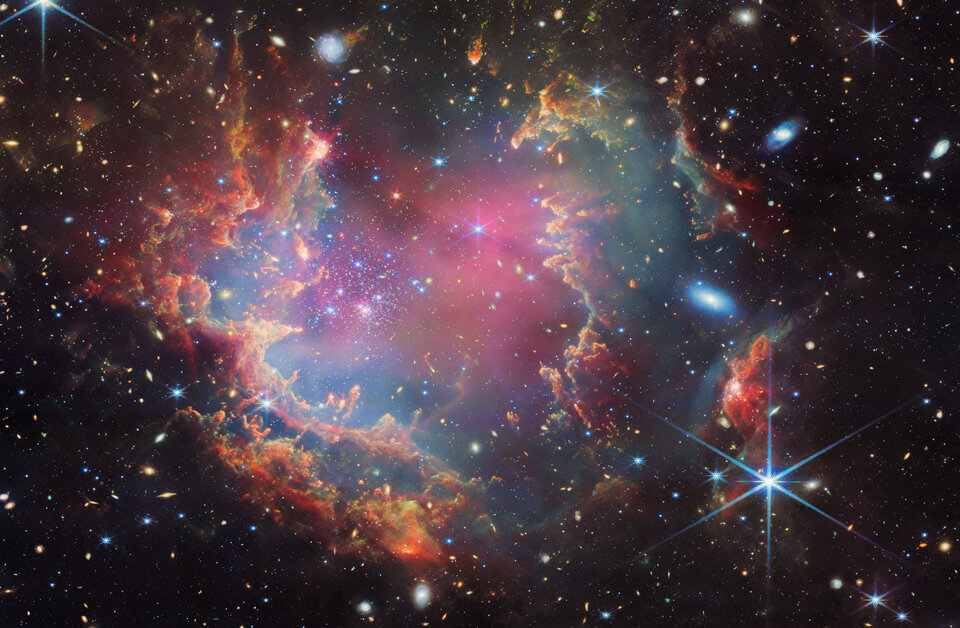
By leveraging the observatory’s Near-Infrared Camera (NIRCam) and specialized coronagraphic masks, astronomers identified a population of free-floating objects with masses as low as three to four times that of Jupiter. These objects exist in a gray area of celestial classification, challenging the long-held “deuterium burning” limit traditionally used to separate gas giant planets from brown dwarfs.
Historical Context of the Planetary Boundary
For decades, the standard model of stellar evolution posited that any object with a mass greater than approximately 13 Jupiter masses was a brown dwarf, capable of fusing deuterium in its core. Anything below this threshold was classified as a planet, typically expected to form within a protoplanetary disk around a host star. However, the James Webb Space Telescope has provided the sensitivity required to detect these low-mass objects in isolation, suggesting they may form through the same gravitational collapse process as stars rather than the core accretion process associated with planets.
Technical Precision via NIRCam Coronagraphy
The discovery was made possible by the NIRCam instrument, which used its coronagraph to block the light of nearby bright stars, allowing the faint infrared signatures of these cool, low-mass objects to be captured. This specific method allows for the characterization of atmospheric compositions, revealing traces of methane and water vapor that provide clues about the object’s temperature and age. These observations indicate that the process of star formation can produce “star-like” bodies at much lower masses than previously theorized by the scientific community.
Implications for Future Exoplanet Research
This redefinition has profound implications for how the U.S. National Aeronautics and Space Administration (NASA), the European Space Agency (ESA), and the Canadian Space Agency (CSA) categorize sovereign astronomical discoveries. If the “dividing line” is based on formation history rather than a strict mass cutoff, thousands of known exoplanets may require reclassification. The data suggests that nature produces a continuous spectrum of objects, making the distinction between a rogue planet and a tiny star increasingly arbitrary as observational technology improves.
Future Exploration of Rogue Worlds
Moving forward, the research team plans to use Webb’s spectrographs to analyze the chemical fingerprints of these objects in even greater detail. These studies will inform the mission requirements for upcoming observatories like the Nancy Grace Roman Space Telescope, which is designed to conduct wide-field surveys for similar free-floating planetary-mass objects. Understanding the lower limit of star formation is essential for creating accurate models of galaxy evolution and determining the true population of planetary-mass bodies in the Milky Way.
