

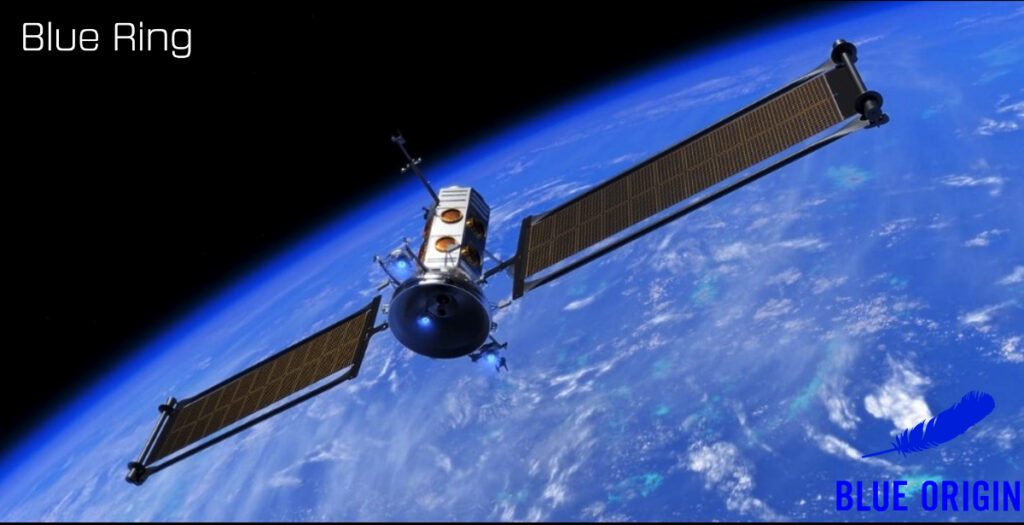
Blue Origin announced today an agreement with Optimum Technologies (OpTech) to integrate its next-generation Caracal optical payload onboard the first mission of Blue Ring, the highly maneuverable, multi-mission spacecraft for payload delivery, hosting, and infrastructure services.
Blue Ring’s first mission is expected to launch in 2026 with initial injection into Geostationary Transfer Orbit (GTO) and additional services performed in Geostationary Orbit (GEO). The Blue Ring vehicle will demonstrate its ability to simultaneously support the GEO tracking and custody mission as well as space object characterization, leveraging dynamic maneuverability to support high-resolution characterization.
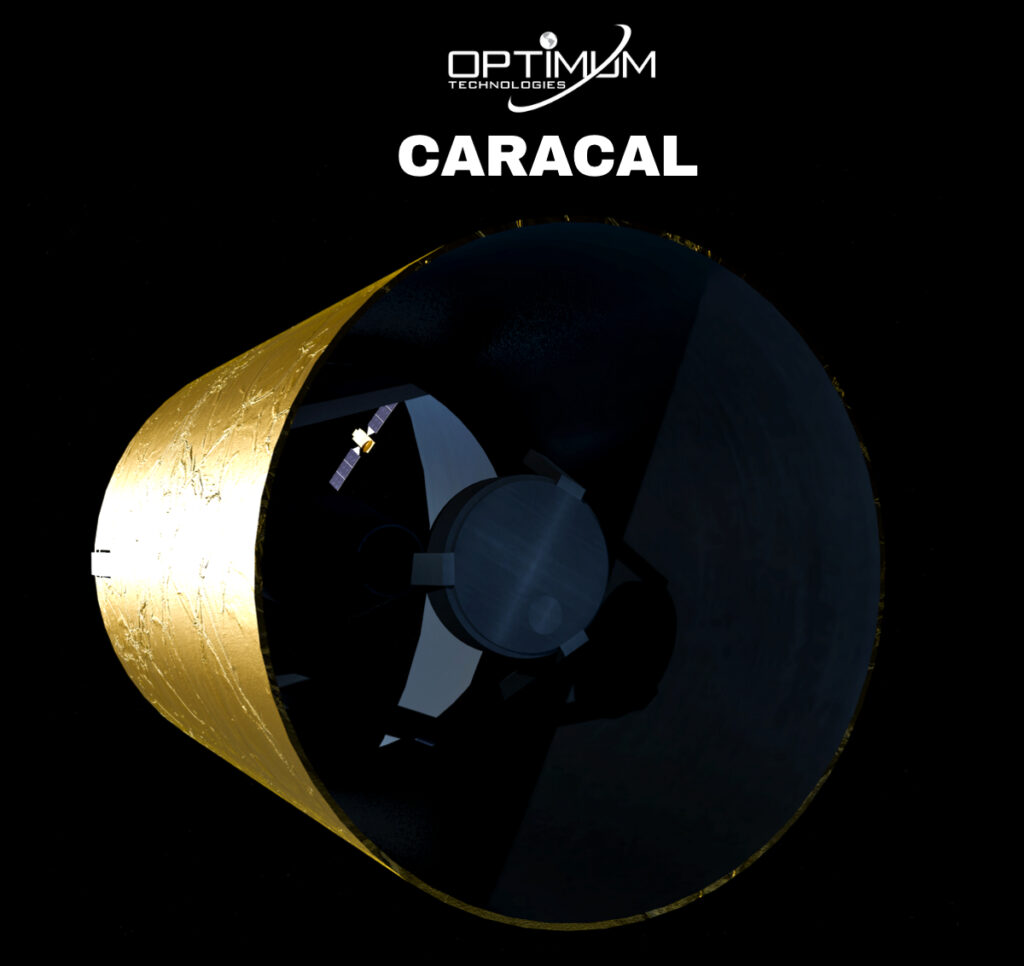
OpTech’s Caracal sensor is designed to provide actionable insights on resident space objects and orbital activity and includes onboard image storage, object detection algorithms, and passive thermal control. The payload is designed to operate flexibly across dynamic orbits over a year-long mission profile. Caracal will fly with Scout Space’s Owl sensor, along with internally developed payloads, all demonstrating Blue Ring as the ideal platform for supporting future GEO space domain awareness missions.
Blue Ring is a multi-mission, multi-destination vehicle providing full-service payload delivery, hosting, and end-to-end mission operations. The spacecraft has industry-leading capabilities, including a nominal Delta-V of at least 3,000m/s (with a max of 4,000m/s) enabled by electric and chemical propulsion systems. The spacecraft is capable of supporting as much as 4,000 kg of payload capacity across 13 ESPA ports, and has powerful onboard edge computing and processing capabilities enabling flexible mission design.
The effort represents a follow-on to OpTech’s contract awarded in 2024 to develop Caracal for the U.S. Space Force’s Tactically Responsive Space program, which is currently in hardware build with scheduled space vehicle integration and assembly in spring 2026. Caracal’s telescope and imaging components for the VICTUS SURGO mission will achieve “flight qualified” status after assembly and testing.
