

Credit: NASA
NASA, Northrop Grumman, and SpaceX are targeting no earlier than 6:11 p.m. EDT, Sunday, Sept. 14, for the next launch to deliver science investigations, supplies, and equipment to the International Space Station. The mission is known as NASA’s Northrop Grumman Commercial Resupply Services 23, or Northrop Grumman CRS-23.
Watch the agency’s launch and arrival coverage on NASA+, Amazon Prime, and more. Learn how to watch NASA content through a variety of platforms, including social media.
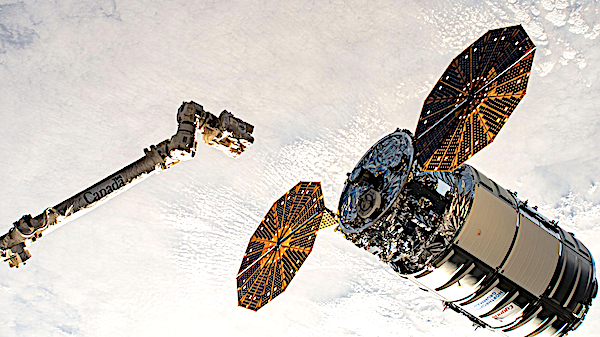
Filled with more than 11,000 pounds of supplies, the Northrop Grumman Cygnus XL spacecraft, carried on a SpaceX Falcon 9 rocket, will launch from Space Launch Complex 40 at Cape Canaveral Space Force Station in Florida. This mission will be the first flight of the Cygnus XL, the larger, more cargo-capable version of the company’s solar-powered spacecraft.
Following arrival, astronauts aboard the space station will use the Canadarm2 to grapple Cygnus XL on Wednesday, Sept. 17, before robotically installing the spacecraft to the Unity module’s Earth-facing port for cargo unloading.
Highlights of space station research and technology demonstrations, facilitated by delivery aboard this Cygnus XL, include materials to produce semiconductor crystals in space and equipment to develop improvements for cryogenic fuel tanks. The spacecraft also will deliver a specialized UV light system to prevent the growth of microbe communities that form in water systems and supplies to produce pharmaceutical crystals that could treat cancer and other diseases.
Media interested in speaking to a science subject matter expert should contact Sandra Jones at: [email protected]. A copy of NASA’s media accreditation policy is available on the agency’s website.
The Cygnus XL spacecraft is scheduled to remain at the orbiting laboratory until March before it departs and burns up in the Earth’s atmosphere. Northrop Grumman has named the spacecraft the S.S. William “Willie” McCool, in honor of the NASA astronaut who perished in 2003 during the space shuttle Columbia accident.
NASA’s mission coverage is as follows (all times Eastern and subject to change based on real-time operations):
Learn more at
